• Fri frakt över 249 kr
  • •
  • Snabba leveranser
  • •
  • Billiga böcker
Kundservice

Du är på sajten för privatpersoner.

Företag, bibliotek eller offentlig verksamhet?

Du handlar på classic.bokus.com, där alla dina funktioner finns intakta.
Till classic.bokus.com
Bokus logotyp. Gå till startsidan.
  • Erbjudanden
  • Nyheter
  • Student
  • Topplistor
  • Barn & ungdom
  • Bokus Play
  • E-böcker
  • Pocketböcker
  • Spel & pussel

10% rabatt på allt med kod: NYSTART10 →

Sidfot

Mina sidor

    Hjälp

    • Kundservice
    • Vanliga frågor och svar
    • Frakt och leverans
    • Retur vid ångerrätt
    • Reklamera vara
    • Betalning
    • Köpvillkor
    • Allmänna villkor
    • Information om webbplatsens tillgänglighet

    Om Bokus

    • Om oss
    • Pressrum
    • För studenter
    • För företag
    • För bibliotek och offentlig verksamhet
    • För leverantörer
    • Hållbarhet

    Populärt

    • Aktuella erbjudanden
    • Presentkort
    • Studentlitteratur
    • Nya böcker
    • Topplistor
    • Signerade böcker
    • Engelska böcker

    Inspiration

    • Boktips
    • BookTok
    • Populära bokserier
    • Barnbokskaraktärer
    • Populära författare
    Logotyp för Bokus
    Följ oss på Facebook (extern länk)Följ oss på Instagram (extern länk)Följ oss på YouTube (extern länk)Följ oss på TikTok (extern länk)
    bokus @ CookiesAnpassa cookiesIntegritetspolicyKöpvillkor
    Till Citymail hemsida (extern länk)Till Budbee hemsida (extern länk)Till Postnord hemsida (extern länk)Till Schenker hemsida (extern länk)Till Early Bird hemsida (extern länk)Till Walleys hemsida (extern länk)
    1. Psykologi och pedagogik
    2. Pedagogik
    3. Högskola och universitet

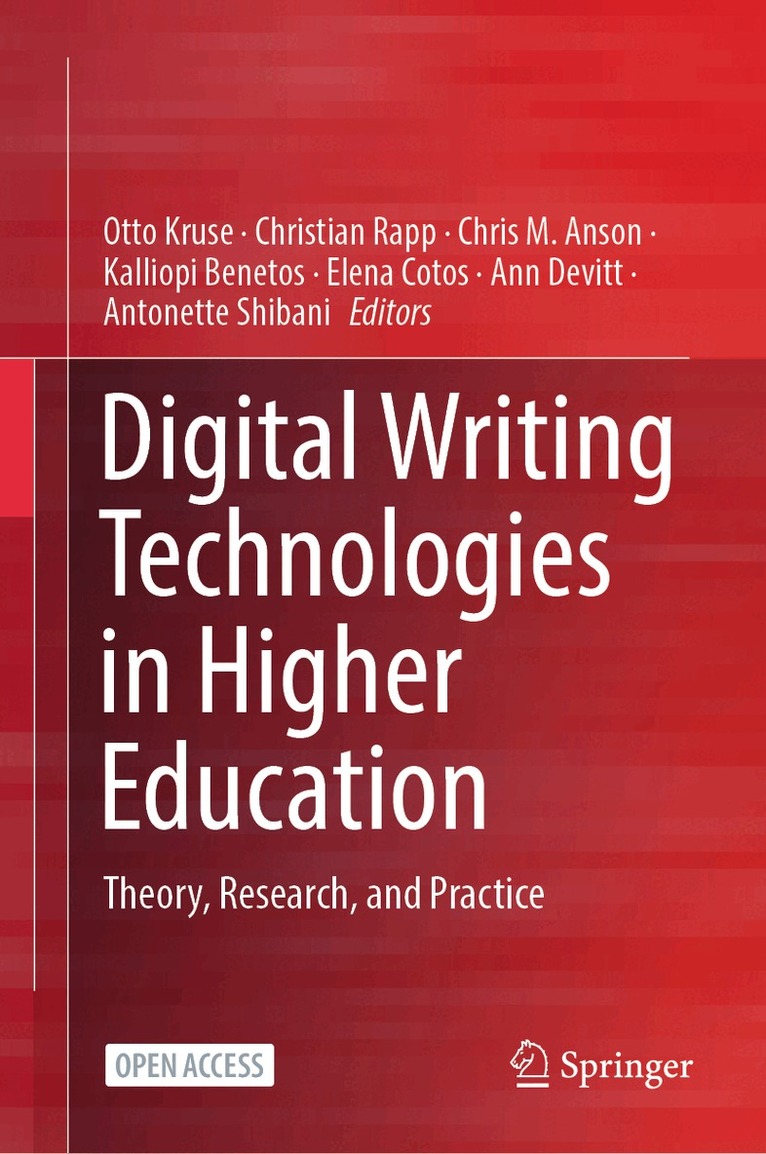
    Digital Writing Technologies in Higher Education

    Theory, Research, and Practice

    AvOtto Kruse,Christian Rapp

    Inbunden, Engelska, 2023

    531 kr

    Beställningsvara. Skickas inom 10-15 vardagar. Fri frakt över 249 kr.

    Beskrivning

    This open access book serves as a comprehensive guide to digital writing technology, featuring contributions from over 20 renowned researchers from various disciplines around the world. The book is designed to provide a state-of-the-art synthesis of the developments in digital writing in higher education, making it an essential resource for anyone interested in this rapidly evolving field.In the first part of the book, the authors offer an overview of the impact that digitalization has had on writing, covering more than 25 key technological innovations and their implications for writing practices and pedagogical uses. Drawing on these chapters, the second part of the book explores the theoretical underpinnings of digital writing technology such as writing and learning, writing quality, formulation support, writing and thinking, and writing processes. The authors provide insightful analysis on the impact of these developments and offer valuable insights into the future of writing. Overall, this book provides a cohesive and consistent theoretical view of the new realities of digital writing, complementing existing literature on the digitalization of writing. It is an essential resource for scholars, educators, and practitioners interested in the intersection of technology and writing.

    Produktinformation

    • Utgivningsdatum:2023-09-16
    • Mått:155 x 235 x 34 mm
    • Vikt:1 087 g
    • Format:Inbunden
    • Språk:Engelska
    • Antal sidor:526
    • Förlag:Springer International Publishing AG
    • ISBN:9783031360329

    Utforska kategorier

    • Högskola och universitet inom Psykologi och pedagogik
    • Språkundervisning och språkinlärning inom Språk och ordböcker
    • Material och digital teknik i undervisningen inom Psykologi och pedagogik

    Mer om författaren

    Otto Kruse is a retired professor at the Zurich University of Applied Sciences. He received his doctoral degree and habilitation from the Technical University of Berlin and is specialized in the teaching and research of academic writing. He was and is involved in several international research projects exploring writing in European higher education and currently is focusing on digital writing, for instance, by developing Thesis Writer, a tool supporting dissertation writers.Christian Rapp is leading the Educational Technology Team at the Center for Innovative Teaching and Learning, School of Management and Law, Zurich University of Applied Sciences. He is a coordinator of several international R&D projects funded by EU and Swiss National Science Foundation. He specializes in writing technology and is a fellow of the Digitalization Initiative of the Zurich Higher Education Institutions.Chris Anson is Distinguished University Professor and Executive Director of the Campus Writing and Speaking Program at North Carolina State University. He has published extensively in the field of writing studies and has spoken and consulted widely across the United States and several dozen other countries. He is the past chair of the Conference on College Composition and Communication and past president of the Council of Writing Program Administrators, and is currently Chair of the International Society for the Advancement of Writing Research. His professional summary can be found at www.ansonica.net.Kalliopi Benetos is a senior researcher and lecturer in educational technology at the University of Geneva's Faculty of Psychology and Educational Sciences, where she teaches courses in HCI and digital fabrication. She uses design-based research approaches to develop and study instructional designs and digital environments to support critical and epistemic thinking and learning through argumentation and has published multiple papers in the domain of technology-mediated learning and instruction.Elena Cotos is an associate professor of applied linguistics, director of the Center for Communication Excellence, and associate dean for professional development at Iowa State University. Her research bridges corpus-based analysis of academic discourse, genre-based automated evaluation of scientific writing, and computer-assisted language learning. She has led design, research, and evaluation projects focused on intelligent writing technology and also developed massive open online writing-related courses sponsored by the US Department of State.Ann Devitt is an associate professor in language education at the School of Education and Fellow at Trinity College Dublin.  She is Academic Director for Learnovate, the Enterprise Ireland funded centre of excellence for educational technology which is hosted in Trinity College Dublin. Her research interests lie in the use of technology in education, in particular for language and literacy learning. Antonette Shibani is a lecturer and researcher at the TD (TransDisciplinary) School, University of Technology Sydney. She researches the use of learning analytics and artificial intelligence tools to improve educational practice with a special focus on writing technologies. Shibani has served on the executive committee of the Society for Learning Analytics Research and founded its special interest group on Writing Analytics.

    Innehållsförteckning

    • Introduction.- Section1: Word processing software.- Name of chapter .- The Beginnings of Word Processing: A Historical Account.- Establishing the Standard: The Rise of Microsoft Word.- Expansions and Alternatives: Beyond Microsoft Word.- Section2: Web applications and platform technology .- Name of chapter .- Hypertext, Hyperlinks, and the World Wide Web.- Creativity Software and Idea Mapping Technology.- Digital tools for Written Argumentation.- Digital Note-taking for Writing .- Synchronous and Asynchronous Collaborative Writing.- Social Annotation: Promising Technologies and Practices in Writing.- Multimodal chat-based apps: enhancing copresence when writing.- Learning Management Systems (LMSs).- Digital Teacher Feedback Tools.- Digital Student Peer Review Systems .- Reference Management Systems.- Plagiarism Detection and Intertextuality Software .- The Electronic Portfolio: self-regulation and reflective practice.- CMS 3.0: The All-in-One Digital Writing Workspace.- Section3: Writing analytics and language technologies .- Name of chapter .- Automated Text Generation and Summarization.- Information Retrieval and Knowledge Extraction for Academic Writing.- Analytic Techniques for Automated Analysis of Writing.- Automated Scoring of Writing .- Automated Feedback on Writing.- Intelligent Tutoring for Writing.- On Corpora and Writing.- Investigating Writing Processes with Keystroke Logging.- Section4: Implications .- Writing and Learning: What Changed with Digitalization?.- Towards Defining Digital Writing Quality.- Finding the Right Words: Language Technologies to Support Formulation .- Writing and Thinking: What Changes with Digital Technologies? .- Writing processes in the digital age: A networked interpretation.- glossary.- index.