• Fri frakt över 249 kr
  • •
  • Snabba leveranser
  • •
  • Billiga böcker
Kundservice

Du är på sajten för privatpersoner.

Företag, bibliotek eller offentlig verksamhet?

Du handlar på classic.bokus.com, där alla dina funktioner finns intakta.
Till classic.bokus.com
Bokus logotyp. Gå till startsidan.
  • Erbjudanden
  • Nyheter
  • Student
  • Topplistor
  • Barn & ungdom
  • Bokus Play
  • E-böcker
  • Pocketböcker
  • Spel & pussel

10% rabatt på allt med kod: NYSTART10 →

Sidfot

Mina sidor

    Hjälp

    • Kundservice
    • Vanliga frågor och svar
    • Frakt och leverans
    • Retur vid ångerrätt
    • Reklamera vara
    • Betalning
    • Köpvillkor
    • Allmänna villkor
    • Information om webbplatsens tillgänglighet

    Om Bokus

    • Om oss
    • Pressrum
    • För studenter
    • För företag
    • För bibliotek och offentlig verksamhet
    • För leverantörer
    • Hållbarhet

    Populärt

    • Aktuella erbjudanden
    • Presentkort
    • Studentlitteratur
    • Nya böcker
    • Topplistor
    • Signerade böcker
    • Engelska böcker

    Inspiration

    • Boktips
    • BookTok
    • Populära bokserier
    • Barnbokskaraktärer
    • Populära författare
    Logotyp för Bokus
    Följ oss på Facebook (extern länk)Följ oss på Instagram (extern länk)Följ oss på YouTube (extern länk)Följ oss på TikTok (extern länk)
    bokus @ CookiesAnpassa cookiesIntegritetspolicyKöpvillkor
    Till Citymail hemsida (extern länk)Till Budbee hemsida (extern länk)Till Postnord hemsida (extern länk)Till Schenker hemsida (extern länk)Till Early Bird hemsida (extern länk)Till Walleys hemsida (extern länk)
    1. Naturvetenskap och teknik
    2. Geovetenskap
    3. Miljövetenskap och miljöpolitik

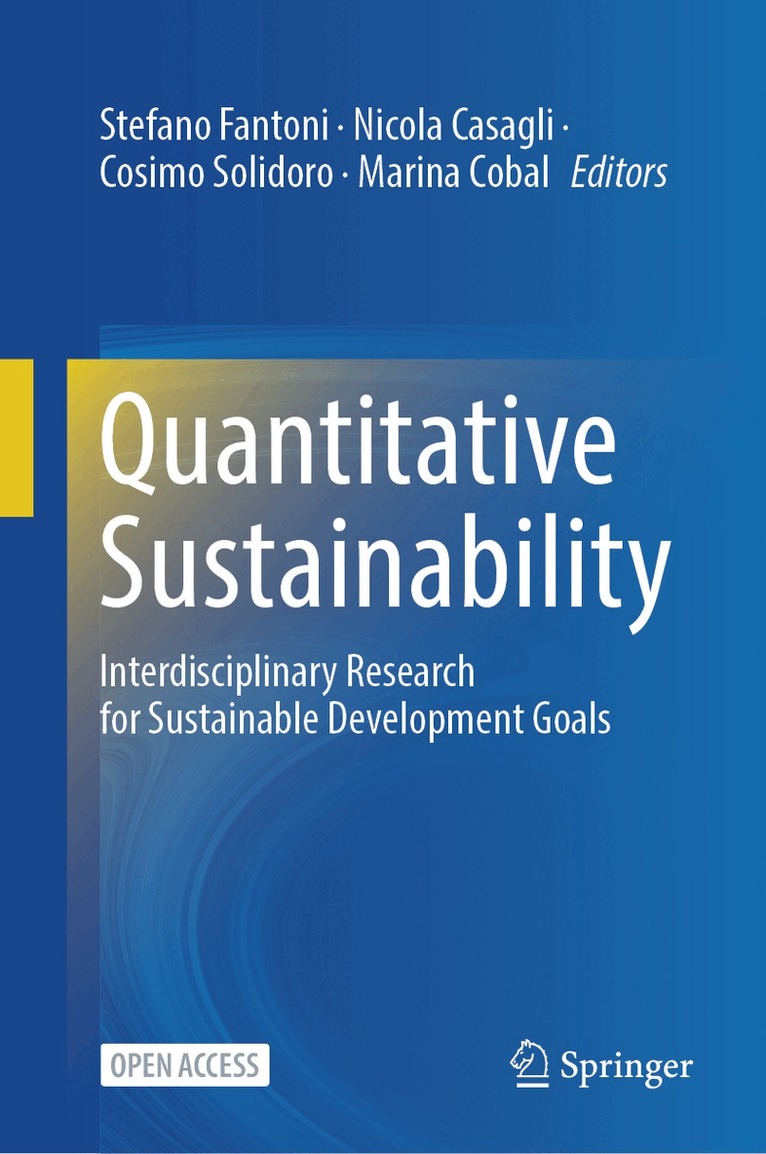
    Quantitative Sustainability

    Interdisciplinary Research for Sustainable Development Goals

    AvStefano Fantoni,Nicola Casagli

    Inbunden, Engelska, 2024

    547 kr

    Beställningsvara. Skickas inom 10-15 vardagar. Fri frakt över 249 kr.

    Beskrivning

    This open access book focuses on how scientific methodologies can help industrial managers, entrepreneurs and policymakers handle the 17 Sustainable Development Goals in an efficient and realistic way. It also offers an operative scheme for scientists to overcome their discipline barriers. Is interdisciplinarity an intrinsic research value or is it merely instrumental for handling the increasing flux of open problems that sustainability poses to science?Can these problems of sustainability be solved with what the authors already know? Is it just a matter of having the right people at the table and giving them sufficient resources, or is it something more? Is meeting the needs of the present without compromising those of future generations a scientific definition of sustainable development? Questions similar to those posed in the sixties regarding complexity must be  asked about sustainability today. In addition, the new data science includes powerful tools for making novelquantitative predictions about future sustainability indicators, an open problem that the book discusses. This book is primarily addressed to Ph.D. students, postdocs and senior researchers in the Life and Hard Science (LHS) and Social Sciences and Humanities (SSH) disciplines, as well as professionals of the primary, secondary and tertiary industrial sectors.

    Produktinformation

    • Utgivningsdatum:2024-01-03
    • Mått:155 x 235 x 17 mm
    • Vikt:477 g
    • Format:Inbunden
    • Språk:Engelska
    • Antal sidor:187
    • Förlag:Springer International Publishing AG
    • ISBN:9783031393105

    Utforska kategorier

    • Miljövetenskap och miljöpolitik inom Naturvetenskap och teknik
    • Databaser inom Data och IT
    • Biovetenskap inom Naturvetenskap och teknik

    Mer om författaren

    Stefano Fantoni is an Italian theoretical physicist, currently retired from the International School for Advanced Studies in Trieste (SISSA), but still working in the fields of nuclear physics, low temperature physics and complex systems. He is the associate professor of Nuclear Physics at the University of Pisa, and has previously been a full professor of both Nuclear Physics at the University of Lecce (1986–1990) and Nuclear Forces at SISSA (1991–2011). He was the director of the Interdisciplinary Laboratory of SISSA (1991–2000) and then subsequently the Director of SISSA (2004–2011). He was the recipient of the 2007 Eugene Feenberg Memorial Medal, the 2001 UNESCO Kalinga Prize, the 2002 Piazzano prize, the 2006 Pirelli International prize, the 2007 Capo d’Orlando, the 2008 Silver Rose Prize and the 2010 Barcola Prize from the city of Trieste.Nicola Casagli is a professor of Engineering Geology at the University of Florence, Department of Earth Sciences. Heis the president of the National Institute of Oceanography and Applied Geophysics and of the Civil Protection Centre of University of Florence, as well as of the International Consortium on Landslides (ICL). He is an expert on geological hazards and ground instability, monitoring technology, remote sensing, engineering geological characterization and modeling. He is a member of the Major Risks National Committee of the Department of Civil Protection of the Italian Government and of the World Centre of Excellence on Landslide Risk Reduction of the International Programme on Landslides. He is the founder and deputy chairholder of the UNESCO Chair on Prevention and Sustainable Mitigation of Geo-hydrological Hazards. He is an adjunct professor of the UNESCO Chair on Geoenvironmental Disaster Reduction at Shimane University (Japan).Marina Cobal is vice-president of the FIT, a current full professor of Physics at the University of Udine, and INFN coordinator of the Gruppo Collegato di Udine. She previously held research positions at the CERN laboratory in Geneva (CH) as a fellow and staff (1995–2001) and at the Fermilab Laboratory in Chicago, (USA) (1994). She is an experimental physicist whose research activity has been carried out mainly in the field of particle physics, more specifically, in fundamental research into sub-nuclear physics conducted with the use of accelerators. She has been part of the CDF and—later on—of the ATLAS and FCC Collaborations, having authored more than 1250 papers, with an h-index of 126 (Scopus, June 2022).Cosimo Solidoro is an oceanographer and marine ecologist,  currently director of the Oceanography department of the National Institute of Oceanography and Applied Geophysics, and professor of Ocean models and data analytics at the University of Trieste. He also serves as the President of the European section of the International Society of Ecological Modelling, the Italian representative of the IMBER (Integration of Marine Biogeochemistry and Ecological Research) program, and is a member of the executive board of the European Consortium Euromarine and of the European Marine Board. His research activities focus mainly on coastal areas, lagoons, and open sea ecosystems, ranging from the impacts of climate change, anthropogenic forcings and natural phenomena on biodiversity and ecosystem functioning, to sustainability, complex systems theory, and integrated ecological-socio-economic systems. Prigogine junior medal 2006 and co-recipient Denny medals in 2018

    Innehållsförteckning

    • Preface.-Forward.-Laboratory structure.- The blue planet and the ocean sustainable economy.- Food security and the health of the planet and its inhabitants.- Climate and environmental changes.- The new data science for sustainability and huiman ecology.- Energy transition and indiustrial product chains.- Sustainability frames and social equity and the right to sustainability.- Protection of the Earth habitats with Space tools.