• Fri frakt över 249 kr
  • •
  • Snabba leveranser
  • •
  • Billiga böcker
Kundservice

Du är på sajten för privatpersoner.

Företag, bibliotek eller offentlig verksamhet?

Du handlar på classic.bokus.com, där alla dina funktioner finns intakta.
Till classic.bokus.com
Bokus logotyp. Gå till startsidan.
  • Erbjudanden
  • Nyheter
  • Student
  • Topplistor
  • Barn & ungdom
  • Bokus Play
  • E-böcker
  • Pocketböcker
  • Spel & pussel

Må bättre, för mindre! Upp till 50% rabatt på hälsoböcker

Sidfot

Mina sidor

    Hjälp

    • Kundservice
    • Vanliga frågor och svar
    • Frakt och leverans
    • Retur vid ångerrätt
    • Reklamera vara
    • Betalning
    • Köpvillkor
    • Allmänna villkor
    • Information om webbplatsens tillgänglighet

    Om Bokus

    • Om oss
    • Pressrum
    • För studenter
    • För företag
    • För bibliotek och offentlig verksamhet
    • För leverantörer
    • Hållbarhet

    Populärt

    • Aktuella erbjudanden
    • Presentkort
    • Studentlitteratur
    • Nya böcker
    • Topplistor
    • Signerade böcker
    • Engelska böcker

    Inspiration

    • Boktips
    • BookTok
    • Populära bokserier
    • Barnbokskaraktärer
    • Populära författare
    Logotyp för Bokus
    Följ oss på Facebook (extern länk)Följ oss på Instagram (extern länk)Följ oss på YouTube (extern länk)Följ oss på TikTok (extern länk)
    bokus @ CookiesAnpassa cookiesIntegritetspolicyKöpvillkor
    Till Citymail hemsida (extern länk)Till Budbee hemsida (extern länk)Till Postnord hemsida (extern länk)Till Schenker hemsida (extern länk)Till Early Bird hemsida (extern länk)Till Walleys hemsida (extern länk)
    1. Medicin
    2. Medicin: allmänt
    3. Den medicinska professionen
    4. Medicinsk etik och läkaretik

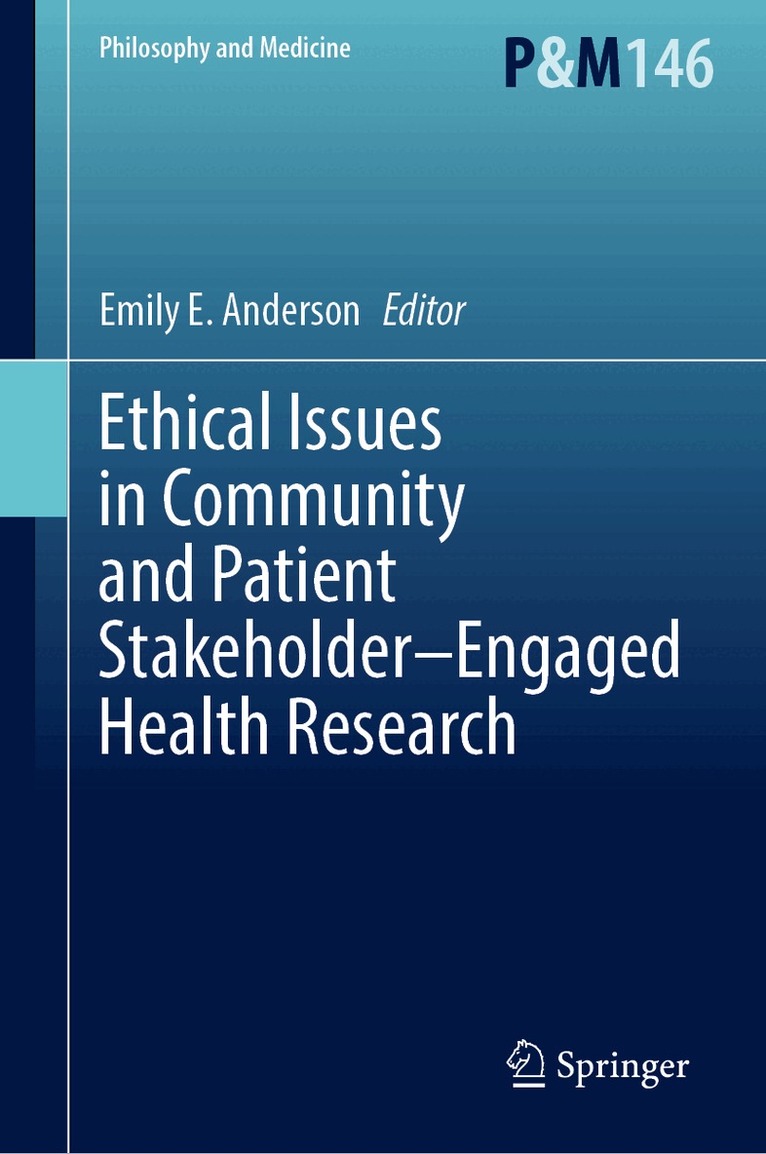
    Ethical Issues in Community and Patient Stakeholder–Engaged Health Research

    AvEmily E. Anderson

    Inbunden, Engelska, 2023

    Del 146 i serien Philosophy and Medicine

    1 518 kr

    Beställningsvara. Skickas inom 10-15 vardagar. Fri frakt över 249 kr.

    Beskrivning

    This book provides in-depth analyses of a wide range of topics surrounding ethical issues in community and patient stakeholder–engaged health research, and highlights where consensus exists, is emerging, or remains elusive. Topics in this book cover the history of stakeholder engagement in health research; how codes of ethics and regulations have (or have not) addressed stakeholder engagement; how to promote equitable collaboration; the ethical perspectives of different stakeholders; and the unique challenges posed by stakeholder- engaged research to the protection of human research participants and the research ethics review process. The book includes discussion of unique issues that arise in stakeholder engagement relevant to different populations, settings, and research designs. This book is relevant for anyone with a role or interest in stakeholder-engaged research, including patient and community research partners; academic researchers; research ethics scholars and educators; and funders.

    Produktinformation

    • Utgivningsdatum:2023-10-02
    • Mått:155 x 235 x 25 mm
    • Vikt:682 g
    • Format:Inbunden
    • Språk:Engelska
    • Serie:Philosophy and Medicine
    • Antal sidor:327
    • Upplaga:2023
    • Förlag:Springer International Publishing AG
    • ISBN:9783031403781

    Utforska kategorier

    • Medicinsk etik och läkaretik inom Medicin
    • Socialpsykologi och gruppsykologi inom Psykologi och pedagogik
    • Filosofiska discipliner inom Filosofi och religion

    Mer om författaren

    Emily E. Anderson, PhD, MPH, is Professor in the Neiswanger Institute for Bioethics and Healthcare Leadership at Loyola University Chicago’s Stritch School of Medicine. Dr. Anderson holds a PhD in health care ethics from Saint Louis University and an MPH from University of Illinois Chicago. She teaches courses on research ethics and responsible conduct of research to bioethics and biomedical sciences graduate students as well as medical students. In addition to the ethics of stakeholder engagement in research, her areas of interest and expertise include researcher and physician professionalism and misconduct; ethical issues in research with vulnerable populations; informed consent; institutional review board (IRB) policy; and the application of qualitative research techniques to the study of research ethics. She has published over 50 articles in top journals including the American Journal of Bioethics, Journal of Law, Medicine, and Ethics, Academic Medicine, and IRB: Ethics & Human Research. Dr. Anderson currently serves as associate editor of Narrative Inquiry in Bioethics. Dr. Anderson has been a co-investigator on several federally-funded research and educational projects and recently co-authored the book 100 Questions and Answers about Research Ethics (Sage Publications, 2018) with Dr. Amy Corneli (at Duke University).

    Innehållsförteckning

    • Chapter 1. Introduction (Emily E. Anderson).- Part 1. History, Codes of Ethics, Regulations.- Chapter 2. Theoretical roots of stakeholder-engaged research and reflections on CBPR and PCOR as a response to past research abuses (Meredith Minkler).- Chapter 3. A philosophical justification for stakeholder engagement and key principles/a conceptual model for ethical stakeholder-engaged research (Emily E. Anderson).- Chapter 4. Epistemology and stakeholder engagement/impact of diversity on ethical standards and practices (Kevin C. Elliott).- Chapter 5. The limitations of the Belmont principles for stakeholder-engaged research (Elisa Hurley).- Chapter 6. Canada’s approach to regulating research with indigenous peoples (Kim Anderson).- Chapter 7. The Council for International Organizations of Medical Sciences (CIOMS) Ethical Guidelines and Stakeholder Engagement (Alex John London).- Chapter 8. History and philosophy of patient engagement in clinical research (Robert M. Califf).- Part 2. Promoting Equitable Collaboration.- Chapter 9. Who represents the community? Diversity and inclusion (Ann-Gel Palermo).- Chapter 10. Engagement for equity and sustainability; developing an equitable partnership; power-sharing, accountability, communication, conflict resolution, and trust (Giselle Corbie-Smith).- Chapter 11.- Capacity building and benefits to communities; Credit and compensation for community and patient stakeholders (Elizabeth Ripley).- Chapter 12. Engaging communities in agenda setting: deciding what questions get asked and how (Alice Ammerman).- Chapter 13. Conflicts of interest in research that engages stakeholders [individual and organizational] (Susannah Rose).- Part 3. Stakeholder Voices.- Chapter 14. “Crossing over” or “between two worlds” – The story of a someone whose engagement in research motivated them to get formal training in research or research ethics (Gigi McMillan).- Chapter 15. A community IRB member/member of a community-based ethics review board (Bronx Community Research Review Board).- Chapter 16. A stakeholder who has served as a PI (Sharon Terry).- Chapter 17. A stakeholder who has served as a community advisory board member (Sandra Crouse Quinn).- Chapter 18. The challenges of working in your own community.- Chapter 19. A patient advocate’s experience engaging in research.- Part 4. Human Research Protections and Research Ethics Review.- Chapter 20. Stakeholder engaged research and (the limits of) IRB review (Jennifer Cross).- Chapter 21. Community-level risks and benefits (Lainie Ross).- chapter 22. The principle of respect for community - a new principle (Nancy Shore).- Chapter 23. Challenges in the field and in interactions with research participants; challenges to voluntary informed consent, privacy, and confidentiality; Moral distress among lay stakeholders (Maghbooba Mosavel).- Chapter 24. The notion of community consent (Charles Weijer).- Chapter 25. Community-based research review processes (Hal Strelnick).- Chapter 26.Data ownership and deciding what gets published (Melody Goodman).- Part 5. Case Studies: Ethics of Stakeholder-Engaged Research Across Settings.- Chapter 27. Research in emergency settings: public notification and consultation (Ryan Spellecy).- Chapter 28. Engaging stakeholders in genomics research and the governance of biobanks (Michelle McGowan).- Chapter 29. Engaging online patient communities in research (Elizabeth Buchanan).- Chapter 30. Engaging patient advocates in research (Deborah Collyar).- Chapter 31. Engaging rare disease communities (Laura P. Forsythe).- Chapter 32. Engaging stakeholders in basic science research (Rhonda Kost).- Chapter 33. Engaging indigenous communities/ American Indian communities in Research (Bonnie Duran).- Chapter 34. North Americans engaging internationally (Amy Corneli).- Chapter 35. Engaging stakeholders in environmental health research (Doug Brugge).- Chapter 36. Engaging stakeholders in research on stigmatized health conditions (e.g., mental health, addiction, HIV) (Dennis Watson).- Chapter 37. Engaging youth in research (Celia Fisher).