• Fri frakt över 249 kr
  • •
  • Snabba leveranser
  • •
  • Billiga böcker
Kundservice

Du är på sajten för privatpersoner.

Företag, bibliotek eller offentlig verksamhet?

Du handlar på classic.bokus.com, där alla dina funktioner finns intakta.
Till classic.bokus.com
Bokus logotyp. Gå till startsidan.
  • Erbjudanden
  • Nyheter
  • Student
  • Topplistor
  • Barn & ungdom
  • Bokus Play
  • E-böcker
  • Pocketböcker
  • Spel & pussel

10% rabatt på allt med kod NYSTART10 →

Sidfot

Mina sidor

    Hjälp

    • Kundservice
    • Vanliga frågor och svar
    • Frakt och leverans
    • Retur vid ångerrätt
    • Reklamera vara
    • Betalning
    • Köpvillkor
    • Allmänna villkor
    • Information om webbplatsens tillgänglighet

    Om Bokus

    • Om oss
    • Pressrum
    • För studenter
    • För företag
    • För bibliotek och offentlig verksamhet
    • För leverantörer
    • Hållbarhet

    Populärt

    • Aktuella erbjudanden
    • Presentkort
    • Studentlitteratur
    • Nya böcker
    • Topplistor
    • Signerade böcker
    • Engelska böcker

    Inspiration

    • Boktips
    • BookTok
    • Populära bokserier
    • Barnbokskaraktärer
    • Populära författare
    Logotyp för Bokus
    Följ oss på Facebook (extern länk)Följ oss på Instagram (extern länk)Följ oss på YouTube (extern länk)Följ oss på TikTok (extern länk)
    bokus @ CookiesAnpassa cookiesIntegritetspolicyKöpvillkor
    Till Citymail hemsida (extern länk)Till Budbee hemsida (extern länk)Till Postnord hemsida (extern länk)Till Schenker hemsida (extern länk)Till Early Bird hemsida (extern länk)Till Walleys hemsida (extern länk)
    1. Djur och Natur
    2. Naturböcker
    3. Växtböcker

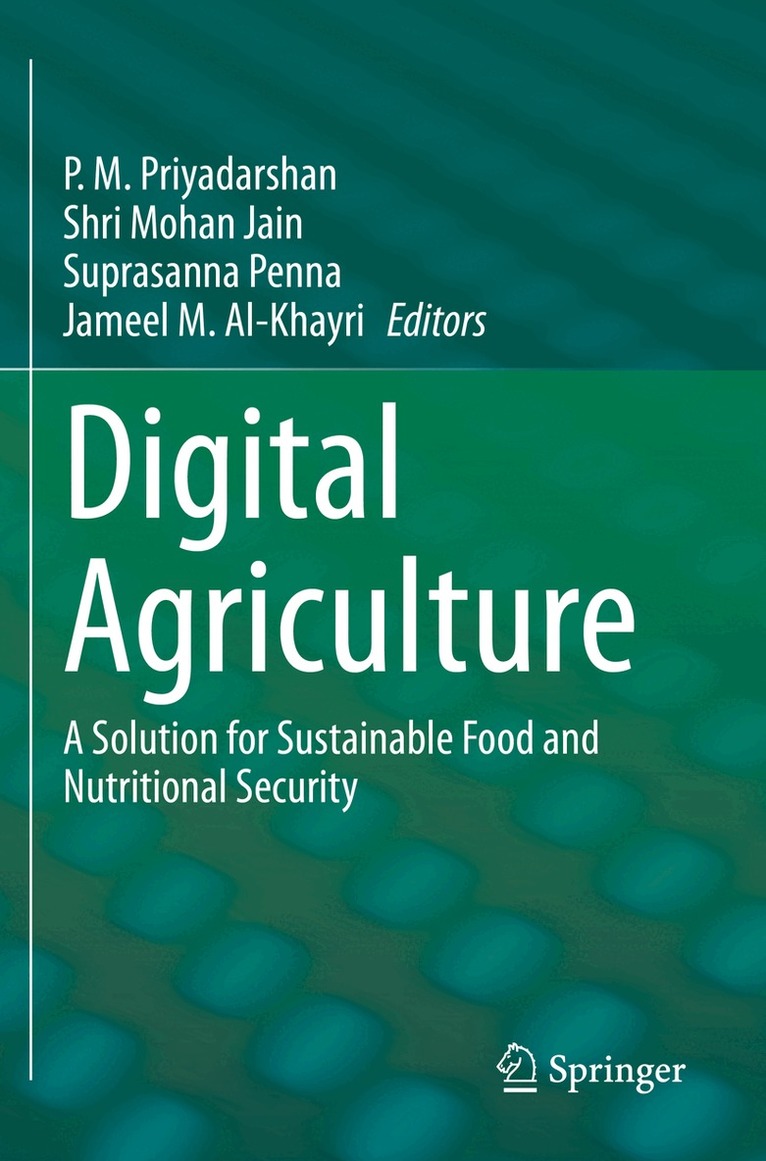
    Digital Agriculture

    A Solution for Sustainable Food and Nutritional Security

    AvP. M. Priyadarshan,Shri Mohan Jain

    Häftad, Engelska, 2025

    2 485 kr

    Beställningsvara. Skickas inom 10-15 vardagar. Fri frakt över 249 kr.

    Beskrivning

    The world population is increasing while arable land is decreasing at an alarming rate. About one-quarter of arable land is degraded and needs significant restoration before it can sustain crops again. By 2030, the water supply will fall 40% short of meeting global demand. Moreover, looming climate change poses additional challenge to increasing food production to feed 10 billion people by 2050. Current major agricultural systems are on a largely unsustainable trajectory because of their contributions to greenhouse gas emissions, water pollution, and biodiversity loss.For these reasons, innovative technologies are being introduced in modern agriculture to sustain food production.  They include digital and geospatial technologies to manage soil, climate and plant genetic resources. With the development of tools and sensors integrated into the internet of things (IoT) environment, physically collected information is converted into computer-readable language. Digital innovations thus allow real-time analysis, machine learning, and artificial intelligence (AI) that manage massive amount of data, also known as big data. Accordingly, digital agriculture affords greater potential for sustainable farming and economic benefits.This book summarizes the latest advances in AI-integration of agriculture practices. Specific focus includes but not limited to, big data, yield mapping, pests management, and optimal fertigation. As such, it presents a forward-looking approach to meet multiple UN Sustainable Development Goals, specifically, SDG 2, 6, 13 and 15.

    Produktinformation

    • Utgivningsdatum:2025-01-26
    • Mått:155 x 235 x 36 mm
    • Vikt:984 g
    • Format:Häftad
    • Språk:Engelska
    • Antal sidor:643
    • Förlag:Springer International Publishing AG
    • ISBN:9783031435508

    Utforska kategorier

    • Växtböcker inom Djur och Natur
    • Botanik inom Naturvetenskap och teknik
    • Miljövetenskap och miljöpolitik inom Naturvetenskap och teknik

    Mer om författaren

    P. M. Priyadarshan is a prominent Hevea rubber breeder. He began his research career by breeding triticale and wheat while doing M.Phil and PhD degrees at the Chaudhary Charan Singh University, Meerut under the guidance of Prof. P.K. Gupta. During the 1980s he focused on the in vitro culture of spices. He joined the Rubber Research Institute of India (Rubber Board, Ministry of Commerce, Govt. of India) as a Plant Breeder in 1990 and specialized in breeding Hevea rubber for sub-optimal environments. He was a visiting scientist at the Hardwood Tree Improvement and Regeneration Centre, Purdue University, U.S.A. In 2009, he became the Institute’s Deputy Director, and managed its Central Experiment Station until 2016.  He has been involved in breeding cereals, spices and Hevea rubber for 32 years. He is a reviewer of international journals, such as Industrial Crops & Products, Tree Genetics and Genomes etc. He has published many research papers in journals of international repute, such as Advances in Agronomy, Advances in Genetics, and Plant Breeding Reviews. He has edited/co-edited Breeding Plantation Tree Crops (Springer), Breeding Major Food Staples (Blackwell-Wiley), the Genomics of Tree Crops (Springer), and more recently, Cash Crops (Springer). Shri Mohan Jain received his Ph.D. in 1978 from Jawaharlal Nehru University, New Delhi, India. He completed his postdoctoral fellowship in Israel, USA, and was a visiting scientist/professor in Japan, Malaysia, Germany, and Italy. He works in both academia and industry, and has served as a Technical Officer on Plant Breeding and Genetics at the International Atomic Energy Agency (IAEA), Vienna, Austria. Dr. Jain is on the editorial Board of Euphytica, In Vitro, Propagation of Ornamental Plants; reviewer in Plant cell and organ culture, Plant cell reports, and few others. He has published more than 165 peer-reviewed journals, book chapters, and conference proceedings, and edited 65 books. He has also been a consultant for the European Union, The Government of Grenada, Iranian date palm Company and the Egyptian Government.   Suprasanna Penna Ph.D. (Genetics), a Professor and Director at the Amity Institute of Nuclear Biotechnology, Amity University of Maharashtra, Mumbai, India. He was formerly with Bhabha Atomic Research Centre, Mumbai, as the Head of Nuclear Agriculture and Biotechnology Division. He is also an IAEA Expert consultant. His significant contributions to plant science include plant biotechnology, mutation breeding, stress tolerance, and bioplymers for enhancing used in enhancing plant productivity in crop plants and vegetables. His research on plant abiotic stress tolerance in crop plants and halophytes led to elucidating mechanisms of salinity tolerance and adaptiveness. He is on the editorial board of several international journals and has published over 380 publications. He has edited several books on plant mutation breeding, salinity tolerance, plant genetic diversity, plant biotechnology and plant-metal interactions, and was the Guest Editor of special issues in Frontiers in Plant Sciences, Physiologia Plantarum (Wiley), Current Plant Biology (Elsevier), and Physiology and Molecular Biology of Plants (Springer).Professor Jameel M. Al-Khayri is affiliated with the Department of Agricultural Biotechnology, King Faisal University, Saudi Arabia. He received B.S. in Biology in 1984 from the University of Toledo, M.S. in Agronomy in 1988, and Ph.D. in Plant Science in 1991 from the University of Arkansas. He is an active member of the International Society for Horticultural Science and serves as the National Correspondent of the International Association of Plant Tissue Culture and Biotechnology. He dedicated his research efforts to date palm biotechnology for the last three decades. Al-Khayri has authored 120 research articles, 70 chaptersand edited several journal special issues and 30 reference books on plant biotechnology, genetic resources, breeding, genomics, nanotechnology, climate change, and food security. He was recognized in the top 2% of Scopus Citation in 2022. Currently, he is the editor of two Springer Book Series, Advances in Plant Breeding Strategies, and Nanotechnology in Plant Sciences. He has been involved in organizing international scientific conferences and contributed numerous research presentations. In addition to teaching, student advising and research, he held administrative responsibilities as the Assistant Director of Date Palm Research Center, Head of Department of Plant Biotechnology and Vice Dean for Development and Quality Assurance. Al-Khayri served as a Member of Majlis Ash Shura (Saudi Legislative Council) for the 2009-2012 session. He is interested in agricultural innovations and sustainability to support food security.

    Innehållsförteckning

    • 1. Digital Agriculture for the years to come.- 2. Agriculture and food security in the era of climate change.- Part. 1 Vertical farming and nurseries (both controlled and uncontrolled environments).- 3. Soilless smart agriculture systems for future climate.- 4. Intelligent Nutrient Controlling System for Precision Urban Agriculture.- 5. Vertical farming of Medicinal plants.- 6. Vertical farms in future cities.- Part. 2 IoT (internet of things) in agriculture for improved farm use efficiency, plant and soil management.- 7. Remote sensing in Precision Agriculture.- 8. Sensing Climate Change through Earth Observation: Perspectives at Global and National level.- 9. Satellite-based remote sensing approaches for estimating evapotranspiration from agricultural systems.- 10. Satellite imagery in precision agriculture.- 11. Applications of UAVs: Image-based Plant Phenotyping.- 12. Digital yield predictions.- Part. 3 Digital agriculture: roles in genetic conservation, speed breeding/fast forward breeding.- 13. Crop phenomics and high-throughput phenotyping.- 14. Speed Breeding for crop improvement.- 15. Digital agriculture for enhancing yield, nutrition and biological stress resistance.- 16. Plant-based Electrical Impedance Spectroscopy for plant health monitoring.- 17. Data analytics in agriculture/ Data science and artificial intelligence.- Part 4. Precision agriculture technologies.- 18. Sensing systems for Precision agriculture.- 19. Applications of Robotics in Agriculture.- 20. Analysing data from open sources to manage risks in food production.- 21. Crop modelling for future climate change adaptation.