• Fri frakt över 249 kr
  • •
  • Snabba leveranser
  • •
  • Billiga böcker
Kundservice

Du är på sajten för privatpersoner.

Företag, bibliotek eller offentlig verksamhet?

Du handlar på classic.bokus.com, där alla dina funktioner finns intakta.
Till classic.bokus.com
Bokus logotyp. Gå till startsidan.
  • Erbjudanden
  • Nyheter
  • Student
  • Topplistor
  • Barn & ungdom
  • Bokus Play
  • E-böcker
  • Pocketböcker
  • Spel & pussel

10% studentrabatt med kod TERM26

Sidfot

Mina sidor

    Hjälp

    • Kundservice
    • Vanliga frågor och svar
    • Frakt och leverans
    • Retur vid ångerrätt
    • Reklamera vara
    • Betalning
    • Köpvillkor
    • Allmänna villkor
    • Information om webbplatsens tillgänglighet

    Om Bokus

    • Om oss
    • Pressrum
    • För studenter
    • För företag
    • För bibliotek och offentlig verksamhet
    • För leverantörer
    • Hållbarhet

    Populärt

    • Aktuella erbjudanden
    • Presentkort
    • Studentlitteratur
    • Nya böcker
    • Topplistor
    • Signerade böcker
    • Engelska böcker

    Inspiration

    • Boktips
    • BookTok
    • Populära bokserier
    • Barnbokskaraktärer
    • Populära författare
    Logotyp för Bokus
    Följ oss på Facebook (extern länk)Följ oss på Instagram (extern länk)Följ oss på YouTube (extern länk)Följ oss på TikTok (extern länk)
    bokus @ CookiesAnpassa cookiesIntegritetspolicyKöpvillkor
    Till Citymail hemsida (extern länk)Till Budbee hemsida (extern länk)Till Postnord hemsida (extern länk)Till Schenker hemsida (extern länk)Till Early Bird hemsida (extern länk)Till Walleys hemsida (extern länk)
    1. Samhälle och politik
    2. Politik och statsskick
    3. Centralt styre och förvaltning

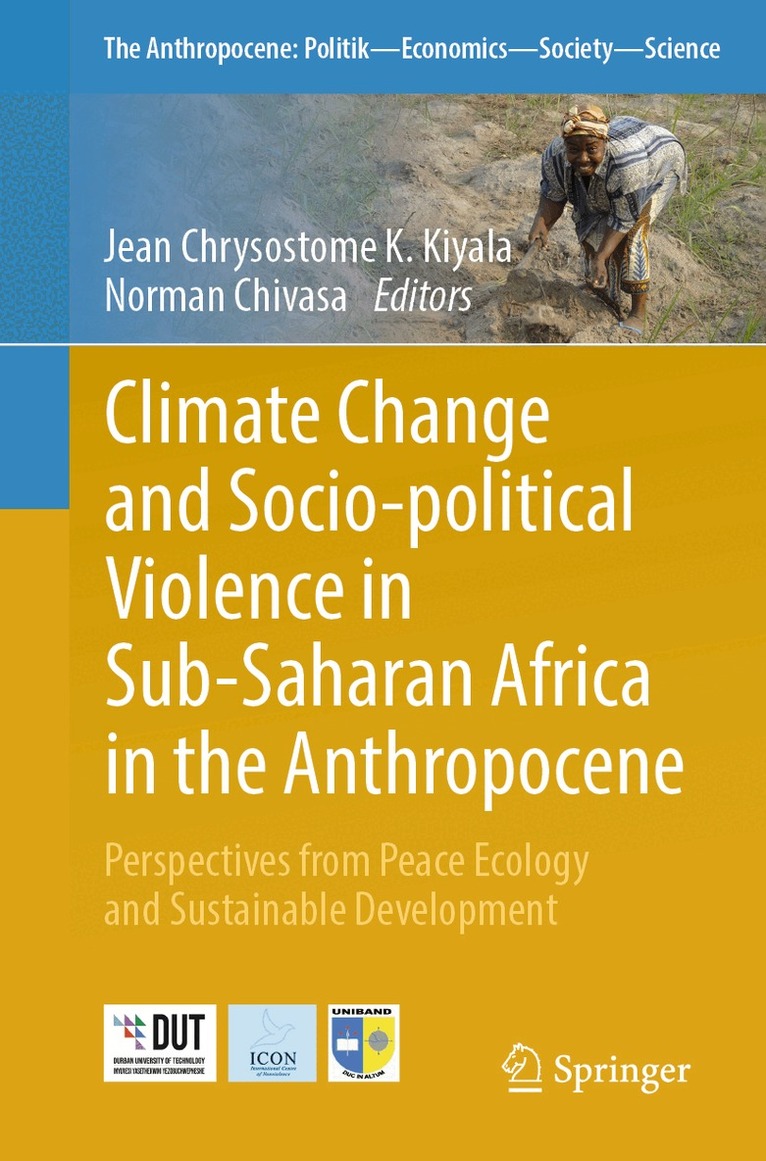
    Climate Change and Socio-political Violence in Sub-Saharan Africa in the Anthropocene

    Perspectives from Peace Ecology and Sustainable Development

    AvJean Chrysostome K. Kiyala,Norman Chivasa

    Häftad, Engelska, 2024

    Del 37 i serien Anthropocene: Politik—Economics—Society—Science

    1 417 kr

    Beställningsvara. Skickas inom 10-15 vardagar. Fri frakt över 249 kr.

    Beskrivning

    This book explores the theoretical contribution of peace ecology to the understanding and practice of environmental and conventional peacebuilding. It integrates environmental questions and factors that drive socio-political violence and climate change-induced violence in Sub-Saharan Africa in the Anthropocene.·   It demonstrates how international peace and global security are no longer solely grounded in conventional peacebuilding that has evolved from liberal to democratic peace theories, but rather in the complex, critical and synergic relations between peace studies and environmental studies.·   It provides a pluridisciplinary body of knowledge that emphasises the need for food security, social climate, social good, social capital and sustainable development at the age of climate change and climate wars.·   It underscores the potential of peace ecology to reduce the Earth systems' vulnerability, to mitigate anthropogenic global warming's consequences on humanity, the ecosystem and biodiversity.·         It yields various models of peacebuilding, conflict-sensitive and climate-sensitive adaptation strategies to enhance the African Region’s security and stability.Finally, this volume argues that planetary boundaries framework remains the safer space within which human and sustainable development can be pursued and attained, and future generations to thrive. A comprehensive and international response to socio-political violence and climate-change induced violence should take into account the vulnerability of individual countries, regions and the global world in order to achieve the dreams of a better future; that makes this book a cutting-edge scholarly work.

    Produktinformation

    • Utgivningsdatum:2024-05-05
    • Mått:155 x 235 x 42 mm
    • Vikt:1 108 g
    • Format:Häftad
    • Språk:Engelska
    • Serie:Anthropocene: Politik—Economics—Society—Science
    • Antal sidor:719
    • Förlag:Springer International Publishing AG
    • ISBN:9783031483745

    Utforska kategorier

    • Centralt styre och förvaltning inom Samhälle och politik
    • Referensverk och tvärvetenskap inom Samhälle och politik
    • Miljövetenskap och miljöpolitik inom Naturvetenskap och teknik

    Mer om författaren

    Jean Chrysostome K. Kiyala (PhD) is a Senior Lecturer at the International Centre of Nonviolence in the Faculty of Management Sciences, Durban University of Technology (DUT), South Africa; Associate Professor and visiting lecturer at the University of Bandundu, Evangelical University in Africa in the Democratic Republic of Congo, and the University of Seychelles (Seychelles). He holds a PhD in Management Sciences specialising in Public Administration: Peace Studies, from DUT. His specialisations include child soldiers, restorative justice, transitional justice, post-conflict reconciliation and nation-building, civil society, peacebuilding and peace ecology.Norman Chivasa is currently a lecturer in the Department of Peace, Security and Society at the University of Zimbabwe after serving as a Research Associate at the University of KwaZulu-Natal and Postdoctoral Fellow at Durban University of Technology (DUT), South Africa. He holds a Masters in Conflict Resolution and Peace Studies from the University of KwaZulu-Natal, and a PhD in Management Sciences Specialising in Public Administration: Peace Studies, from DUT. His research focuses on community peacebuilding and informal infrastructures for peace

    Innehållsförteckning

    • Chapter 1: Introduction to Climate Change, Violence and Sustainable Development in the Anthropocene.- Chapter 2:Climate Change and Climate Wars in the Anthropocene: Expectations from Environmental Peacebuilding Towards Sustainable Development.- Chapter 3: Environmental Conflicts, Peace and Security in the Lake Chad Region in Central Africa.- Chapter 4: Climate Change-Induced West Africa: Conflict-Sensitive Adaptation Perspectives.- Chapter 5: The Impacts of Climate Change on Water Resources in the Anthropocene: Mitigation and Adaptation Strategies in Southern Africa.- Chapter 6: Drought, the War in Europe and its Impacts on Food Insecurity in Sub-Saharan Africa, East Africa.- Chapter 7: Climate Change and Its Implications on Food Security In The Great Lakes Region.- Chapter 8:Climate Change, Food Insecurity, Peace and Sustainable Development in East Africa: Case Study of South Sudan, Sudan, Ethiopia and Kenya.- Chapter 9: Gender, A Global Ecological Challenge to Peace in The Anthropocene: Women in Environmental Justice.- Chapter 10: Non-Military Threats and Structural Violence In South Africa And Zimbabwe: Did The Covid-19 Pandemic Practically Unmask a Long-Known Reality?.- Chapter 11: Community-based Early Warning Mechanisms to Address Machete Violence in the Artisanal Mining Areas in Zimbabwe.- Chapter 12: Mapping the Conflict Between Street Vendors and Harare City Council: Towards Building Peace in Zimbabwe.- Chapter 13: Youths in War in a Post-Colonial State and Revolving Use of Child Soldiers: Perspectives from The Democratic Republic of Congo.- Chapter 14: Rethinking Peace: Some Reflections on The Imaginary Nature of Contemporary Peace Model.- Chapter 15: Inequality, Unemployment and Poverty in the COVID-19 era in Eastern Cape Province, South Africa.- Chapter 16: Sustainable Development in South Africa in the Anthropocene in the Post-Covid-19 Era.- Chapter 17: Civil Society-Community Partnership for Sustainable Livelihoods and Development in Ward 7 of ChiviDistrict (Masvingo Province), Zimbabwe.- Chapter 18:Peace, Security and Sustainable Development Goals in Zimbabwe.- Chapter 19: The Nexus Approach in Relation to Climate Action and Planetary Integrity: Delimiting SDG13 Relative to Accelerating Sustainable Development in Africa.- Chapter 20: Social Climate, Social Capital and Social Good in Sub-Saharan African Countries: Implications for Sustainable Development.- Chapter 21: Occupational Health and Safety of Artisanal Miners in Kolwezi, Democratic Republic of Congo: A problem for Goals 3 and 8 of Sustainable Development Goals.- Chapter 22: Setting African Higher Education Agendas that tackle Global Sustainability and SDGs.- Chapter 23: Russia’s War in Ukraine: Impacts on Ecology, Energy Market, Food Security and Sustainable Development.- Chapter 24: Child Soldiering Justice and Peacebuilding: A Dialectic Analysis of Conventional Criminal Justice System and African Indigenous Jurisprudence.- Chapter 25: Honour Culture and Rape Denialism in the Southern Sudanese Culture: A Response from Ubuntu Restorative Justice.- Chapter 26: Effects of State Capturing Truth and reconciliation Commissions in Zimbabwe on of Sustainable Development.- Chapter 27: Handling Indiscipline Involving Children at Home and Schools: A Restorative Justice Perspective to Unlearn Violent Behaviours in Zimbabwe.- Chapter 28: Schools as Agents of Change: Effects of peacebuilding via Restorative Circles in Mbambangwe High School.- Chapter 29: Peace-Building Processes to Address Xenophobia in South Africa.- Chapter 30: State and Civil Society-Led Peace Committees in Zimbabwe.- Chapter 31:Personal Identity and Peacebuilding: A Critical Reflection.