• Fri frakt över 249 kr
  • •
  • Snabba leveranser
  • •
  • Billiga böcker
Kundservice

Du är på sajten för privatpersoner.

Företag, bibliotek eller offentlig verksamhet?

Du handlar på classic.bokus.com, där alla dina funktioner finns intakta.
Till classic.bokus.com
Bokus logotyp. Gå till startsidan.
  • Erbjudanden
  • Nyheter
  • Student
  • Topplistor
  • Barn & ungdom
  • Bokus Play
  • E-böcker
  • Pocketböcker
  • Spel & pussel

10% rabatt på allt med kod: NYSTART10 →

Sidfot

Mina sidor

    Hjälp

    • Kundservice
    • Vanliga frågor och svar
    • Frakt och leverans
    • Retur vid ångerrätt
    • Reklamera vara
    • Betalning
    • Köpvillkor
    • Allmänna villkor
    • Information om webbplatsens tillgänglighet

    Om Bokus

    • Om oss
    • Pressrum
    • För studenter
    • För företag
    • För bibliotek och offentlig verksamhet
    • För leverantörer
    • Hållbarhet

    Populärt

    • Aktuella erbjudanden
    • Presentkort
    • Studentlitteratur
    • Nya böcker
    • Topplistor
    • Signerade böcker
    • Engelska böcker

    Inspiration

    • Boktips
    • BookTok
    • Populära bokserier
    • Barnbokskaraktärer
    • Populära författare
    Logotyp för Bokus
    Följ oss på Facebook (extern länk)Följ oss på Instagram (extern länk)Följ oss på YouTube (extern länk)Följ oss på TikTok (extern länk)
    bokus @ CookiesAnpassa cookiesIntegritetspolicyKöpvillkor
    Till Citymail hemsida (extern länk)Till Budbee hemsida (extern länk)Till Postnord hemsida (extern länk)Till Schenker hemsida (extern länk)Till Early Bird hemsida (extern länk)Till Walleys hemsida (extern länk)
    1. Ekonomi och Ledarskap
    2. Industrier och branscher
    3. Servicesektorn

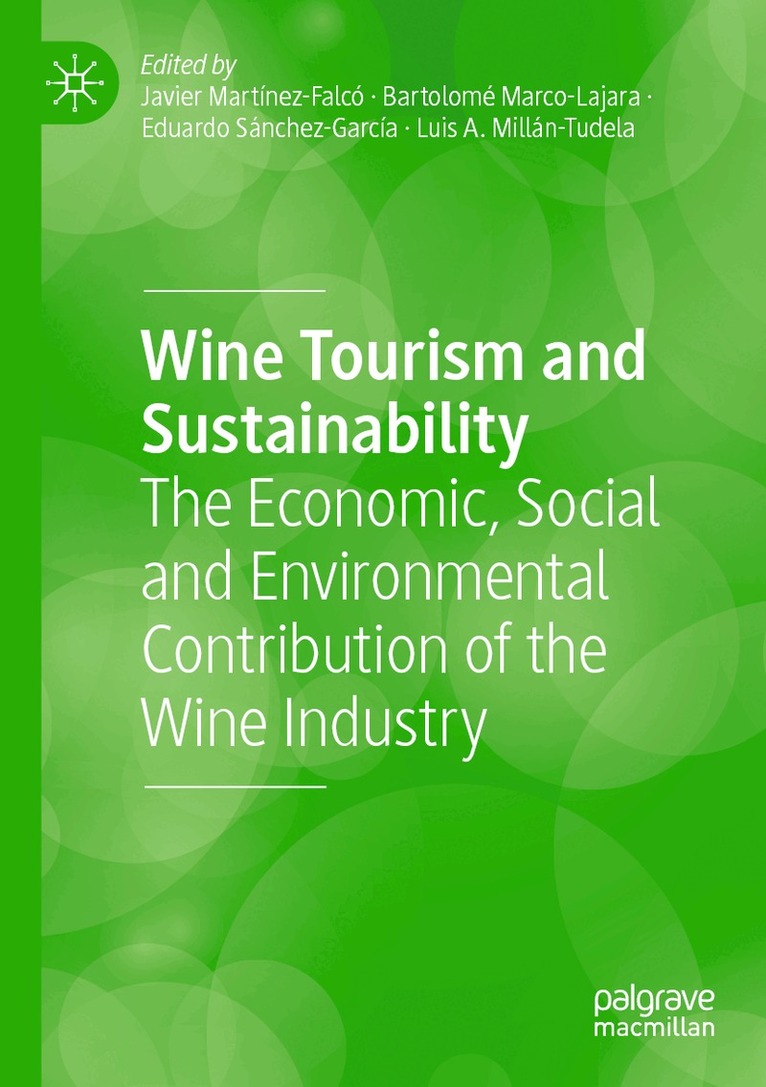
    Wine Tourism and Sustainability

    The Economic, Social and Environmental Contribution of the Wine Industry

    AvJavier Martínez-Falcó,Bartolomé Marco-Lajara

    Häftad, Engelska, 2025

    1 896 kr

    Beställningsvara. Skickas inom 5-8 vardagar. Fri frakt över 249 kr.

    Beskrivning

    Climate change has put the survival andviability of wine-growing regions at risk. Whereas the implementation of sustainableapproaches was once seen as a source of competitive advantage, it is now criticalto the survival of the industry. Winetourism should therefore aim to minimize possible cultural and environmentaldamage while improving the economic and social well-being of the wine-growingregion. Contributing to the targets of SDG 8, specifically target 8.9: ‘By 2030,devise and implement policies to promote sustainable tourism that creates jobsand promotes local culture and products,’ this book argues that wine tourism canbe considered as a catalyst for the environmental sustainability of wineries. Chaptershighlight the economic, socioeconomic, environmental, socio-cultural impact ofwine tourism around the world, before concluding with a look to the future trendsand challenges. Itfeatures best practices from around the world that wineriesand wine tourism companies can incorporate into their core business functionsto make their operations more sustainable and also showcases how wineries have designedtheir tourism offerings to meet sustainable tourism development objectives

    Produktinformation

    • Utgivningsdatum:2025-02-04
    • Mått:148 x 210 x 15 mm
    • Vikt:336 g
    • Format:Häftad
    • Språk:Engelska
    • Antal sidor:232
    • Förlag:Springer International Publishing AG
    • ISBN:9783031489396

    Utforska kategorier

    • Servicesektorn inom Ekonomi och Ledarskap

    Mer om författaren

    Javier Martínez Falcó(PhD) is Assistant Professor in the Department of Management at the Universityof Alicante. His research expertise include the Strategic Management of theCompany, specifically in the areas of Knowledge Management and CorporateSustainability of wine companies, on which he has written several publicationsin the form of articles, book chapters and contributions to conferences. Bartolomé Marco-Lajara(PhD) is Professor at the University of Alicante. He is the author of severalbooks, book chapters and international articles and is a member of the TourismResearch Institute at the University of Alicante since its foundation as wellas the main researcher of the European project ‘Next Tourism GenerationAlliance’ at his University, as well as of the public competitive project forthe creation of the Tourist Observatory of the Valencian Community (Spain). Hehas taken part in others public and private projects and is the Head of theDepartment of Management at the University of Alicante.Eduardo Sánchez Garcíaworks as Teaching and Research Staff in the Department of Business Organisationat the University of Alicante, as an Assistant. He holds a PhD withinternational mention in the area of Business, Economics and Society. Hisresearch is in the field of strategic business management. In addition, he hascarried out several works in collaboration with other researchers specialisedin the study of industrial districts and entrepreneurial capabilities. He is amember of the research group "Strategic Management, Knowledge andInnovation in a Global Economy (DECI-GLOBAL)". He has published severalarticles in indexed journals, as well as several book chapters, and has madenumerous presentations at national and international scientific conferences.Heteaches the subject of Strategic Management of the Company in the Degree inBusiness Administration and Management, and the double degrees in TADE, DADEand I2ADE.Luis A. Millán-Tudela is Assistant Professor in the Department of Management. His research focuses onbusiness longevity, and more specifically on the factors that influence thesurvival of companies. This activity is developed within the research group"Dirección Estratégica, conocimiento e innovación en una economía global(DECI-GLOBAL)". He also teaches strategic management in the Degree ofBusiness Administration.

    Innehållsförteckning

    • Part I: Introduction.- Chapter 1. Wine tourism, innovation and sustainable winegrowing in cool climate regions: a longitudinal international comparative analysis Tim Baird, Michael Hall, Pavel Castka and Haywantee Ramkissoon.- Part II: Economic impact of wine tourism.- Chapter 2. Economic structure and geographic scope of Spanish wine routes Luis A. Millan-Tudela, Bartolomé Marco-Lajara, Javier Martínez-Falcó and Eduardo Sánchez-García.- Chapter 3. Developing Sustainable Tourism in Tanzania: Perspective from Wine Stakeholders Galinoma Gahele Lubawa and Evans S. Osabuohien.- Chapter 4. Spain's Wine Tourism: Evaluating the Economic Contributions of Wineries and Museums Javier Martínez-Falcó, Bartolomé Marco-Lajara, Eduardo Sánchez-García and Luis A. Millán-Tudela.- Part III: Environmental impact of wine tourism.- Chapter 5. Sustainable Wine Tourism: Best Practices Dhruv Kishore Bole.- Chapter 6. Wine Tourism, The Business of Wine and the Impact of the Environment and Sustainability DonnaLee Rosen and Doris Miculan Bradley.- Chapter 7. Discovering Enocotourism in Ribera del Duero Appellation: A New Concept Combining Wine Tourism and Ecotourism for a Unique Experience Rosana Fuentes Fernández, María del Carmen González-Velasco and Marcos González-Fernández.- Part IV: Social-cultural impact of wine tourism.- Chapter 8. Exploring the intersection between Geographical Indications and Sustainable Wine Tourism: the case of le Colline del Prosecco di Conegliano e Valdobbiadene Francesca Checchinato, Cinzia Colapinto, Vladi Finotto, Christine Mauracher and Chiara Rinaldi.- Chapter 9. Wine tourism in the province of Alicante (Spain). Revitalisation of wine heritage as a strategy for tourism diversification and differentiation in mature tourist destinations Rosario Navalón-García.- Part V: Epilogue.- Chapter 10. The impact of wine tourism on the economic, social and environmental outcomes of Spanish wineries: An exploration via structural equation modelling Javier Martínez-Falcó, Bartolomé Marco-Lajara, Eduardo Sánchez-García and Luis A. Millán-Tudela.