• Fri frakt över 249 kr
  • •
  • Snabba leveranser
  • •
  • Billiga böcker
Kundservice

Du är på sajten för privatpersoner.

Företag, bibliotek eller offentlig verksamhet?

Du handlar på classic.bokus.com, där alla dina funktioner finns intakta.
Till classic.bokus.com
Bokus logotyp. Gå till startsidan.
  • Erbjudanden
  • Nyheter
  • Student
  • Topplistor
  • Barn & ungdom
  • Bokus Play
  • E-böcker
  • Pocketböcker
  • Spel & pussel

10% rabatt på allt med kod: NYSTART10 →

Sidfot

Mina sidor

    Hjälp

    • Kundservice
    • Vanliga frågor och svar
    • Frakt och leverans
    • Retur vid ångerrätt
    • Reklamera vara
    • Betalning
    • Köpvillkor
    • Allmänna villkor
    • Information om webbplatsens tillgänglighet

    Om Bokus

    • Om oss
    • Pressrum
    • För studenter
    • För företag
    • För bibliotek och offentlig verksamhet
    • För leverantörer
    • Hållbarhet

    Populärt

    • Aktuella erbjudanden
    • Presentkort
    • Studentlitteratur
    • Nya böcker
    • Topplistor
    • Signerade böcker
    • Engelska böcker

    Inspiration

    • Boktips
    • BookTok
    • Populära bokserier
    • Barnbokskaraktärer
    • Populära författare
    Logotyp för Bokus
    Följ oss på Facebook (extern länk)Följ oss på Instagram (extern länk)Följ oss på YouTube (extern länk)Följ oss på TikTok (extern länk)
    bokus @ CookiesAnpassa cookiesIntegritetspolicyKöpvillkor
    Till Citymail hemsida (extern länk)Till Budbee hemsida (extern länk)Till Postnord hemsida (extern länk)Till Schenker hemsida (extern länk)Till Early Bird hemsida (extern länk)Till Walleys hemsida (extern länk)
    1. Samhälle och politik
    2. Samhälle och kultur

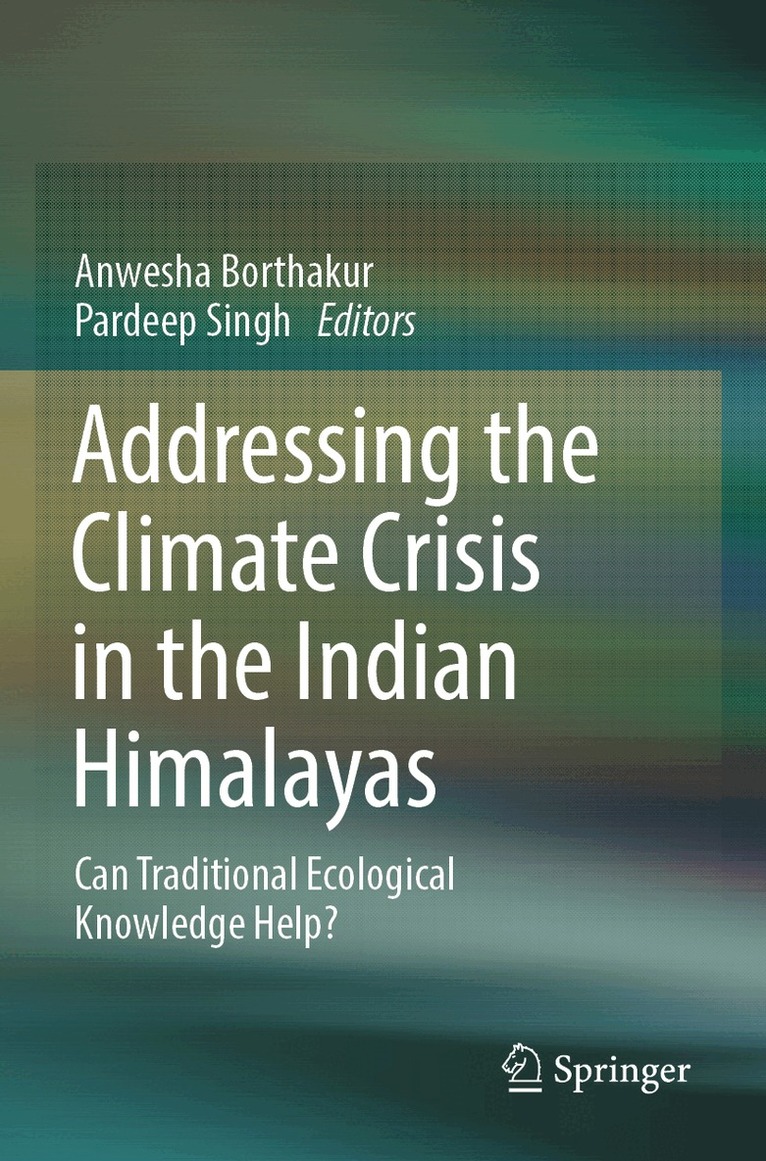
    Addressing the Climate Crisis in the Indian Himalayas

    Can Traditional Ecological Knowledge Help?

    AvAnwesha Borthakur,Pardeep Singh

    Häftad, Engelska, 2025

    1 410 kr

    Beställningsvara. Skickas inom 10-15 vardagar. Fri frakt över 249 kr.

    Beskrivning

    This book focuses on the traditional ecological knowledge in addressing the current climate crisis in the Indian Himalayas. Local or indigenous people in the Himalayas, through their low-carbon producing lifestyles, contribute very little to the climate crisis. However, at the same time, they bear the brunt of this crisis way more than many others. It is important to learn about their traditional ways of life and the knowledge that they hold regarding ecology and environment. Traditional ecological knowledge and associated belief systems are given increasing attention across the globe in recent times toward addressing some of the grave environmental concerns. Climate change is one such concern. The rising consideration of concepts such as ethnoecology and ethnobotany signifies the scientific, socio-cultural and economic potential of the traditional ecological knowledge systems. It is indisputable that these knowledge systems have the ability to provide important insights towards tackling many present-day environmental distresses including several climate change challenges. In this book, the authors concentrate on such traditional ecological knowledge systems in the Indian Himalayan region and try to figure out their significance in relation to the modern science. Overall, the authors attempt to write a book where the relevance of traditional ecological knowledge systems could be addressed and communicated to a larger audience—both academic scientific and non-academic.

    Produktinformation

    • Utgivningsdatum:2025-02-22
    • Mått:155 x 235 x 18 mm
    • Vikt:487 g
    • Format:Häftad
    • Språk:Engelska
    • Antal sidor:311
    • Förlag:Springer International Publishing AG
    • ISBN:9783031500992

    Utforska kategorier

    • Samhälle och kultur inom Samhälle och politik
    • Miljövetenskap och miljöpolitik inom Naturvetenskap och teknik
    • Sociologi inom Samhälle och politik

    Mer om författaren

    Dr. Anwesha Borthakur is presently a Landhaus Fellow at the Rachel Carson Center for Environment and Society, Ludwig Maximilian University of Munich in Germany. She is an affiliate with the University of Leuven (KU Leuven) in Belgium from where she completed her Marie Skłodowska-Curie Postdoctoral Fellowship in 2021. Prior to that, she obtained her PhD in science policy from Jawaharlal Nehru University (JNU), New Delhi, India. She has published over 40 research articles/book chapters in peer-reviewed, indexed journals/books and edited volumes on topics associated with environmental sustainability. Her broad areas of research interest include waste governance, electronic and textile waste, traditional ecological knowledge, public engagement for environmental sustainability and scientometric analysis.Dr. Pardeep Singh is presently an Assistant Professor at the Department of Environmental Studies, PGDAV College, University of Delhi in New Delhi, India. He obtained his PhD fromthe Indian Institute of Technology (Banaras Hindu University), Varanasi. He was selected as a Young Scientist by the Department of Science and Technology (DST), India for the BRICS Young Scientist Conclave held in Durban, South Africa. His research interests include waste management, wastewater treatment, water scarcity and global climate change. He has published more than 75 research papers/book chapters in international journals/books in the field of environmental science. He has also edited more than 40 books with various international publishers including Springer Nature, Elsevier, CRC Press and Wiley.

    Innehållsförteckning

    • The climate crisis in the Indian Himalayas: An introduction.- Traditional ecological knowledge repository in the Indian Himalayas: An overview.- Traditional ecological knowledge and associated belief systems for applied environmental protection in the Indian Himalayas.- Traditional weather and climate indicators: Experiences from the Indian Himalayas.- Traditional agroforestry practices in the Indian Himalayas.- Traditional ecological knowledge in sustainable conservation of seeds and food grains in the Himalayas.- Development of climate resilient varieties of agricultural produces in the Indian Himalayas.- Traditional food systems in the Indian Himalayas: Perspectives from climate science.- Grassroots Conservators and Innovators: Contributions of the traditional ecological knowledge.- The link between traditional ecological knowledge and climate science.- Mitigation of climate change impacts and disasters in the Indian Himalayas: The role of traditional ecological knowledge.- Adaptation to climate change in the Indian Himalayas: Could traditional ecological knowledge help?