• Fri frakt över 249 kr
  • •
  • Snabba leveranser
  • •
  • Billiga böcker
Kundservice

Du är på sajten för privatpersoner.

Företag, bibliotek eller offentlig verksamhet?

Du handlar på classic.bokus.com, där alla dina funktioner finns intakta.
Till classic.bokus.com
Bokus logotyp. Gå till startsidan.
  • Erbjudanden
  • Nyheter
  • Student
  • Topplistor
  • Barn & ungdom
  • Bokus Play
  • E-böcker
  • Pocketböcker
  • Spel & pussel

10% rabatt på allt med kod NYSTART10 →

Sidfot

Mina sidor

    Hjälp

    • Kundservice
    • Vanliga frågor och svar
    • Frakt och leverans
    • Retur vid ångerrätt
    • Reklamera vara
    • Betalning
    • Köpvillkor
    • Allmänna villkor
    • Information om webbplatsens tillgänglighet

    Om Bokus

    • Om oss
    • Pressrum
    • För studenter
    • För företag
    • För bibliotek och offentlig verksamhet
    • För leverantörer
    • Hållbarhet

    Populärt

    • Aktuella erbjudanden
    • Presentkort
    • Studentlitteratur
    • Nya böcker
    • Topplistor
    • Signerade böcker
    • Engelska böcker

    Inspiration

    • Boktips
    • BookTok
    • Populära bokserier
    • Barnbokskaraktärer
    • Populära författare
    Logotyp för Bokus
    Följ oss på Facebook (extern länk)Följ oss på Instagram (extern länk)Följ oss på YouTube (extern länk)Följ oss på TikTok (extern länk)
    bokus @ CookiesAnpassa cookiesIntegritetspolicyKöpvillkor
    Till Citymail hemsida (extern länk)Till Budbee hemsida (extern länk)Till Postnord hemsida (extern länk)Till Schenker hemsida (extern länk)Till Early Bird hemsida (extern länk)Till Walleys hemsida (extern länk)
    1. Samhälle och politik
    2. Politik och statsskick
    3. Centralt styre och förvaltning

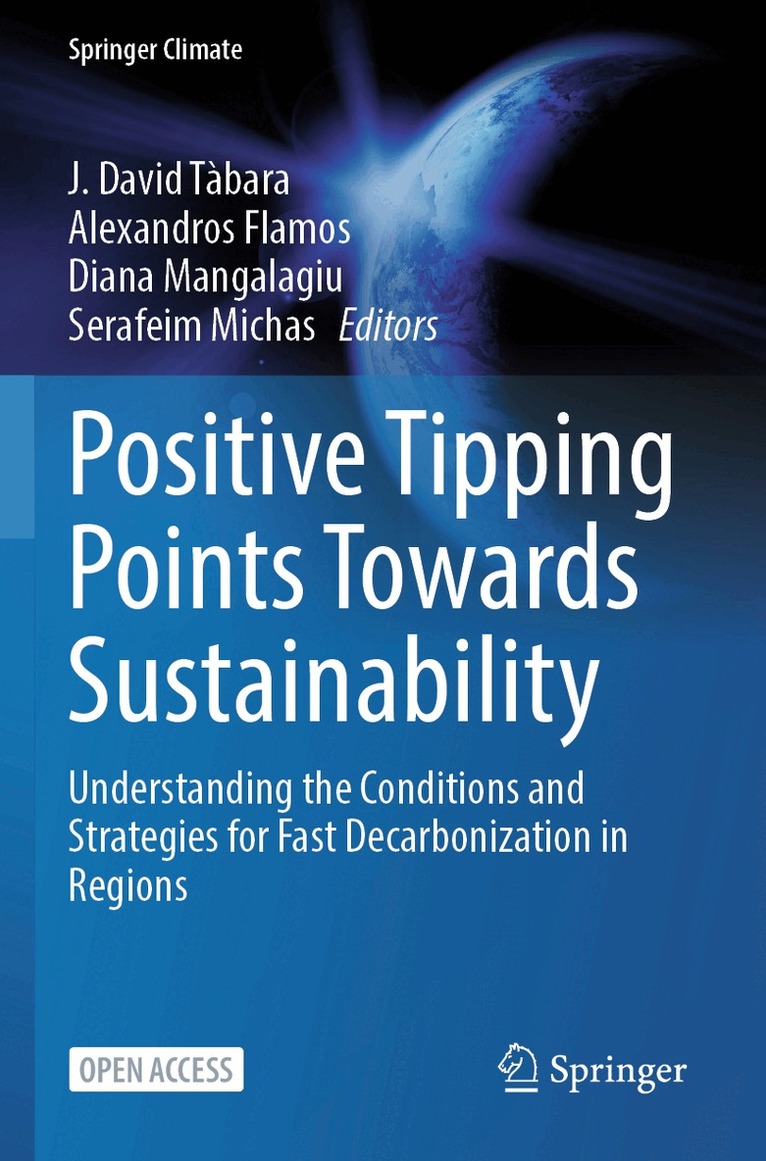
    Positive Tipping Points Towards Sustainability

    Understanding the Conditions and Strategies for Fast Decarbonization in Regions

    AvJ. David Tàbara,Alexandros Flamos

    Häftad, Engelska, 2025

    Del i serien Springer Climate

    438 kr

    Beställningsvara. Skickas inom 10-15 vardagar. Fri frakt över 249 kr.

    Beskrivning

    This open access book provides the first comprehensive review of the state of the art of social tipping points applied to energy systems from a social interdisciplinary perspective. It does so by presenting a novel theory of systemic and transformative change, linking it to empirical cases assisted with relevant assessment methodologies, including modeling. The authors unveil the narratives and visions, the transformative capacities as well as deliberate strategies and collective actions that at one point in time have been able - or were prevented - to tip a given social-ecological system towards low-carbon, sustainable trajectories in diverse high-intensive carbon regions around the world. This volume shows that self-reinforcing learning feedbacks connecting transformative solutions and strategies across scales and domains can be induced by targeted policy interventions both in local and regional contexts. It further indicates how changes in behavioral patterns, supported by good governance of disruptive technologies, carbon (dis)investment and finance processes as well as new forms of civic engagement, can create the necessary transformative enabling conditions for the emergence of positive tipping points towards low-carbon sustainable futures.  The book is a must-read for students, researchers, and scholars, as well as policy-makers and practitioners interested in a better understanding of sustainability, climate, and energy issues and in assessing the potential impacts and effectiveness of strategic interventions aimed at accelerating just sustainable decarbonization processes.

    Produktinformation

    • Utgivningsdatum:2025-03-23
    • Mått:155 x 235 x 20 mm
    • Vikt:552 g
    • Format:Häftad
    • Språk:Engelska
    • Serie:Springer Climate
    • Antal sidor:343
    • Upplaga:2024
    • Förlag:Springer International Publishing AG
    • ISBN:9783031507649

    Utforska kategorier

    • Centralt styre och förvaltning inom Samhälle och politik
    • Miljövetenskap och miljöpolitik inom Naturvetenskap och teknik
    • Ekonomisk politik inom Ekonomi och Ledarskap

    Mer om författaren

    ​J. David Tàbara is an Associate Researcher at the Global Climate Forum in Berlin, Germany, and at the Autonomous University of Barcelona, Spain. He has been working for over 25 years in EU and international interdisciplinary research on Sustainable Development and has published extensively on knowledge integration methods, with particular attention to questions of public perception, social learning, communication, and public participation for sustainability. He contributed to the first book on Public Participation in Sustainability Science (Cambridge University Press 2003) and recently to various EU research projects on transformative solutions to support sustainable climate action, such as GREEN-WIN, IMPRESSIONS, and as principal investigator of TIPPING+. He is also a member of the Earth Commission Working Group on Transformations of the Global Commons Alliance. Alexandros Flamos is a Professor at the University of Piraeus (UNIPI) and Director of the Technoeconomics of Energy Systems Laboratory of UNIPI. He has a Degree in Electrical and Computer Engineering and a PhD in Decision Support Systems (DSS) applied in Energy and Environmental Economics, Planning & Policy. He has held the position of scientific coordinator/ senior researcher in more than 40 European Commission (EC) and other internationally funded projects (H2020, DG RELEX, EACI, DG R&D, DG Energy, SFOE, European Investment Bank, EuropeAid etc.) in DSS, Energy Management & Planning, Energy and Climate Policy, Security of Energy Supply, Energy Competitiveness, and Energy Justice. Flamos was Editor in Chief of the scientific journal Energy Sources Part B: Economics, Planning & Policy (2018-22). He has authored more than 150 publications in high-impact international scientific journals and international conferences and as an invited speaker at major international energy policy cooperation events (MENAREC, Euro-Asia meetings, COPs). Diana Mangalagiu is a Professor at Neoma Business School, France and the University of Oxford, United Kingdom. She holds degrees in natural sciences (Ph.D. Artificial Intelligence, Ecole Polytechnique, MSc Physics) and social sciences (MSc Sociology, MSc Management). She has over two decades of research, advising and teaching experience in sustainability, environmental policy, and foresight. She participated as principal investigator or senior researcher in European Commission (DG CLIMA, CONNECT, ENV, ENER, ENV), OECD, World Bank, and UN agencies funded research projects such as GREEN-WIN, IMPRESSIONS, and TIPPING+. She co-founded the Initiative for Science, Society and Policy Dialogue, co-chaired the pan-European Environmental Outlook of the UN Environment, is a scientific board member of the Global Climate Forum, SEI Initiative on Governing Bioeconomy, member of the High-Level Group for International Science Council, and Coordinating Lead Author for IPBES.Serafeim Michas is a Research Associate at the Technoeconomics of Energy Systems Laboratory (TEESlab) at the University of Piraeus, Greece. He holds a degree on Mechanical Engineering from the National Technical University of Athens (NTUA). Michas teaches energy modelling at the University of Piraeus, with 7 years of research experience acquired through his participation in 6 projects with European and national funding. His expertise is on energy systems' modelling, exploration of decarbonization pathways, analysis of the socio-economic implications of energy transitions, and decision support for the assessment of policy measures' effectiveness under contextual uncertainties. He also has published 5 papers in high impact international peer-reviewed academic journals and his work has been accepted for presentation at several international scientific conferences.

    Innehållsförteckning

    • Chapter 1. The Tipping+ Project Journey.- Chapter 2. Tipping Points Emerge in the Interaction Between Narrative and Reality.- Chapter 3. Tipping Points: Deep Roots and Contemporary Challenges in Psychology.- Chapter 4. Transformations, Agency and Positive Tipping Points: a Resilience-based Approach.- Chapter 5. Principles for a Case Study Approach to Social Tipping Points.- Chapter 6. Post-war Development Energy Scenarios for Ukraine.- Chapter 7. Exploring Transition in Coal- and Carbon-intensive Regions Through an Interdisciplinary Lens.- Chapter 8. Social Tipping Processes in the Transformation of Civitavecchia’s Socio-energy System.- Chapter 9. Realizing Alternative Energy Futures: From the Promise of a Petroleum Future to Imagining Lofoten as the Green Islands.- Chapter 10. Exploring the Role of Identities and Perceptions of the Future in a Post-coal Mining Region. The Demolition of Andorra Coal-fired Cooling Towers (Spain) as a Tipping Point.- Chapter 11. Narrative-network Dynamics in Tipping Processes Towards Low-carbon Energy Futures: the Case of Indonesia.- Chapter 12. Situated Knowledge and Energy Transformations: a Socioanthropological Exploration.- Chapter 13. Tipping Away From Coal?: Exploring Narratives and Tipping Dynamics in the Phaseout of Coal on Svalbard.- Chapter 14. Confronting Local and Global Tipping Narratives: Green Energy Development in the Arctic and Why Greenland is Not for Sale.- Chapter 15. Assessing Macroeconomic Effects of a Carbon Tax as a Tipping Intervention in Economies Undergoing Coal Phase-out: the Cases of Poland and Greece.- Chapter 16. Transformative Emergence. Research Challenges for Enabling Social-ecological Tipping Points Toward Regional Sustainability Transformations.