Inbunden, Engelska, 2024
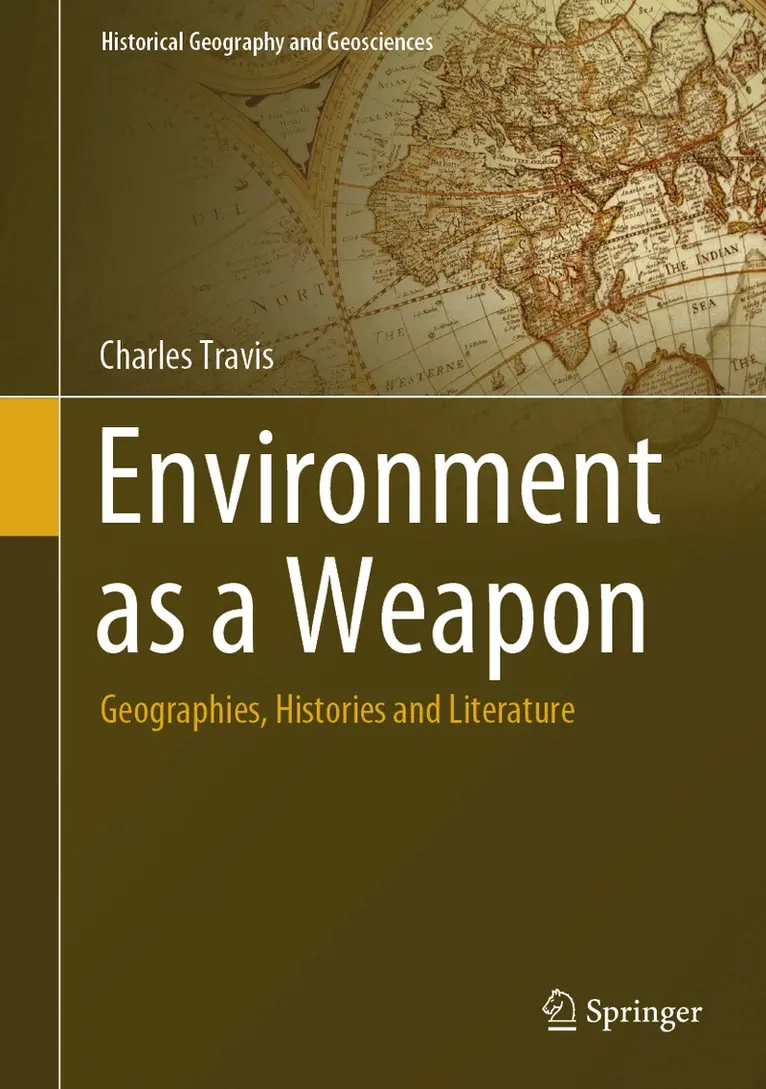
Environment as a Weapon
2281 kr
Skickas inom 10-15 vardagar
Beskrivning
Environment as a Weapon considers how the confluence of war and nature from the time of the Agricultural Revolution (10,000 BCE) to our present day has been represented in works of history, geography, and literature. In the Epic of Gilgamesh, the Torah and Greco-Roman myths, warfare is a trope commensurate with environmental disasters, extreme climate, and plague. In the medieval age myths the Táin, and Beowulf environments become allies and enemies. The equestrian steppeland as foundation of Genghis Khan’s and his heirs Pax Mongolica is chronicled in The Secret History of the Mongols and The Travels of Marco Polo. The West African Griot legend of Sundiata and the Little Ice Age wreck of the Spanish Armada in 1588 speak to oceanic and atmospheric dimensions of warfare. American Revolution political pamphlets, poetry, diaries and weather logs, reflect the severe weather and terrain deployed by George Washington’s early campaigns in the war of independence. Napoleon’s midwifing of Total War is captured in Mary Shelley’s Frankenstein, Leo Tolstoy’s War and Peace, and Charles Minard’s Carte figurative carto-graph of the disastrous 1812 French invasion of Russia. The U.S. Civil War and the organic-industrial assembles of its battles, arguably the first Anthropocene War, is parsed by the clarifying poetry of Emily Dickinson. Geopolitik and geo-hazards of flood and fire feature in the Global War works of Samuel Beckett, Kurt Vonnegut and James Dickey. The literature of Vietnamese and American war combat veterans reveals how North Vietnam’s Environmental Military Complex stalled the American Military Industrial Complex in the jungles, and R&R districts of southwestern Asia. Finally, he sci-fi of H.G. Wells’ World Set Free and David Mitchell’s Cloud-Atlas frame Oppenheimer’s sub-atomic deployments at Hiroshima and Nagasaki, James Lovelock’s ‘Gaia’ and U.S. military discourses situating global warming as a national security threat to America. Indeed, Environment and War ironically resonates with U.N. Secretary General António Guterres proclamation that “seventy-five years ago, the world emerged from a series of cataclysmic events: two successive world wars, genocide, a devastating influenza pandemic . . . Our founders gathered in San Francisco promising to save succeeding generations from the scourge of war.” Thus, a holistic approach to studying and mitigating the human and environmental impacts of warfare, must integrate methods from the arts, humanities and sciences. This involves understanding how the historical geographies of the Earth’s planetary systems have been perceived, deployed and emerged as agents of warfare, with the lithosphere, hydrosphere, cryosphere, biosphere and atmosphere transformed as arsenals against anthropogenic global warming. This book will be of interest to geographers, historians, and scholars in environmental studies, climate change, literature and military studies, as well as the broader environmental humanities.
Produktinformation
- Utgivningsdatum: 2024-03-21
- Mått: 178 x 254 x 15 mm
- Vikt: 555 g
- Format: Inbunden
- Språk: Engelska
- Antal sidor: 154
- Förlag: Springer International Publishing AG
- Serie: Historical Geography and Geosciences
- ISBN: 9783031508554
Utforska kategorier
Betyg & recensioner
0 recensioner
Inga recensioner tillgängliga.