• Fri frakt över 249 kr
  • •
  • Snabba leveranser
  • •
  • Billiga böcker
Kundservice

Du är på sajten för privatpersoner.

Företag, bibliotek eller offentlig verksamhet?

Du handlar på classic.bokus.com, där alla dina funktioner finns intakta.
Till classic.bokus.com
Bokus logotyp. Gå till startsidan.
  • Erbjudanden
  • Nyheter
  • Student
  • Topplistor
  • Barn & ungdom
  • Bokus Play
  • E-böcker
  • Pocketböcker
  • Spel & pussel

10% rabatt på allt med kod NYSTART10 →

Sidfot

Mina sidor

    Hjälp

    • Kundservice
    • Vanliga frågor och svar
    • Frakt och leverans
    • Retur vid ångerrätt
    • Reklamera vara
    • Betalning
    • Köpvillkor
    • Allmänna villkor
    • Information om webbplatsens tillgänglighet

    Om Bokus

    • Om oss
    • Pressrum
    • För studenter
    • För företag
    • För bibliotek och offentlig verksamhet
    • För leverantörer
    • Hållbarhet

    Populärt

    • Aktuella erbjudanden
    • Presentkort
    • Studentlitteratur
    • Nya böcker
    • Topplistor
    • Signerade böcker
    • Engelska böcker

    Inspiration

    • Boktips
    • BookTok
    • Populära bokserier
    • Barnbokskaraktärer
    • Populära författare
    Logotyp för Bokus
    Följ oss på Facebook (extern länk)Följ oss på Instagram (extern länk)Följ oss på YouTube (extern länk)Följ oss på TikTok (extern länk)
    bokus @ CookiesAnpassa cookiesIntegritetspolicyKöpvillkor
    Till Citymail hemsida (extern länk)Till Budbee hemsida (extern länk)Till Postnord hemsida (extern länk)Till Schenker hemsida (extern länk)Till Early Bird hemsida (extern länk)Till Walleys hemsida (extern länk)
    1. Psykologi och pedagogik
    2. Pedagogik
    3. Material och digital teknik i undervisningen

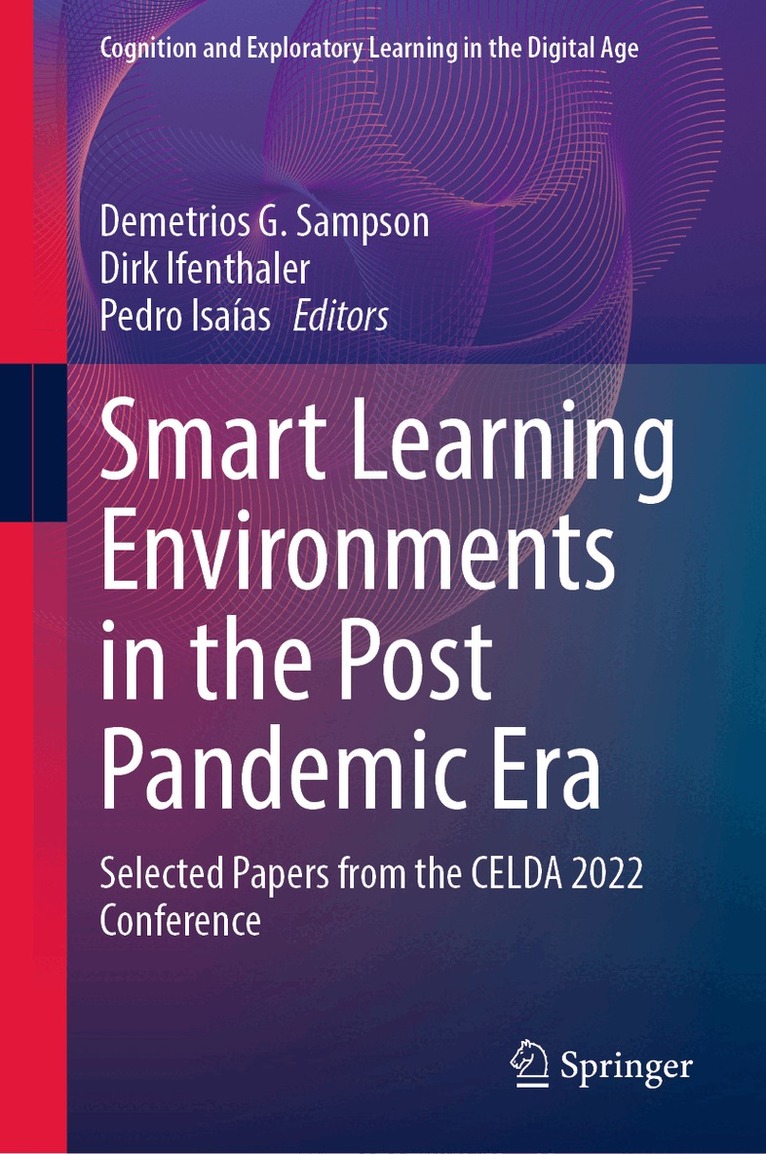
    Smart Learning Environments in the Post Pandemic Era

    Selected Papers from the CELDA 2022 Conference

    AvDemetrios G. Sampson,Dirk Ifenthaler

    Inbunden, Engelska, 2024

    Del i serien Cognition and Exploratory Learning in the Digital Age

    1 684 kr

    Beställningsvara. Skickas inom 10-15 vardagar. Fri frakt över 249 kr.

    Beskrivning

    This edited volume presents the latest research focussing on current challenges on the deployment of smart technologies and pedagogies for supporting teaching and learning in the post-covid19 era.  This is at the core of studying the evolution of the learning process, the role of technology-supported pedagogical approaches, and the progress of educational technology innovations in the context of digital transformation in education and professional training. A selection of the best papers from the Cognition and Exploratory Learning in the Digital Age (CELDA) Conference, 2022 are included in this volume, bringing together high-quality research on Smart Pedagogies in the Post-Pandemic Era; Smart Learning Technologies in the Post-Pandemic Era; and Case Studies of Smart Learning Environments. The volume contributes to the discussion of current issues in digital education between researchers, practitioners, and policymakers.

    Produktinformation

    • Utgivningsdatum:2024-03-26
    • Mått:155 x 235 x 21 mm
    • Vikt:592 g
    • Format:Inbunden
    • Språk:Engelska
    • Serie:Cognition and Exploratory Learning in the Digital Age
    • Antal sidor:270
    • Upplaga:2024
    • Förlag:Springer International Publishing AG
    • ISBN:9783031542060

    Utforska kategorier

    • Material och digital teknik i undervisningen inom Psykologi och pedagogik
    • Lärarutbildning inom Psykologi och pedagogik
    • Studieteknik och inlärningsförmåga inom Psykologi och pedagogik

    Mer om författaren

    Demetrios Sampson is a Professor of Digital Systems for Learning and Education, Director of the MSc Program on Digital Learning, and Director of the Research Laboratory DiLearn at the Department of Digital Systems, University of Piraeus, Greece. He has been engaged in teaching and research in the field of educational technologies and digital learning since 1996. Dirk Ifenthaler is a Professor of Learning, Design and Technology at the University of Mannheim, Germany and UNESCO Deputy Chair on Data Science in Higher Education Learning and Teaching at Curtin University, Australia. Dirk’s research focuses on the intersection of cognitive psychology, educational technology, data analytics, and organisational learning.Pedro Isaías is an Associate Professor at Universidade Aberta (Portuguese Open University) in Lisbon, Portugal. Pedro is also an Adjunct Associate Professor at the School of Information Systems & Technology Management of The University of NewSouth Wales (UNSW – Sydney), Australia. He is co-founder and president of IADIS – International Association for Development of the Information Society.

    Innehållsförteckning

    • Part I – Smart Pedagogies in the Post-Pandemic Era: Chapter 1 – Learning Analytics in Supporting Teaching and Learning – Pedagogical Perspectives (Laura Hirsto, Sanna Väisänen, Erkko Tapio Sointu & Teemu Valtonen).- Chapter 2 – Learning Analytics Based Interventions: a Systematic Re-view of Experimental Studies (Mustafa Tepgeç, Dirk Ifenthal-er).- Chapter 3 – Experiencing Flow in Virtual Reality: an Investigation of Complex Interaction Structures of Learning-related Variables (Miriam Mulders).- Chapter 4 – Determining Learners’ Behavioral Patterns in a Technolo-gy and Analytics Enhanced Assessment Environment (Muhittin Şahin, Dirk Ifenthaler).- Chapter 5 – Clustering Techniques to Investigate Engagement and Performance in Online Mathematics Courses (Francesco Floris, Marina Marchisio, Fabio Roman, Matteo Sacchet, Sergio Rabellino).- Part II: Smart Learning Technologies in the Post-Pandemic Era: Chapter 6 – Automatic Speech Recognition System to Enhance the Use of Vocalization Strategy (Saki Hirata Masanori Yamada).- Chapter 7 – An Educational Unified Modelling Language Program-ming Environment and its two Case Studies (Maruyama, Shinpei Ogata, Mizue Kayama, Nobuyuki Tachi, Takashi Na-gai, Naomi Taguchi).- Chapter 8 – Physical Computing Systems: a Systematic Approach (Er-ic Schätz and Alke Martens).- Chapter 9 – a Digital Educational Game for Practicing OER (Lubna Ali, Quang Phung, Rene Roepke, Ulrik Schroeder).- Part III – Case Studies of Smart Learning Environments: Chapter 10 – Student Acceptance of Social Robots in Higher Education: Evidence from a Vignette Study (Josef Guggemos, Stefan Sonderegger and Sabine Seufert).- Chapter 11 – Evaluating Different Assessment Types in an Online Geoscience Course (Emre Dinç, April L. Millet).- Chapter 12 – Students Use of Learning Aids: Lessons from LearningAnalytics (Dirk Tempelaar).- Chapter 13 – Didactic Activities of Artificial Intelligence: the Perspec-tive of STEM Teachers (Cecilia Fissore, Francesco Floris, Ma-rina Marchisio and Matteo Sacchet).- Part IV – Looking To The Future: Chapter 14 – Is it time to consider Biomimetics for sustainable educa-tion? Lessons from the nature for “smarter” learning environ-ments (Boulus Shehata, Ahmed Tlili, Demetrios Sampson, Ronghuai Huang).