• Fri frakt över 249 kr
  • •
  • Snabba leveranser
  • •
  • Billiga böcker
Kundservice

Du är på sajten för privatpersoner.

Företag, bibliotek eller offentlig verksamhet?

Du handlar på classic.bokus.com, där alla dina funktioner finns intakta.
Till classic.bokus.com
Bokus logotyp. Gå till startsidan.
  • Erbjudanden
  • Student
  • Topplistor
  • Barn & ungdom
  • Bokus Play
  • E-böcker
  • Ljudböcker
  • Pocketböcker
  • Spel & pussel

Upp till 25% på utvalda nyheter →

Sidfot

Mina sidor

    Hjälp

    • Kundservice
    • Vanliga frågor och svar
    • Frakt och leverans
    • Retur vid ångerrätt
    • Reklamera vara
    • Betalning
    • Köpvillkor
    • Allmänna villkor
    • Information om webbplatsens tillgänglighet

    Om Bokus

    • Om oss
    • Pressrum
    • För studenter
    • För företag
    • För bibliotek och offentlig verksamhet
    • För leverantörer
    • Hållbarhet

    Populärt

    • Aktuella erbjudanden
    • Presentkort
    • Studentlitteratur
    • Nya böcker
    • Topplistor
    • Signerade böcker
    • Engelska böcker

    Inspiration

    • Boktips
    • BookTok
    • Populära bokserier
    • Barnbokskaraktärer
    • Populära författare
    Logotyp för Bokus
    Följ oss på Facebook (extern länk)Följ oss på Instagram (extern länk)Följ oss på YouTube (extern länk)Följ oss på TikTok (extern länk)
    bokus @ CookiesAnpassa cookiesIntegritetspolicyKöpvillkor
    Till Citymail hemsida (extern länk)Till Budbee hemsida (extern länk)Till Postnord hemsida (extern länk)Till Schenker hemsida (extern länk)Till Early Bird hemsida (extern länk)Till Walleys hemsida (extern länk)
    1. Naturvetenskap och teknik
    2. Geovetenskap
    3. Miljövetenskap och miljöpolitik

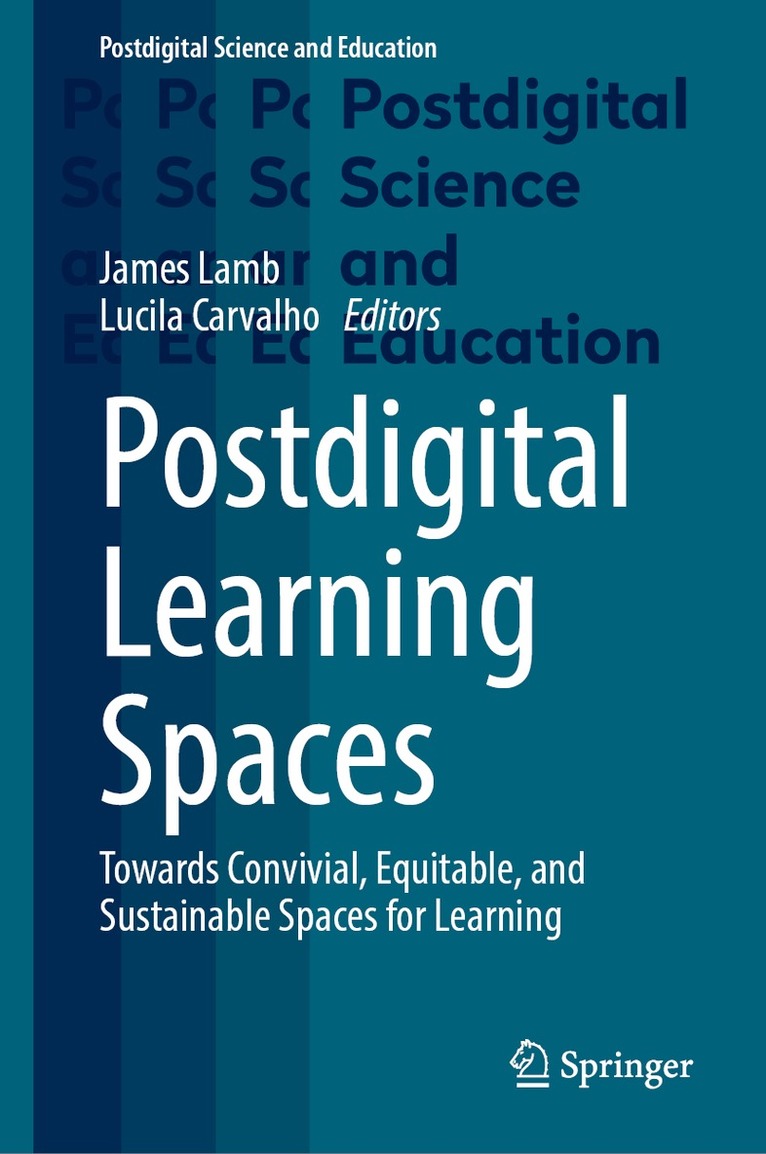
    Postdigital Learning Spaces

    Towards Convivial, Equitable, and Sustainable Spaces for Learning

    AvJames Lamb,Lucila Carvalho

    Inbunden, Engelska, 2024

    Del i serien Postdigital Science and Education

    1 942 kr

    Beställningsvara. Skickas inom 10-15 vardagar. Fri frakt över 249 kr.

    Beskrivning

    This edited collection brings empirical, theoretical, and conceptual work related to learning spaces and practices that draw on the convergence of nature, humans, and the digital, in order to contribute to transformative action (that is likely) to effect change. The book asks, how can learning spaces be more convivial, equitable or sustainable, considering the challenges our world is facing? With a view to extending the reach and impact of existing postdigital scholarship, the book explores learning spaces beyond higher education. This includes learning spaces associated with cultural heritage, creative arts, refugees and displaced persons, schools, outdoor education, the city, and elsewhere.

    Produktinformation

    • Utgivningsdatum:2024-07-11
    • Mått:155 x 235 x 21 mm
    • Vikt:588 g
    • Format:Inbunden
    • Språk:Engelska
    • Serie:Postdigital Science and Education
    • Antal sidor:244
    • Förlag:Springer International Publishing AG
    • ISBN:9783031596902

    Utforska kategorier

    • Miljövetenskap och miljöpolitik inom Naturvetenskap och teknik
    • Material och digital teknik i undervisningen inom Psykologi och pedagogik
    • Utbildningsstrategier och utbildningspolitik inom Psykologi och pedagogik

    Mer om författaren

    James Lamb is a lecturer and researcher within the Centre for Research in Digital Education, and The Edinburgh Futures Institute, at the University of Edinburgh. His research and teaching particularly concern the relationship between digital technologies and learning spaces. This includes work that has explored the postdigital learning spaces of higher education, the ways that online students conceptualise the campus, mobile learning in urban settings, and how sound can shape our learning spaces. He has also written about multimodal assessment, and argued the case for sonic methods in social research. He is a co-author of the Manifesto for Teaching Online and runs the Elektronisches Lernen Muzik project, which explores the relationship between music and learning. Lucila Carvalho is an associate professor at the Institute of Education, Massey University (Auckland), New Zealand, and co-director of the Equity Through Education Research Centre. Lucila’s research interests are at the intersection of sociology, design, digital technologies and learning. Her research explores how knowledge and social structures shape the design and use of technology, and the web of elements – tasks, people, digital and material tools – that come together to influence social and educational experiences. Lucila co-edited the books: Place-based Spaces for Networked Learning (with Peter Goodyear and Maarten de Laat, Routledge, 2017) and The Architecture of Productive Learning Networks (with Peter Goodyear, Routledge, 2014).

    Recensioner i media

    “This book is a rich resource for teachers, educational technology specialists, educational designers, students, and researchers who want to learn more about postdigital spaces, the possibilities they offer, and most importantly, how to think about such spaces to make them more convivial, equitable, and sustainable. … For researchers the book also offers a broad range of postdigital research methods, often transdisciplinary, innovative, and collaborative.” (Henrietta Carbonel, Postdigital Science and Education, Vol. 6 (4), 2024)

    Innehållsförteckning

    • Chapter 1. Introduction: Postdigital Learning Spaces.- Chapter 2. Exploring the postdigital through our learning spaces.- Chapter 3. Digital and material manifestations of schooling: entrenching the old or enabling the new?.- Chapter 4. Archives, memories and spaces of children’s play: Pre-digital and postdigital places of affective possibility.- Chapter 5. Nomadic cultures & dynamic practices. A case study towards reconfiguring the post-digital school space.- Chapter 6. Belonging: The role of a multimedia project in expressing and connecting migrant communities' discourses.- Chapter 7. The postdigital learning spaces of Anglophone Sub Saharan Africa.- Chapter 8. Postdigital learning spaces in rural Peru: a case study of a remote diploma aimed at hard-to-reach teachers from low-resource schools.- Chapter 9. Beyond campuses and across cultures: engaging Brazilian and New Zealand learners in postdigital times.- Chapter 10. ‘Loose Ends andMissing Links’: Strategies for learning in the postdigital city.- Chapter 11. An attempt at exhausting the train journey as a postdigital learning space.- Chapter 12. Knowledge, knowing, and the knower: A patient’s perspective of learning to live with Long COVID in the Postdigital era.- Chapter 13. “We Live in Their Shade”: Towards a Plant-Based Civic Imagination.- Chapter 14. Music in the composition of postdigital writing spaces.- Chapter 15. Conclusion.