• Fri frakt över 249 kr
  • •
  • Snabba leveranser
  • •
  • Billiga böcker
Kundservice

Du är på sajten för privatpersoner.

Företag, bibliotek eller offentlig verksamhet?

Du handlar på classic.bokus.com, där alla dina funktioner finns intakta.
Till classic.bokus.com
Bokus logotyp. Gå till startsidan.
  • Erbjudanden
  • Nyheter
  • Student
  • Topplistor
  • Barn & ungdom
  • Bokus Play
  • E-böcker
  • Pocketböcker
  • Spel & pussel

10% rabatt på allt med kod: NYSTART10 →

Sidfot

Mina sidor

    Hjälp

    • Kundservice
    • Vanliga frågor och svar
    • Frakt och leverans
    • Retur vid ångerrätt
    • Reklamera vara
    • Betalning
    • Köpvillkor
    • Allmänna villkor
    • Information om webbplatsens tillgänglighet

    Om Bokus

    • Om oss
    • Pressrum
    • För studenter
    • För företag
    • För bibliotek och offentlig verksamhet
    • För leverantörer
    • Hållbarhet

    Populärt

    • Aktuella erbjudanden
    • Presentkort
    • Studentlitteratur
    • Nya böcker
    • Topplistor
    • Signerade böcker
    • Engelska böcker

    Inspiration

    • Boktips
    • BookTok
    • Populära bokserier
    • Barnbokskaraktärer
    • Populära författare
    Logotyp för Bokus
    Följ oss på Facebook (extern länk)Följ oss på Instagram (extern länk)Följ oss på YouTube (extern länk)Följ oss på TikTok (extern länk)
    bokus @ CookiesAnpassa cookiesIntegritetspolicyKöpvillkor
    Till Citymail hemsida (extern länk)Till Budbee hemsida (extern länk)Till Postnord hemsida (extern länk)Till Schenker hemsida (extern länk)Till Early Bird hemsida (extern länk)Till Walleys hemsida (extern länk)
    1. Naturvetenskap och teknik
    2. Matematik och naturvetenskap
    3. Biologi
    4. Biovetenskap

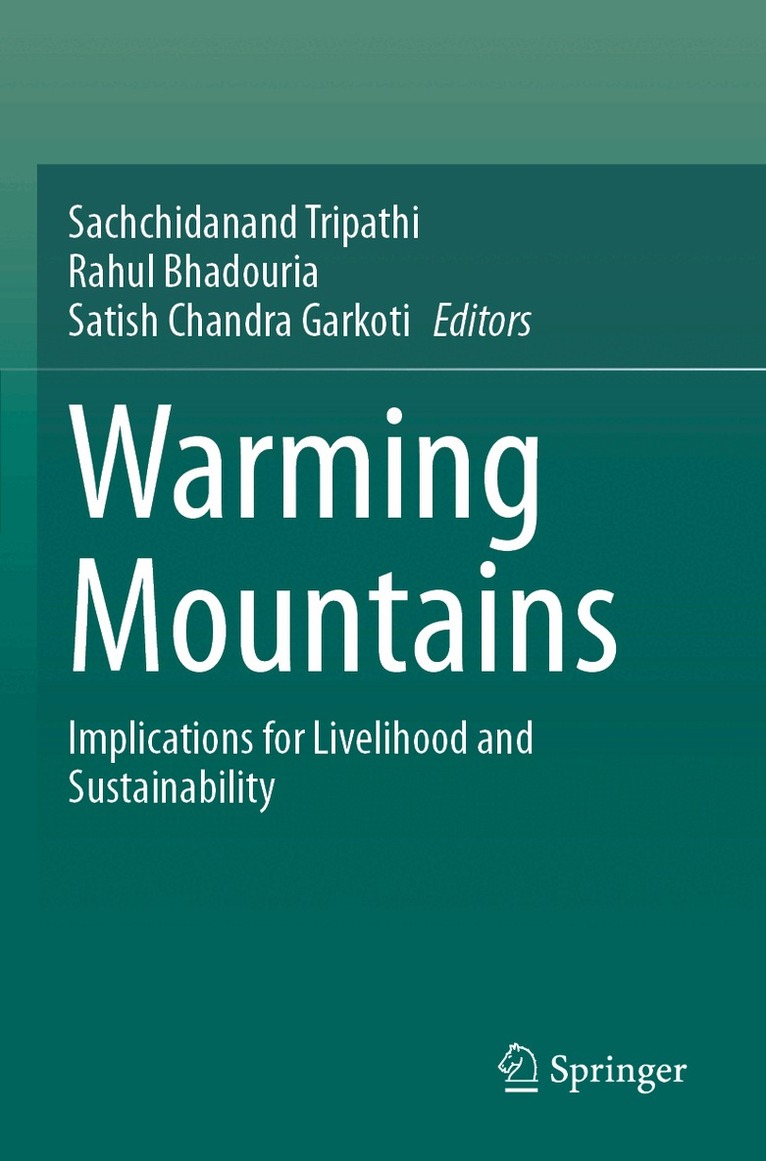
    Warming Mountains

    Implications for Livelihood and Sustainability

    AvSachchidanand Tripathi,Rahul Bhadouria

    Häftad, Engelska, 2025

    1 842 kr

    Beställningsvara. Skickas inom 10-15 vardagar. Fri frakt över 249 kr.

    Beskrivning

    This contributed volume focuses on the sustainability of mountain ecosystems in the face of a changing climate. Its chapters highlight climate change impacts on the livelihoods of the people and communities that live in mountains and ways that these effects can be mitigated through adaptive measures. The chapters herein address a gamut of topics from use of remote sensing tools to assess changing ecosystems, disaster management in mountains, policymaking between institutions, and more. This book is suitable for students (undergraduate and postgraduates) of ecology and environmental studies/sciences, mountainous agriculture, mountain forestry, teachers, researchers, climate change scientists in academic and research institutions. It will also be useful to environmental management agencies particularly working towards sustainable development in mountainous regions, disaster management authorities, government agencies and policy makers.

    Produktinformation

    • Utgivningsdatum:2025-11-14
    • Mått:155 x 235 x 26 mm
    • Vikt:709 g
    • Format:Häftad
    • Språk:Engelska
    • Antal sidor:462
    • Förlag:Springer International Publishing AG
    • ISBN:9783031621994

    Utforska kategorier

    • Biovetenskap inom Naturvetenskap och teknik
    • Geografi inom Naturvetenskap och teknik
    • Miljövetenskap och miljöpolitik inom Naturvetenskap och teknik

    Mer om författaren

    Sachchidanand Tripathi, Ph.D.Sachchidanand Tripathi is an associate professor at the Department of Botany, Deen Dayal Upadhyaya College, University of Delhi, Delhi, India. He obtained his doctoral degree from the Department of Botany, Banaras Hindu University, India. The areas of his interest are plant ecology, soil ecology of various ecosystems, ecophysiology and urban ecology. He has published more than 60 publications (including research publications, books and book chapters, conference proceedings) with journals and publishers of international repute. Rahul Bhadouria, Ph.D.Rahul Bhadouria is an assistant professor at the Department of Environmental Studies, Delhi College of Arts and Commerce, University of Delhi, New Delhi, India. He obtained his doctoral degree from the Department of Botany, Banaras Hindu University, Varanasi, India. He has published more than 24 papers, 25 book chapters, and 12 edited books in internationally reputed journals/publishers. His current research areas are, management of soil C dynamics to mitigate climate change, a perspective on tree seedling survival and growth attributes in tropical dry forests under the realm of climate change, plant community assembly, functional diversity and soil attributes along the forest-savanna-grassland continuum in India, recovery of degraded mountains in central Himalayas and urban ecology.Satish Chandra Garkoti, Ph.D. Satish Chandra Garkoti is Professor at School of Environmental Sciences and Rector (Pro-Vice Chancellor) in Jawaharlal Nehru University, New Delhi, India. His areas of research are Plant Ecology, Traditional Ecological Knowledge, Tree water relations, Plant invasions, Ecosystem restoration, Himalayan Ecology. Prof. Garkoti has 32 years of Research and 23 Years of teaching experience. He is member of various professional societies of international repute such as International Society for Tropical Ecology, India (Fellow); Ecological Society of America, USA (Member); National Institute of Ecology, India (Fellow); International Association for Ecology (INTECOL)(Member).  Prof. Garkoti has been awarded and successfully conducted a number of research and development projects funded by various funding agencies of the Government of India. He has published more than 85 research publications, 8 chapters in proceedings and books and 2 books with journals and publishers of international and national repute.

    Innehållsförteckning

    • Chapter 1: Emerging threats to mountain ecosystem services under changing climate.- Chapter 2: Ecosystem Functioning in the Chittagong Hill Tracts, Bangladesh: Scopes and Challenges for Indigenous Communities Adaptation to Climate Change.- Chapter 3: Long-term monitoring of Snow Cover Extent and Land Surface Temperature to understand the warming of mountains in a semi-urban location of North Western Himalayas.- Chapter 4: Plant phenological shifts in the Indian Himalayan Region.- Chaper 5: Climate Variability in the Kilum-Ijim Mountain Range of Cameroon: Implications for Rural Livelihoods and Food Security.- Chapter 6: Increasing warming of Cameroon’s Afromontane landscape: Realities and implications for livelihoods and sustainability .- Chapter 7: Implications of climate change on Health and Livelihood of people in Hindu Kush Himalayan Region.- Chapter 8: Minimizing carbon footprint through the traditional approach Tar Span in the mountain valleys of Himachal Pradesh .- Chapter 9: Impact of Climate change and mitigation plans for building climate resilient village ecosystem: Challenges and adaptive strategies.- Chapter 10: Managing disasters in mountains: challenges in the era of global warming .- Chapter 11: Ground based and Geospatial measurement of Aerosol and Black Carbon to assess the Warming patterns in a sub urban location in Himachal Pradesh, India.- Chapter 12: Spatio-Temporal Assessment of Climate Change led Ecological Vulnerability through DPSIR in Indian Himalayan Region.- Chapter 13: Exploring alternative livelihood opportunities for mountain people as an adaptive strategy to changing climate: A case of Chyulu Hills, Kenya.- Chapter 14: An area of Dankness: Food security of Food Producers When the Kosi comes down to the plains.- Chapter 15: Enhancing Soil Carbon Stocks in Agricultural and Forest Soils: A Crucial Step towards Climate Change Mitigation and Ecological Security.- Chapter 16: Warming mountains: Gendered implications for livelihood and sustainability .- Chapter 17: Analysis of normalized difference vegetation index (NDVI) of Chittagong Hill Tracts from 1991-2021 using remote sensing tools.- Chapter 18: Communal arrangements for sustainably managing soil quality and adapting to climate change: a case study in Peruvian Central Andes .- Chapter 19: Consequences of Climate Change on Medicinal and Aromatic Plants in Indian Himalayan Regions: An Overview.- Chapter 20: Landslide’s Recovery and Restoration: A Way to Sustainable Development Goal (SDG) 15.- Chapter 21: Community managed forests and their effectiveness in SDGs implications in Western Himalayan Region.