• Fri frakt över 249 kr
  • •
  • Snabba leveranser
  • •
  • Billiga böcker
Kundservice

Du är på sajten för privatpersoner.

Företag, bibliotek eller offentlig verksamhet?

Du handlar på classic.bokus.com, där alla dina funktioner finns intakta.
Till classic.bokus.com
Bokus logotyp. Gå till startsidan.
  • Erbjudanden
  • Nyheter
  • Student
  • Topplistor
  • Barn & ungdom
  • Bokus Play
  • E-böcker
  • Pocketböcker
  • Spel & pussel

10% rabatt på allt med kod NYSTART10 →

Sidfot

Mina sidor

    Hjälp

    • Kundservice
    • Vanliga frågor och svar
    • Frakt och leverans
    • Retur vid ångerrätt
    • Reklamera vara
    • Betalning
    • Köpvillkor
    • Allmänna villkor
    • Information om webbplatsens tillgänglighet

    Om Bokus

    • Om oss
    • Pressrum
    • För studenter
    • För företag
    • För bibliotek och offentlig verksamhet
    • För leverantörer
    • Hållbarhet

    Populärt

    • Aktuella erbjudanden
    • Presentkort
    • Studentlitteratur
    • Nya böcker
    • Topplistor
    • Signerade böcker
    • Engelska böcker

    Inspiration

    • Boktips
    • BookTok
    • Populära bokserier
    • Barnbokskaraktärer
    • Populära författare
    Logotyp för Bokus
    Följ oss på Facebook (extern länk)Följ oss på Instagram (extern länk)Följ oss på YouTube (extern länk)Följ oss på TikTok (extern länk)
    bokus @ CookiesAnpassa cookiesIntegritetspolicyKöpvillkor
    Till Citymail hemsida (extern länk)Till Budbee hemsida (extern länk)Till Postnord hemsida (extern länk)Till Schenker hemsida (extern länk)Till Early Bird hemsida (extern länk)Till Walleys hemsida (extern länk)
    1. Naturvetenskap och teknik
    2. Matematik och naturvetenskap
    3. Matematik
    4. Tillämpad matematik

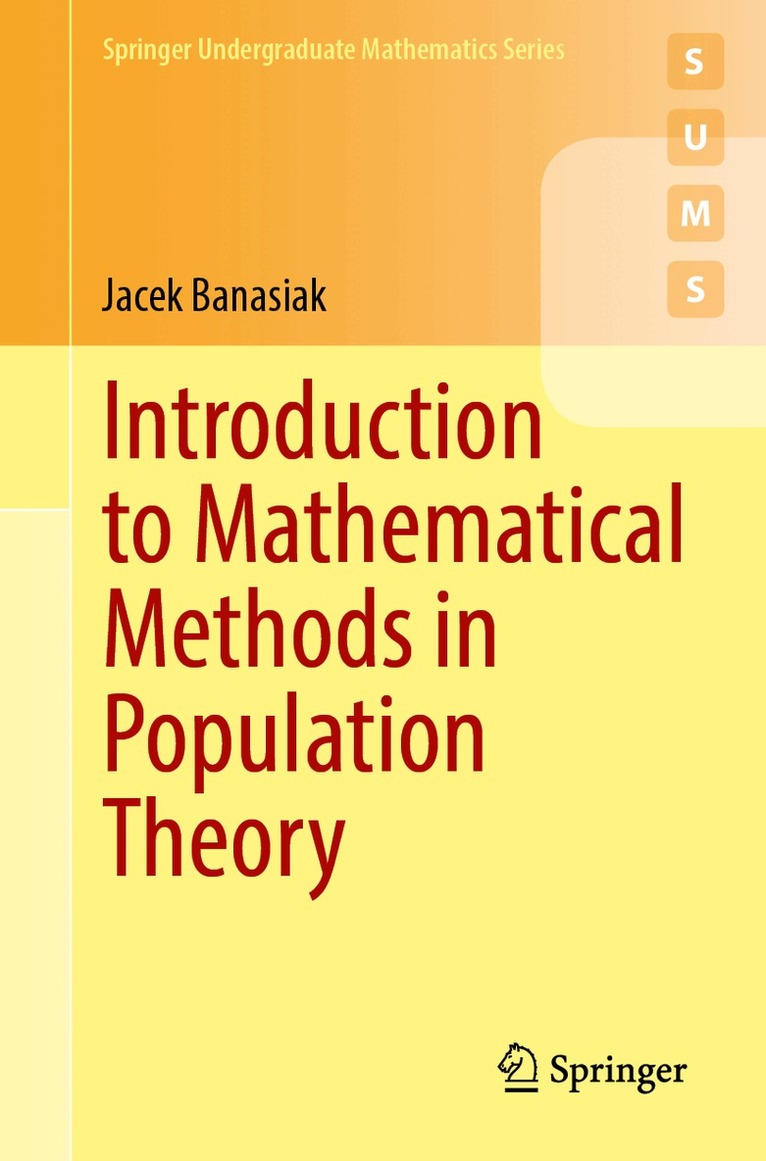
    Introduction to Mathematical Methods in Population Theory

    AvJacek Banasiak

    Häftad, Engelska, 2024

    Del i serien Springer Undergraduate Mathematics Series

    654 kr

    Beställningsvara. Skickas inom 5-8 vardagar. Fri frakt över 249 kr.

    Fler format och utgåvor

    E-bok

    868 kr

    Beskrivning

    This textbook provides an introduction to the mathematical methods used to analyse deterministic models in life sciences, including population dynamics, epidemiology and ecology. The book covers both discrete and continuous models.The presentation emphasises the solvability of the equations appearing in the mathematical modelling of natural phenomena and, in the absence of solutions, the analysis of their relevant properties. Of particular interest are methods that allow for determining the long-term behaviour of solutions. Thus, the book covers a range of techniques, from the classical Lyapunov theorems and positivity methods based on the Perron–Frobenius theorem, to the more modern monotone dynamical system approach. The book offers a comprehensive presentation of the Lyapunov theory, including the inverse Lyapunov theorems with applications to perturbed equations and Vidyasagar theorem. Furthermore, it provides a coherent presentation of the foundations of the theory of monotone dynamical systems with its applications to epidemiological models. Another feature of the book is the derivation of the McKendrick–von Foerster equation from the discrete Leslie model and the analysis of the long-term behaviour of its solutions.Designed for upper undergraduate courses and beyond, this textbook is written for students and researchers looking to master the mathematics of the tools commonly used to analyse life science models. It therefore goes somewhat deeper into mathematics than typical books at this level but should be accessible to anyone with a good command of calculus with elements of real and complex analysis and linear algebra; the necessary concepts are collected in the appendices.

    Produktinformation

    • Utgivningsdatum:2024-12-21
    • Mått:155 x 235 x 32 mm
    • Vikt:1 170 g
    • Format:Häftad
    • Språk:Engelska
    • Serie:Springer Undergraduate Mathematics Series
    • Antal sidor:615
    • Förlag:Springer International Publishing AG
    • ISBN:9783031654909

    Utforska kategorier

    • Tillämpad matematik inom Naturvetenskap och teknik
    • Beräkning och matematisk analys inom Naturvetenskap och teknik

    Mer om författaren

    Jacek Banasiak was born on 15th March 1959 in Łódź, Poland. The current holder of the DSI/NRF SARChI Chair in Mathematical Models and Methods in Biosciences and Bioengineering at the University of Pretoria, he is also a research professor at the Łódź University of Technology in Poland and a visiting professor at the University of Strathclyde in Glasgow, Scotland. His research interests are nonlocal integro-differential models in kinetic theory, mathematical biology and fragmentation-coagulation theory, asymptotic analysis of multiple scale problems and epidemiological modelling. Up to this point in his career, he has authored/co-authored seven research monographs and over 145 refereed research papers. He is a recipient of the South African Mathematical Society Award for Research Distinction (2012), Cross of Merit (Silver) of the Republic of Poland (2013), 1st prize for the best paper in applied mathematics from the Centre for Applications of Mathematics of Gdańsk (2014), as well as the Minister of Science and Education of the Republic of Poland Award for Scientific Achievements in 2022. He is the Editor-in-Chief of Afrika Matematika (Springer journal) and a member of editorial boards of several other journals.

    Innehållsförteckning

    • 1 Mathematical modelling.- Part I Unstructured Models.- 2 Models with discrete time.- 3 Models with continuous time.- 4 Qualitative theory for a single equation.- Part II Models with discrete structure.- 5 Linear models with discrete structure.- 6 Continuous time non-linear models for interacting species and age-structured populations.- 7 Discrete time non-linear models for interacting species and structured populations.- 8 Positivity in natural science models.- Part III Models with continuous age structure.- 9 McKendrick–von Foerster model.- 10 Basic nonlinear models. Part IV Appendices.- A Spaces, norms and order.- B Differential equations and systems.- C Linear algebra tools.- D First order partial differential equations and the method of characteristics.