• Fri frakt över 249 kr
  • •
  • Snabba leveranser
  • •
  • Billiga böcker
Kundservice

Du är på sajten för privatpersoner.

Företag, bibliotek eller offentlig verksamhet?

Du handlar på classic.bokus.com, där alla dina funktioner finns intakta.
Till classic.bokus.com
Bokus logotyp. Gå till startsidan.
  • Erbjudanden
  • Nyheter
  • Student
  • Topplistor
  • Barn & ungdom
  • Bokus Play
  • E-böcker
  • Pocketböcker
  • Spel & pussel

10% rabatt på allt med kod: NYSTART10 →

Sidfot

Mina sidor

    Hjälp

    • Kundservice
    • Vanliga frågor och svar
    • Frakt och leverans
    • Retur vid ångerrätt
    • Reklamera vara
    • Betalning
    • Köpvillkor
    • Allmänna villkor
    • Information om webbplatsens tillgänglighet

    Om Bokus

    • Om oss
    • Pressrum
    • För studenter
    • För företag
    • För bibliotek och offentlig verksamhet
    • För leverantörer
    • Hållbarhet

    Populärt

    • Aktuella erbjudanden
    • Presentkort
    • Studentlitteratur
    • Nya böcker
    • Topplistor
    • Signerade böcker
    • Engelska böcker

    Inspiration

    • Boktips
    • BookTok
    • Populära bokserier
    • Barnbokskaraktärer
    • Populära författare
    Logotyp för Bokus
    Följ oss på Facebook (extern länk)Följ oss på Instagram (extern länk)Följ oss på YouTube (extern länk)Följ oss på TikTok (extern länk)
    bokus @ CookiesAnpassa cookiesIntegritetspolicyKöpvillkor
    Till Citymail hemsida (extern länk)Till Budbee hemsida (extern länk)Till Postnord hemsida (extern länk)Till Schenker hemsida (extern länk)Till Early Bird hemsida (extern länk)Till Walleys hemsida (extern länk)
    1. Naturvetenskap och teknik
    2. Geovetenskap
    3. Miljövetenskap och miljöpolitik

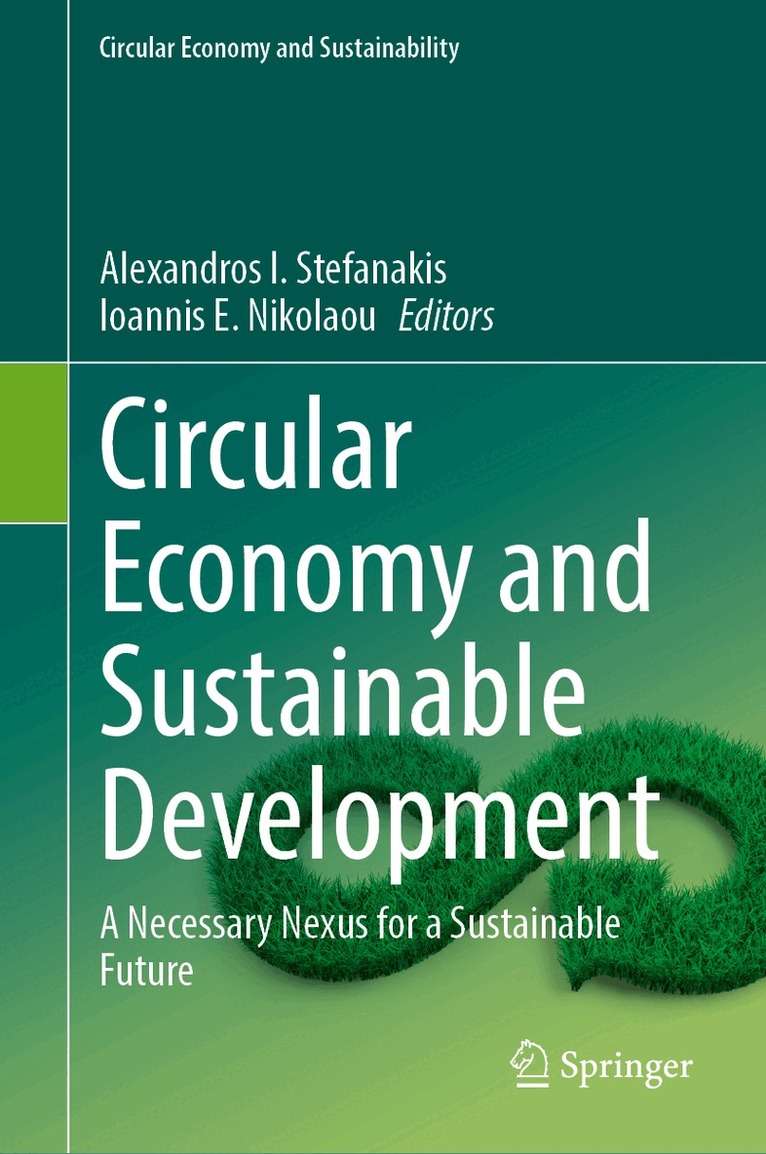
    Circular Economy and Sustainable Development

    A Necessary Nexus for a Sustainable Future

    AvAlexandros I. Stefanakis,Ioannis E. Nikolaou

    Inbunden, Engelska, 2024

    Del i serien Circular Economy and Sustainability

    2 165 kr

    Beställningsvara. Skickas inom 10-15 vardagar. Fri frakt över 249 kr.

    Beskrivning

    This book will highlight the role of CE in the sustainability field as it is expressed in the various fields and disciplines and its contribution to building a sustainable society by providing a better understanding of the relevant social and cultural structures and the need for cross-disciplinary knowledge and diverse skills. Such an integrated approach which combines the concept of sustainability in the engineering field to create a CE, has not yet been presented in detail in the published literature, and there are only scattered studies covering only small parts of this holistic approach. Hence, this book will represent a single reference that will provide summarized information and state-of-the-art knowledge on this topic of the future. The book will include chapters showcasing/investigating the relation between circular economy principles and their realization in different engineering fields. This includes theoretical justification, research studies and full-scale case studies. The approach focuses on two distinct levels: macro and micro, on both production and consumption sides.

    Produktinformation

    • Utgivningsdatum:2024-10-23
    • Mått:155 x 235 x 45 mm
    • Vikt:1 256 g
    • Format:Inbunden
    • Språk:Engelska
    • Serie:Circular Economy and Sustainability
    • Antal sidor:725
    • Förlag:Springer International Publishing AG
    • ISBN:9783031660061

    Utforska kategorier

    • Miljövetenskap och miljöpolitik inom Naturvetenskap och teknik
    • Sociologi inom Samhälle och politik
    • Ekonomiska system inom Ekonomi och Ledarskap

    Mer om författaren

    Alexandros I. Stefanakis is an Assistant Professor at the School of Chemical and Environmental Engineering, Technical University of Crete, Greece. He is the elected President of the International Ecological Engineering Society. His expertise lies in ecological engineering and technology, specifically in nature-based solutions for sustainable water and wastewater management. He is known as an expert and enthusiast of the green technology of constructed wetlands. He studies and investigates the role of nature-based solutions in a circular water economy.Ioannis E. Nikolaou is an Associate Professor of Corporate Environmental Management and Performance in the Department of Environmental Engineering, Democritus University of Thrace, Greece. His current work focuses on linking knowledge-based views of firms with corporate environmental management and engineering, circular business models, as well as developing essential system dynamic models to explain strategic alliances of firms to face contemporary environmental challenges.

    Innehållsförteckning

    • Chapter 1. The Circular Economy concept: A new or an old, refreshed concept?.- Chapter 2. The Circular Economy Design and Energy Innovation for Industries in 2060.- Chapter 3. The contribution of implementing Circular economy to the sustainable development goals:  Findings from a case study.- Chapter 4. Skills and jobs in demand for the circular economy.- Chapter 5. Sustainable Business through Circularity: A Practical Framework for Small- and Medium-sized Enterprises in Europe.- Chapter 6. Sustainable Fashion and Circular Economy: Historical Trends and Future Orientations.- Chapter 7. The role of Logistics in the Circular Economy: An incompatible or inevitable synergy.- Chapter 8. Analysing Circular Economy using Circularity Metrics in Europe: Towards a Sustainable Development.- Chapter 9. The role of engineering design methodologies for new circular business models: A sustainable finance challenge.- Chapter 10. Unravelling transition pathways (1): Conceptually clarifying the construct of events.- Chapter 11. Unravelling transition pathways (2): Conceptually clarifying the construct of patterns.- Chapter 12. Acting Innovation through Efficient Solutions for a Sustainable Future.- Chapter 13. Population growth, consumption, technological innovation and environmental sustainability.- Chapter 14. A review of social challenges of green hydrogen economy and its realization towards sustainable development goals.- Chapter 15. Creating Systematic Change: The Role of Social Entrepreneurship in Circular Economy.- Chapter 16. Integrated life cycle sustainability assessment- A necessary nexus for implementing circular economy principles and accomplishing sustainable development goals.- Chapter 17. An integrated Lifecycle Sustainability Assessment framework for product lifecycle-oriented decision making.- Chapter 18. Digital Technology and Acceleration of the Circular Economy.- Chapter 19. Blockchain Technology Toward a Circular Economy: A Future Paradigm.- Chapter 20. Segregations in sustainability-oriented policy framework as circular economy stumbling stones: Waste recovery suitability analysis and critical review of the EU legislation.- Chapter 21. Applying Circular Economy paradigm for preventing marine plastic pollution in Kenya: Opportunities and challenges.- Chapter 22. Use of Agricultural Wastes for Developing Planet-friendly Biodegradable Packaging.- Chapter 23. The Role of Biochar in the Era of Ecological Sustainability.- Chapter 24. Environmentally sound recycling of e-waste: A sustainable method toward a more resource-efficient circular economy.- Chapter 25. Waste Management for the Recovery of Agricultural Nutrients: A Case Study of Ethanol Vinasse.- Chapter 26. Lithium-ion battery processes from a Circular Economy point of view.- Chapter 27. Recovery of raw materials and obtaining functional carbonaceous materials from the circular economy of organic waste.- Chapter 28. A Comparative Review of Environmental Impact of Menstrual Waste Management in Indian & Global Scenario with a focus upon Single Use Conventional Sanitary Products.- Chapter 29. Industrial Symbiosis: A Suggested Example for Wastewater Reuse.- Chapter 30. Public participation of small-scale farmers to advance the sustainability of Payments for Ecosystem Services: a case study in a Brazilian watershed.- Chapter 31. The sustainable school. Humankind can grow in a Circular Environment. Which is the challenge of circular education for a change in future generations?.- Chapter 32. Recent Developments of 3R Activities in Indonesia.- Chapter 33. How power dynamics influence the transition towards a circular flexible packaging value chain in Jakarta.- Chapter 34. Fast Fashion and Circular Economy: Insights from Corporate Social Responsibility Report Evaluation.- Chapter 35. Cleaner Production in Multivariate Supply Chain Networks: Sustainable Business Future through a “Roll of Dice”.- Chapter 36. Rethinking Economic growth, full employment and decent work in the 2030 Sustainable Development Agenda: The means and ends in SDG 8.- Chapter 37. Doughnut Cities: Businesses as Enablers for Nature-Based Solutions and Net-Zero Transitions.- Chapter 38. Exploring the Nexus between Bioeconomy and Sustainability: Towards a Sustainable and Circular Bioeconomy Enabled by Innovation.