• Fri frakt över 249 kr
  • •
  • Snabba leveranser
  • •
  • Billiga böcker
Kundservice

Du är på sajten för privatpersoner.

Företag, bibliotek eller offentlig verksamhet?

Du handlar på classic.bokus.com, där alla dina funktioner finns intakta.
Till classic.bokus.com
Bokus logotyp. Gå till startsidan.
  • Erbjudanden
  • Nyheter
  • Student
  • Topplistor
  • Barn & ungdom
  • Bokus Play
  • E-böcker
  • Pocketböcker
  • Spel & pussel

10% studentrabatt med kod TERM26

Sidfot

Mina sidor

    Hjälp

    • Kundservice
    • Vanliga frågor och svar
    • Frakt och leverans
    • Retur vid ångerrätt
    • Reklamera vara
    • Betalning
    • Köpvillkor
    • Allmänna villkor
    • Information om webbplatsens tillgänglighet

    Om Bokus

    • Om oss
    • Pressrum
    • För studenter
    • För företag
    • För bibliotek och offentlig verksamhet
    • För leverantörer
    • Hållbarhet

    Populärt

    • Aktuella erbjudanden
    • Presentkort
    • Studentlitteratur
    • Nya böcker
    • Topplistor
    • Signerade böcker
    • Engelska böcker

    Inspiration

    • Boktips
    • BookTok
    • Populära bokserier
    • Barnbokskaraktärer
    • Populära författare
    Logotyp för Bokus
    Följ oss på Facebook (extern länk)Följ oss på Instagram (extern länk)Följ oss på YouTube (extern länk)Följ oss på TikTok (extern länk)
    bokus @ CookiesAnpassa cookiesIntegritetspolicyKöpvillkor
    Till Citymail hemsida (extern länk)Till Budbee hemsida (extern länk)Till Postnord hemsida (extern länk)Till Schenker hemsida (extern länk)Till Early Bird hemsida (extern länk)Till Walleys hemsida (extern länk)
    1. Ekonomi och Ledarskap
    2. Företagsekonomi
    3. Entreprenörskap

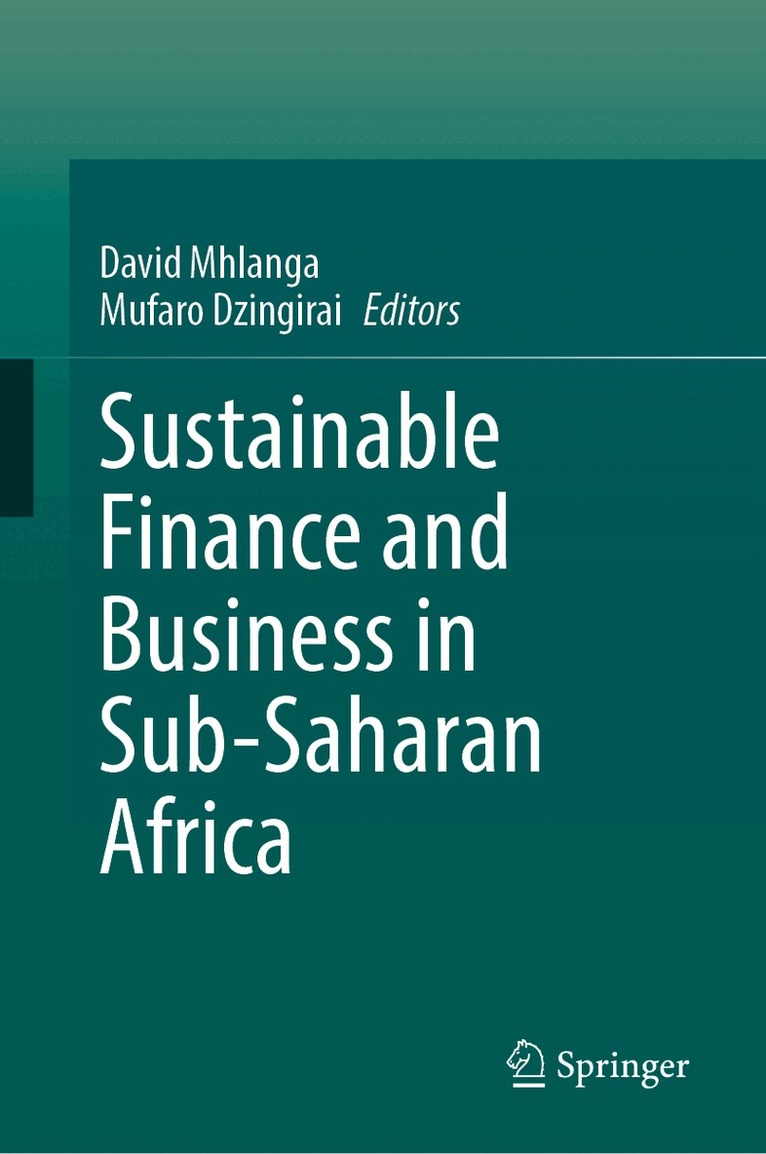
    Sustainable Finance and Business in Sub-Saharan Africa

    AvDavid Mhlanga,Mufaro Dzingirai

    Inbunden, Engelska, 2024

    2 394 kr

    Beställningsvara. Skickas inom 10-15 vardagar. Fri frakt över 249 kr.

    Beskrivning

    In the 21st century, the imperative for sustainable development has assumed a paramount role, echoing the pressing global concerns surrounding environmental degradation, social inequalities, and economic challenges. Within this context, Sub-Saharan Africa emerges as a region of particular significance, where the pursuit of sustainability holds immense promise and relevance. Despite being endowed with abundant natural resources and a vibrant entrepreneurial spirit, Sub-Saharan Africa grapples with enduring issues of poverty, inequality, and environmental harm. This book explores the innovative paradigms of sustainable finance and business within Sub-Saharan Africa, exploring how novel approaches can effectively tackle the region's most pressing challenges while simultaneously catalyzing economic growth and societal progress. The chapters presented here comprise a diverse array of cutting-edge financial strategies, circular economy initiatives, technological advancements, and business models that are revolutionizing sustainable development across the continent.Sub-Saharan Africa, characterized by its youthful demographic and rapidly expanding economies, is poised for transformation. Yet, it confronts formidable obstacles in the form of poverty, inequality, and environmental degradation. The United Nations' Sustainable Development Goals (SDGs) offer a comprehensive framework to address these issues. However, realizing these objectives requires innovative solutions that can surmount the unique constraints of the region. Fortunately, Sub-Saharan Africa is a crucible of innovation, with a growing community of entrepreneurs, financiers, and decision-makers committed to sustainable development. Initiatives promoting circular economies are reducing waste and enhancing resource efficiency, while financial instruments like impact investing and green bonds are attracting new streams of funding. Simultaneously, technological breakthroughs such as mobile payment systems and renewable energy solutions are expanding access to essential services and driving economic expansion. Despite these encouraging advancements, Sub-Saharan Africa stands at a pivotal juncture in its journey towards sustainability. This book, with a focus on practical and scalable solutions, endeavors to showcase the most promising and successful models that can propel sustainable development across the region.

    Produktinformation

    • Utgivningsdatum:2024-12-14
    • Mått:155 x 235 x 32 mm
    • Vikt:1 032 g
    • Format:Inbunden
    • Språk:Engelska
    • Antal sidor:509
    • Förlag:Springer International Publishing AG
    • ISBN:9783031740497

    Utforska kategorier

    • Entreprenörskap inom Ekonomi och Ledarskap
    • Internationell ekonomi inom Ekonomi och Ledarskap
    • Miljövetenskap och miljöpolitik inom Naturvetenskap och teknik

    Mer om författaren

    David Mhlanga is a Professor at the University of Johannesburg, South Africa.  His research topics include financial inclusion, poverty studies, Industry 4.0 and the application of emerging technologies(AI, Blockcjain) in Business, Economics and Finance. His more expansive subject areas include development economics, the economics of artificial intelligence, health, and education economics. He is the author of several books.Mufaro Dzingirai (Ph.D) is a seasoned researcher who is interested in sustainable development, finance, entrepreneurship and strategic management. He publishes in high-impact journals accredited by Scopus and also reviewed many Scopus-indexed scientific papers.

    Innehållsförteckning

    • Chapter 1: Sustainable Finance and Business in Sub-Saharan Africa an Introduction.- Chapter 2: Tracing the Journey of Sustainability Practices, the Historical Evolution through the Industrial Revolutions.- Chapter 3: Fostering Growth in African Frontier Financial Markets through Sustainable Finance, Opportunities and Mechanisms.- Chapter 4: An Analysis of the Factors Influencing Presumptive Taxation Compliance in the Zimbabwean Retail Sector.- Chapter 5: Financial Literacy and Financial Sustainability of Micro-Businesses at Bokamoso Entrepreneurial Centre in Namibia.- Chapter 6: Financial Sustainability Constraints facing Namibian Local Authorities: A Comparative Study.- Chapter 7: The Carbon Credits Controversy in Rural Communities in Africa: A Solution or Problem  to  Fostering Climate Change Mitigation and Economic Sustainability?.- Chapter 8: The Role of Technology as An Anchor for Economists, Accountants and Business Professionals in Business Recovery.- Chapter 9: Bridging the Sustainable Finance Gap, A Comparative Analysis of Africa and Asia within the Global Context.- Chapter 10: Green Finance and the Evolution of Financial Markets in Sub-Saharan Africa: A Comprehensive Analysis.- Chapter 11: Multilateral Development Banks and Sustainable Finance in Africa.- Chapter 12: Promoting Sustainable Finance for Enhanced Economic Growth in Sub-Saharan Africa.- Chapter 13: Strengthening Sustainable Finance in Africa, Regulatory Frameworks and Policy Directions.- Chapter 14: Impact of Internal Savings and Lending Schemes on the Growth of Female-owned Micro, Small to Medium Enterprises in Rural Zimbabwe.- Chapter 15: Leveraging Artificial Intelligence for Enhanced Credit Risk Management: Case of Zimbabwe's Commercial Banks.- Chapter 16: Blockchain and Crowdfunding for Renewable Energy Projects in Africa.- Chapter 17: Group Lending Dynamics and Enhancing Financial Access for the Underbanked, Lessons for Africa.- Chapter 18: Sustainable Finance and Sustainable Businesses in Africa.- Chapter 19: An ICT Strategy to Enhance Sustainability in Orphans and Vulnerable Children Non-Governmental Organisations in Zimbabwe.- Chapter 20: Challenges Faced by Green Entrepreneurs during Turbulent Times: Evidence from Zimbabwean SMEs.- Chapter 21: Augmented Reality and Consumer Experiences.- Chapter 22: The Digital Evolution of Global Tourism and the Practical Lessons for African Small Businesses.- Chapter 23: Promoting Sustainable Finance for Enhanced Economic Growth in Sub-Saharan Africa.- Chapter 24: Sustainable Finance and Business in Sub-Saharan Africa a Conclusion.