• Fri frakt över 249 kr
  • •
  • Snabba leveranser
  • •
  • Billiga böcker
Kundservice

Du är på sajten för privatpersoner.

Företag, bibliotek eller offentlig verksamhet?

Du handlar på classic.bokus.com, där alla dina funktioner finns intakta.
Till classic.bokus.com
Bokus logotyp. Gå till startsidan.
  • Erbjudanden
  • Nyheter
  • Student
  • Topplistor
  • Barn & ungdom
  • Bokus Play
  • E-böcker
  • Pocketböcker
  • Spel & pussel

10% rabatt på allt med kod: NYSTART10 →

Sidfot

Mina sidor

    Hjälp

    • Kundservice
    • Vanliga frågor och svar
    • Frakt och leverans
    • Retur vid ångerrätt
    • Reklamera vara
    • Betalning
    • Köpvillkor
    • Allmänna villkor
    • Information om webbplatsens tillgänglighet

    Om Bokus

    • Om oss
    • Pressrum
    • För studenter
    • För företag
    • För bibliotek och offentlig verksamhet
    • För leverantörer
    • Hållbarhet

    Populärt

    • Aktuella erbjudanden
    • Presentkort
    • Studentlitteratur
    • Nya böcker
    • Topplistor
    • Signerade böcker
    • Engelska böcker

    Inspiration

    • Boktips
    • BookTok
    • Populära bokserier
    • Barnbokskaraktärer
    • Populära författare
    Logotyp för Bokus
    Följ oss på Facebook (extern länk)Följ oss på Instagram (extern länk)Följ oss på YouTube (extern länk)Följ oss på TikTok (extern länk)
    bokus @ CookiesAnpassa cookiesIntegritetspolicyKöpvillkor
    Till Citymail hemsida (extern länk)Till Budbee hemsida (extern länk)Till Postnord hemsida (extern länk)Till Schenker hemsida (extern länk)Till Early Bird hemsida (extern länk)Till Walleys hemsida (extern länk)
    1. Djur och Natur
    2. Naturböcker
    3. Växtböcker

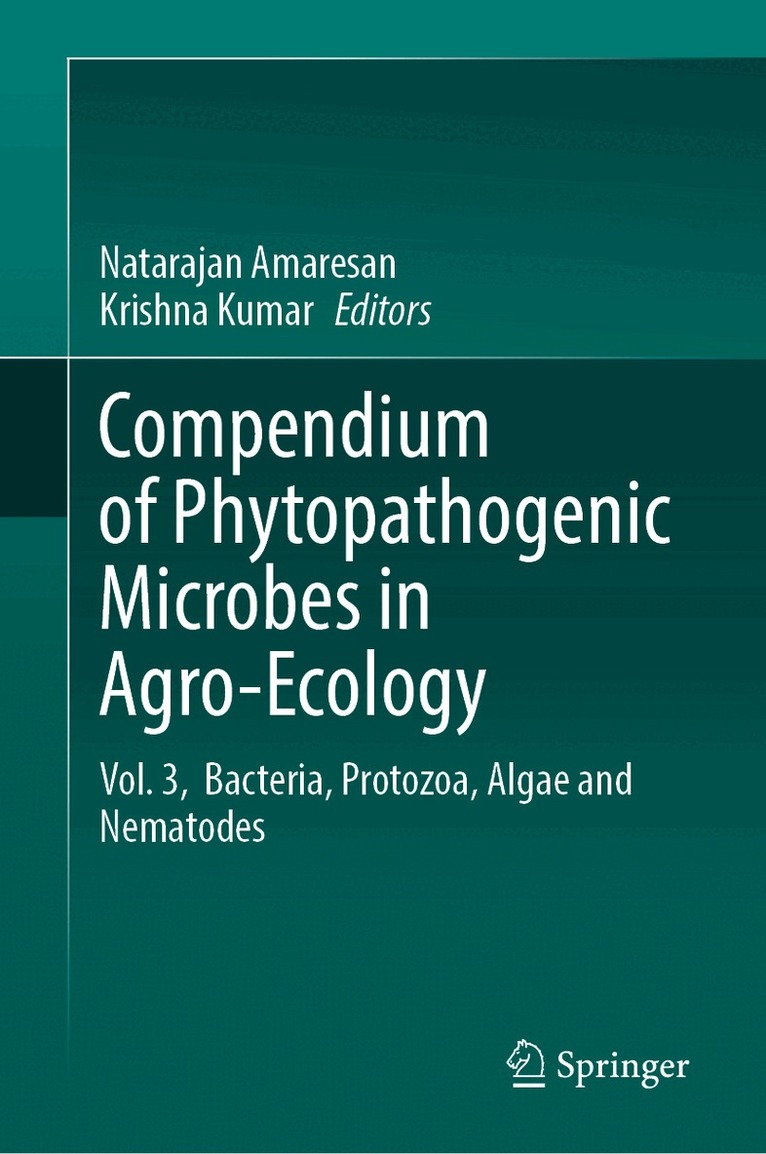
    Compendium of Phytopathogenic Microbes in Agro-Ecology

    Vol. 3, Bacteria, Protozoa, Algae and Nematodes

    AvNatarajan Amaresan,Krishna Kumar

    Inbunden, Engelska, 2025

    3 029 kr

    Beställningsvara. Skickas inom 10-15 vardagar. Fri frakt över 249 kr.

    Beskrivning

    This book offers an in-depth exploration of phytopathogenic bacteria, nematodes, protozoa, and algae within the context of agroecology. Each chapter meticulously details the introduction, taxonomy, and diseases caused by these pathogens, alongside their pathogenic mechanisms, economic significance, and strategies for identification and control. By providing comprehensive insights into these topics, the book empowers researchers to manipulate these pathogens to suit their needs.Key concepts covered include the economic impact of plant pathogens on yield loss, the pathogenic cycles of various microbes, and effective control measures. The book's expert contributors present a thorough analysis of 104 plant pathogens, organized into distinct microbial groups. This volume is an essential resource for understanding the complex interactions between pathogens and their host plants, offering valuable knowledge for developing sustainable agricultural practices.This book is an indispensable resource for postgraduate students, research scholars, post-doctoral fellows, and educators in fields such as Plant Microbiology, Plant Pathology, Bacteriology, Protozoology, Algology, and Nematology. As the third volume in a comprehensive three-volume compendium, it provides critical insights into the economic importance of pathogens and their role in yield loss, making it a must-have for anyone involved in plant sciences.

    Produktinformation

    • Utgivningsdatum:2025-04-23
    • Mått:155 x 235 x 44 mm
    • Vikt:1 224 g
    • Format:Inbunden
    • Språk:Engelska
    • Antal sidor:701
    • Förlag:Springer International Publishing AG
    • ISBN:9783031819988

    Utforska kategorier

    • Växtböcker inom Djur och Natur
    • Botanik inom Naturvetenskap och teknik
    • Agronomi inom Naturvetenskap och teknik

    Mer om författaren

    Dr. N. Amaresan is an Associate Professor at C.G. Bhakta Institute of Biotechnology, Uka Tarsadia University, Gujarat. He has over sixteen years of experience in teaching & research in various allied fields of microbiology mainly plant-microbe interactions, bioremediation, plant pathology and others. He has been awarded young scientist awards by Association of Microbiologists of India and National Academy of Biological Sciences. He also been awarded visiting scientist fellowship from National Academy of India to learn advanced techniques. He has published more than 180 research articles, book chapters and books of national and international reputes. He also deposited over 550 16S rDNA, 28S rDNA and ITS rDNA sequences in the Genbank (NCBI, EMBL & DDBJ) and also preserved over 150 microbial germplasm in various culture collection centres of India. He has successfully completed research projects from national funding agencies such as DBT, SERB-DST, GUJCOST, UTU, & GEMI and guided students for their doctoral and master degrees.Dr. Krishna Kumar obtained Ph. D. degree in Plant Pathology from NDUAT, Faizabad, India. He worked as a Research Associate at IARI, New Delhi, Assistant Professor at SKUAST, Jammu, Senior Scientist and Principal Scientist at Central Agricultural Research Institute, Port Blair, Principal Scientist at IARI, New Delhi, Head, Division of Crop Protection at Indian Institute of Pulses Research (IIPR), Kanpur, and Dean of Pandit Deendayal Upadhyay College of Horticulture & Forestry, Bihar. Presently he is a Principal Scientist, Division of Crop Protection at Indian Institute of Pulses Research (IIPR), Kanpur. He has over 27 years of research, teaching and extension experience in the field of Plant Pathology, bio-control, microbial diversity, integrated disease management, and diagnosis of unknown plant diseases. He has handled several projects on crop protection funded by various funding agencies. He is a recipient of Fakhruddin Ali Ahmed Award for Outstanding Research in Tribal Farming Systems-2010 by Indian Council of Agricultural Research, New Delhi, India, SPPS Meritorious Scientist Award-2011 by Society of Plant Protection Sciences, New Delhi, India and Distinguished Service Award-2010 for his contribution in Plant Pathology by BIOVED Research Society, Allahabad, Uttar Pradesh, India. He is a fellow of three prestigious professional societies and life member of 12 scientific societies. He has published over 135 research papers includes books, chapters, popular articles, extension bulletins, and various training manuals in National and International level. He also deposited 42 microorganisms at National Bureau of Agriculturally Important Microorganisms (NCBI) and submitted 400 sequences of them to NCBI. He delivered several radio talks and TV shows on different topics for the benefit of farming community.

    Innehållsförteckning

    • Part 1: Plant diseases caused by bacteria.- Chapter 1. Acidovorax.- Chapter 2. Burkholderia.- Chapter 3. Dickeya.- Chapter 4. Leifsonia.- Chapter 5. Liberibacter.- Chapter 6. Pectobacterium.- Chapter 7. Phytoplasma.- Chapter 8. Pseudomonas.- Chapter 9. Ralstonia.- Chapter 10. Rickettsia.- Chapter 11. Spiroplasma.- Chapter 12. Streptomyces.- Chapter 13. Xanthomonas.- Chapter 14. Xylella.- Chapter 15. Xylophilus.- Part 2.  Plant diseases caused by nematodes.- Chapter 16. Anguina.- Chapter 17. ​Aphelenchoides.- Chapter 18. Belonolaimus.- Chapter 19. Bursaphelenchus.- Chapter 20. Ditylenchus.- Chapter 21. Globodera.- Chapter 22. Helicotylenchus.- Chapter 23. Heterodera.- Chapter 24. Hirschmanniella.- Chapter 25. Meloidogyne.- Chapter 26. Nacobbus.- Chapter 27. Pratylenchus.- Chapter 28. Radopholus.- Chapter 29. Rotylenchulus.- Chapter 30. Trichodorus and Paratrichodorus.- Chapter 31. Tylenchulus.- Part 3. Plant diseases caused by protozoa.- Chapter 32. Phytomona.- Chapter 33. Plasmodiophora.- Chapter 34. Spongospora.- Part 4. Plant diseases caused by algae.- Chapter 35. Trentepohlia.