• Fri frakt över 249 kr
  • •
  • Snabba leveranser
  • •
  • Billiga böcker
Kundservice

Du är på sajten för privatpersoner.

Företag, bibliotek eller offentlig verksamhet?

Du handlar på classic.bokus.com, där alla dina funktioner finns intakta.
Till classic.bokus.com
Bokus logotyp. Gå till startsidan.
  • Erbjudanden
  • Nyheter
  • Student
  • Topplistor
  • Barn & ungdom
  • Bokus Play
  • E-böcker
  • Pocketböcker
  • Spel & pussel

10% rabatt på allt med kod: NYSTART10 →

Sidfot

Mina sidor

    Hjälp

    • Kundservice
    • Vanliga frågor och svar
    • Frakt och leverans
    • Retur vid ångerrätt
    • Reklamera vara
    • Betalning
    • Köpvillkor
    • Allmänna villkor
    • Information om webbplatsens tillgänglighet

    Om Bokus

    • Om oss
    • Pressrum
    • För studenter
    • För företag
    • För bibliotek och offentlig verksamhet
    • För leverantörer
    • Hållbarhet

    Populärt

    • Aktuella erbjudanden
    • Presentkort
    • Studentlitteratur
    • Nya böcker
    • Topplistor
    • Signerade böcker
    • Engelska böcker

    Inspiration

    • Boktips
    • BookTok
    • Populära bokserier
    • Barnbokskaraktärer
    • Populära författare
    Logotyp för Bokus
    Följ oss på Facebook (extern länk)Följ oss på Instagram (extern länk)Följ oss på YouTube (extern länk)Följ oss på TikTok (extern länk)
    bokus @ CookiesAnpassa cookiesIntegritetspolicyKöpvillkor
    Till Citymail hemsida (extern länk)Till Budbee hemsida (extern länk)Till Postnord hemsida (extern länk)Till Schenker hemsida (extern länk)Till Early Bird hemsida (extern länk)Till Walleys hemsida (extern länk)
    1. Samhälle och politik
    2. Politik och statsskick
    3. Centralt styre och förvaltning

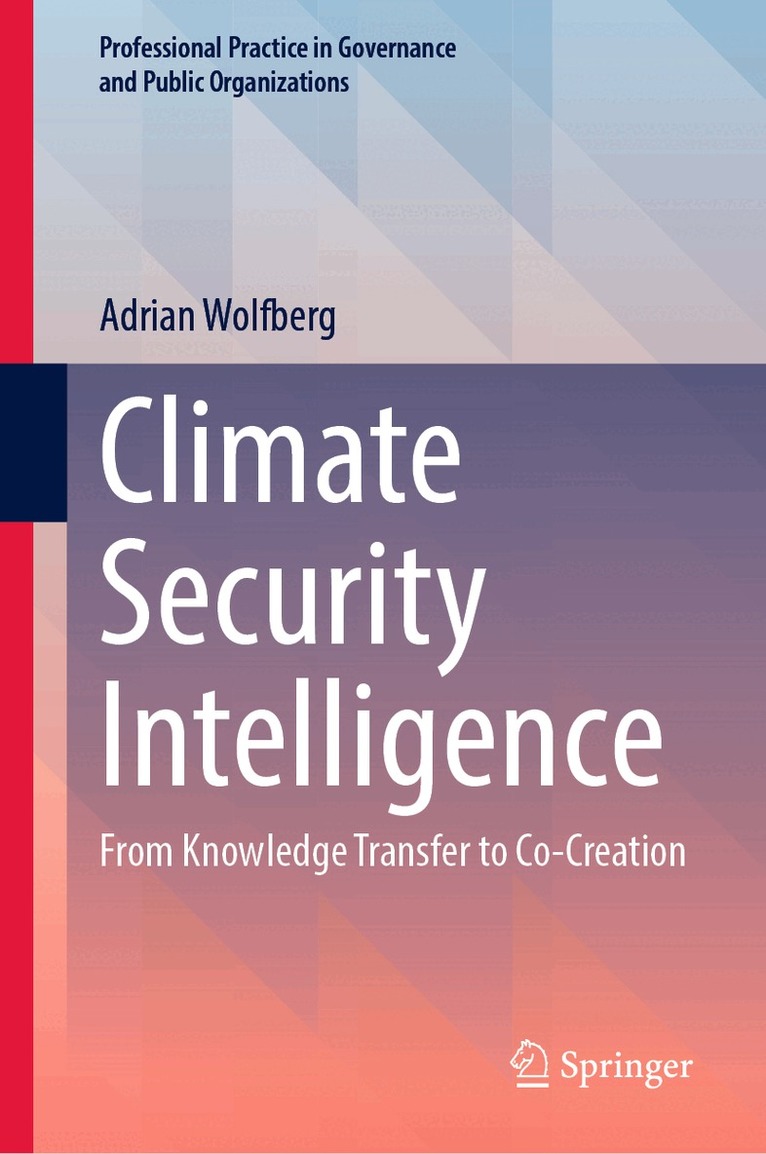
    Climate Security Intelligence

    From Knowledge Transfer to Co-Creation

    AvAdrian Wolfberg

    Inbunden, Engelska, 2025

    Del i serien Professional Practice in Governance and Public Organizations

    1 301 kr

    Beställningsvara. Skickas inom 5-8 vardagar. Fri frakt över 249 kr.

    Fler format och utgåvor

    E-bok

    1 728 kr

    Häftad

    924 kr

    Beskrivning

    Climate security intelligence is the capacity to warn national and sub-national security organizations of the physical effects of climate change that can have a negative societal effect on nations, governments, and their populations. This book discusses the uniqueness of climate security intelligence, the maturity of its development as a knowledge domain, and its possible future. Written by an intelligence analyst with over forty years of experience, this book centers upon the challenges that organizations may face when analysts, their managers, and their organizations are given the task of warning policymakers and decision-makers about threats to climate security. Taking a necessarily transdisciplinary approach, this book will be of interest to a wide audience of students, researchers, practitioners, and policy-makers concerned with how the impacts of climate change affect the social, cultural, political, and economic stability of national interests.

    Produktinformation

    • Utgivningsdatum:2025-04-23
    • Mått:155 x 235 x 31 mm
    • Vikt:850 g
    • Format:Inbunden
    • Språk:Engelska
    • Serie:Professional Practice in Governance and Public Organizations
    • Antal sidor:436
    • Förlag:Springer International Publishing AG
    • ISBN:9783031862588

    Utforska kategorier

    • Centralt styre och förvaltning inom Samhälle och politik
    • Organisationsteori inom Ekonomi och Ledarskap
    • Offentlig förvaltning inom Samhälle och politik

    Mer om författaren

    Adrian Wolfberg is the founder of Organizational Insight Consulting LLC and an adjunct professor at Case Western Reserve University’s Weatherhead School of Management. He has four decades of combined experience as a naval officer, intelligence officer, change agent, boundary spanner, scholarly researcher, and educator. As a naval officer, he was trained as an airborne electronic intelligence officer collecting and analyzing electromagnetic signals from weapon-associated radars on adversary ground-, sea-, and air-based systems. He flew intelligence gathering missions from aircraft carrier-based reconnaissance aircraft and, then, assigned as an Indications & Warning officer assigned to the Joint Staff Intelligence Directorate. He was employed by Defense Intelligence Agency (DIA) as a civilian intelligence analyst where he was a counterdrug analyst. While at DIA, he created and led an internal organizational consulting capability called the DIA Knowledge Lab. Its purpose was to help intelligence officers in the organization—regardless of seniority or formal position—learn how to help themselves in order to solve or make progress solving intractable problems. While assigned to DIA, he graduated from the National War College, spent four years supporting the Office of National Drug Control Policy, four years teaching at the United States Army War College, and two years conducting research at the National Intelligence University. He earned a Ph.D. in organizational science from Case Western Reserve University. Adrian’s scholarly research has focused on factors that affect the intelligence analyst’s ability to create and communicate knowledge, and how consumers of intelligence receive and absorb knowledge. His experiences as an intelligence analyst, leading the DIA Knowledge Lab, and his scholarly research have addressed the challenges of confronting and navigating different knowledge boundaries.

    Innehållsförteckning

    • Introduction.- Scope and motivation.- Difference between climate security and climate change.- Difference between climate threats and risks.- Framing Approach to Understand Developmental Efforts.- Framing climate security intelligence as unintentional threats.- Conventional framework for developing an intelligence capacity.- System level Developmental Efforts.- The demand signals.- Policy prioritizations and sustainability.- Budget process challenges.- Organizational-level Developmental Efforts.- Knowledge producing responsibilities.-Developing knowledge expertise.- Data collection strategies.- Establishing a community of partners.- Decision maker relationships.- Uniqueness of Climate Security Intelligence.-Applying the framework to an analog problem space.- Comparing the framework of the analog problem space to climate security.- A Way Forward.- Towards a learning based approach to climate security intelligence.- What climate security intelligence may look like.