• Fri frakt över 249 kr
  • •
  • Snabba leveranser
  • •
  • Billiga böcker
Kundservice

Du är på sajten för privatpersoner.

Företag, bibliotek eller offentlig verksamhet?

Du handlar på classic.bokus.com, där alla dina funktioner finns intakta.
Till classic.bokus.com
Bokus logotyp. Gå till startsidan.
  • Erbjudanden
  • Nyheter
  • Student
  • Topplistor
  • Barn & ungdom
  • Bokus Play
  • E-böcker
  • Pocketböcker
  • Spel & pussel

10% rabatt på allt med kod NYSTART10 →

Sidfot

Mina sidor

    Hjälp

    • Kundservice
    • Vanliga frågor och svar
    • Frakt och leverans
    • Retur vid ångerrätt
    • Reklamera vara
    • Betalning
    • Köpvillkor
    • Allmänna villkor
    • Information om webbplatsens tillgänglighet

    Om Bokus

    • Om oss
    • Pressrum
    • För studenter
    • För företag
    • För bibliotek och offentlig verksamhet
    • För leverantörer
    • Hållbarhet

    Populärt

    • Aktuella erbjudanden
    • Presentkort
    • Studentlitteratur
    • Nya böcker
    • Topplistor
    • Signerade böcker
    • Engelska böcker

    Inspiration

    • Boktips
    • BookTok
    • Populära bokserier
    • Barnbokskaraktärer
    • Populära författare
    Logotyp för Bokus
    Följ oss på Facebook (extern länk)Följ oss på Instagram (extern länk)Följ oss på YouTube (extern länk)Följ oss på TikTok (extern länk)
    bokus @ CookiesAnpassa cookiesIntegritetspolicyKöpvillkor
    Till Citymail hemsida (extern länk)Till Budbee hemsida (extern länk)Till Postnord hemsida (extern länk)Till Schenker hemsida (extern länk)Till Early Bird hemsida (extern länk)Till Walleys hemsida (extern länk)
    1. Samhälle och politik
    2. Samhälle och kultur
    3. Sociala och etiska frågor
    4. Migration

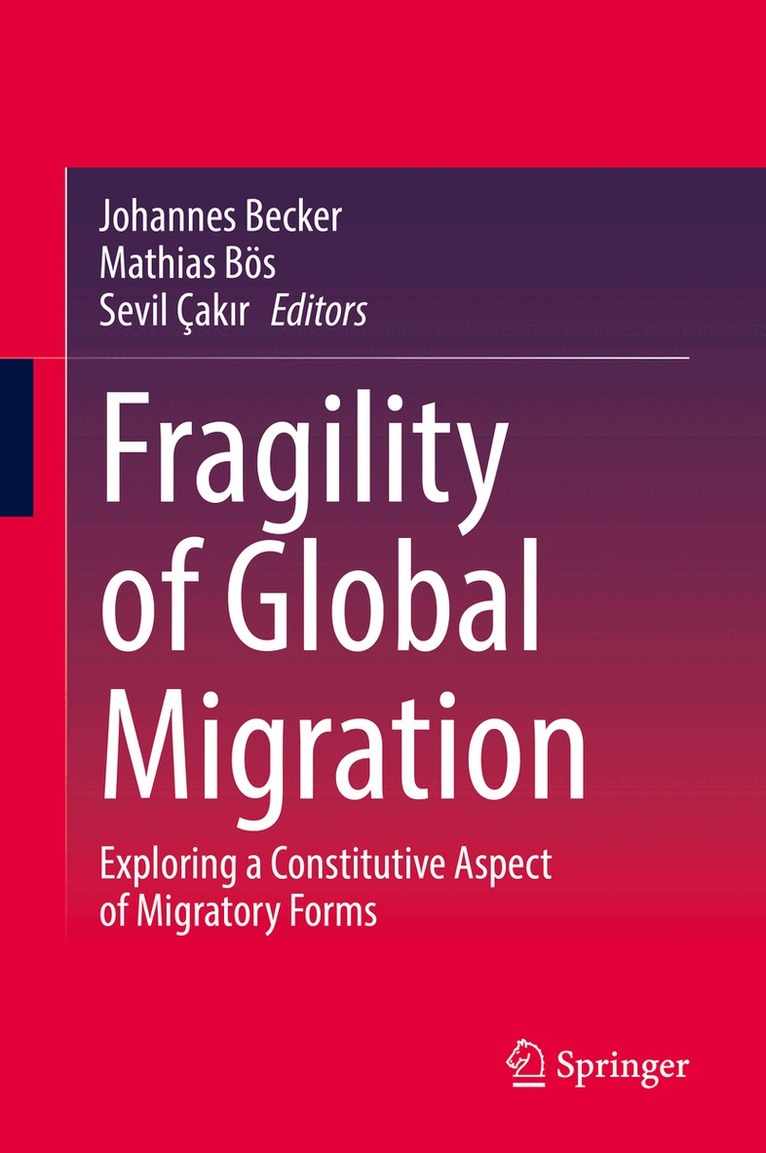
    Fragility of Global Migration

    Exploring a Constitutive Aspect of Migratory Forms

    AvJohannes Becker,Mathias Bös

    Inbunden, Engelska, 2025

    1 409 kr

    Beställningsvara. Skickas inom 10-15 vardagar. Fri frakt över 249 kr.

    Beskrivning

    This book demonstrates the analytical power of the concept of fragility as a central and defining aspect of global migration processes. To this end, the book brings together authors from the Americas, South Asia, the Middle East, and Europe, fostering a global dialogue on the social structuring of migration fragility in and between the Global North and the Global South. The various chapters of the book focus on two aspects. First, it discusses the multiplicity of the migrant as a social figure. There is not just one type of migrant, but a multiplicity of different fragile configurations that lead to the migrantization of people. Secondly, the same applies to the process of migration itself. There is a plethora of different articulations of fragility in crossing borders and organizing a new life somewhere else. Both perspectives show that the fragility of migration is not an aberration from “normality”. Fragility is an intrinsic part of the stabilization of social inequalities of migration between different migrants and different countries and regions of the globe. As such, this book is an important resource for researchers and students interested in the study of migration processes.

    Produktinformation

    • Utgivningsdatum:2025-05-30
    • Mått:155 x 235 x 17 mm
    • Vikt:469 g
    • Format:Inbunden
    • Språk:Engelska
    • Antal sidor:191
    • Förlag:Springer International Publishing AG
    • ISBN:9783031892912

    Utforska kategorier

    • Migration inom Samhälle och politik
    • Sociologi inom Samhälle och politik
    • Offentlig förvaltning inom Samhälle och politik

    Mer om författaren

    Johannes Becker is a research fellow at the Leibniz-Zentrum Moderner Orient (ZMO), Berlin, Germany. His research revolves around the relationship between biographies, history and space, especially in relation to cities, migration and family in the Middle East. He is the principal investigator of the research project “Migrant arrival contexts in transregional comparison” and co-convener of the scientific network “Qualitative social research and transregional theory-building in the context of global sociology(ies)”, both funded by the German Research Foundation (DFG). 2023-2027 he is the President of the RC38 “Biography and Society” in the International Sociological Association (ISA).Mathias Bös is a Professor of Sociological Theory at the Institute of Sociology, Leibniz University Hannover, Germany. He received his doctorate from Johann Wolfgang Goethe-University Frankfurt am Main, he habilitated at Ruprecht-Karls-University Heidelberg and held a professorship at Philipps-University Marburg. His main research interests are in the sociology of migration, race and ethnic relations, citizenship studies, global conflict dynamics, and cultural heritage in North Atlantic societies, as well as in the history of ideas in social sciences, especially in the USA.Dr. Sevil Çakır earned her Ph.D. in Middle Eastern studies from Leiden University in the Netherlands. Her research interests revolve around forced migration, social and political movements, gender, intersectionality, political violence and the Middle East. She has authored publications that cover diverse topics such as activism in exile, Kurdish migrant women in Germany, feminist methods in social movements, and women’s movements in Iran and Turkey. From 2018 to 2023, she worked as a research associate and lecturer at the Center for Methods of Social Sciences at the University of Göttingen, where she taught graduate seminars and lectures on social movements, intersectionality, research methods, and feminist methodologies. Her postdoctoral research examines the social and political activism, intersectional solidarity, and transnational activities of racialized migrant women in Germany.

    Innehållsförteckning

    • Chapter 1. Introduction.- Chapter 2. Observations on the fragility of global migration.- Chapter 3. Immobilized Markets: Perception, experience, and response of migration brokers to state-induced immobility.- Chapter 4. Fragile as a class: Marxist scholars’ views of the ‘Gastarbeiter’ in West Germany in the global 1970s.- Chapter 5. Contingency and fragility in mass immigration to São Paulo coffee economy (1880-1930).- Chapter 6. The neocolonial securitisation of mobilities: (Re)producing (in)fragilities, (in)securities, and (im)mobilities.- Chapter 7. Citizenship, local history and immigrant fragility: Reactions to Venezuelans, Northeasterners and Haitians in Brazil.- Chapter 8. Negotiating the citizenship-regime: Fragility and the example of sanctuary cities in the U.S.- Chapter 9. Intersectional solidarities in resisting intersectional fragilities: Kurdish migrant women’s activism in Germany.- Chapter 10. Family figurations becoming fragile in forced migration processes.