• Fri frakt över 249 kr
  • •
  • Snabba leveranser
  • •
  • Billiga böcker
Kundservice

Du är på sajten för privatpersoner.

Företag, bibliotek eller offentlig verksamhet?

Du handlar på classic.bokus.com, där alla dina funktioner finns intakta.
Till classic.bokus.com
Bokus logotyp. Gå till startsidan.
  • Erbjudanden
  • Nyheter
  • Student
  • Topplistor
  • Barn & ungdom
  • Bokus Play
  • E-böcker
  • Pocketböcker
  • Spel & pussel

10% studentrabatt med kod TERM26

Sidfot

Mina sidor

    Hjälp

    • Kundservice
    • Vanliga frågor och svar
    • Frakt och leverans
    • Retur vid ångerrätt
    • Reklamera vara
    • Betalning
    • Köpvillkor
    • Allmänna villkor
    • Information om webbplatsens tillgänglighet

    Om Bokus

    • Om oss
    • Pressrum
    • För studenter
    • För företag
    • För bibliotek och offentlig verksamhet
    • För leverantörer
    • Hållbarhet

    Populärt

    • Aktuella erbjudanden
    • Presentkort
    • Studentlitteratur
    • Nya böcker
    • Topplistor
    • Signerade böcker
    • Engelska böcker

    Inspiration

    • Boktips
    • BookTok
    • Populära bokserier
    • Barnbokskaraktärer
    • Populära författare
    Logotyp för Bokus
    Följ oss på Facebook (extern länk)Följ oss på Instagram (extern länk)Följ oss på YouTube (extern länk)Följ oss på TikTok (extern länk)
    bokus @ CookiesAnpassa cookiesIntegritetspolicyKöpvillkor
    Till Citymail hemsida (extern länk)Till Budbee hemsida (extern länk)Till Postnord hemsida (extern länk)Till Schenker hemsida (extern länk)Till Early Bird hemsida (extern länk)Till Walleys hemsida (extern länk)
    1. Samhälle och politik
    2. Samhälle och kultur
    3. Kultur och medier
    4. Referensverk och tvärvetenskap

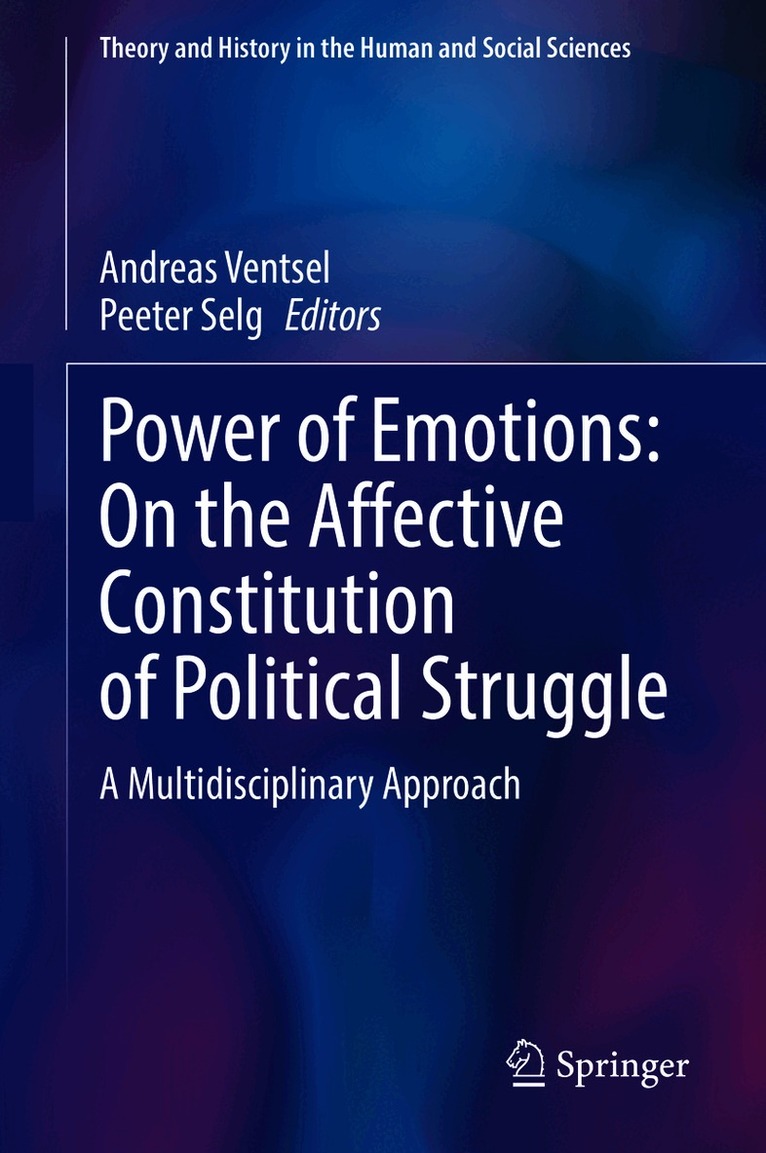
    Power of Emotions: On the Affective Constitution of Political Struggle

    A Multidisciplinary Approach

    AvAndreas Ventsel,Peeter Selg

    Inbunden, Engelska, 2025

    Del i serien Theory and History in the Human and Social Sciences

    1 895 kr

    Beställningsvara. Skickas inom 10-15 vardagar. Fri frakt över 249 kr.

    Beskrivning

    The emergence of political identities and communities in (social) media is largely driven by affective responses to current events—a tendency facilitated by the dominance of emotionally and visually oriented communication. However, this mode of community formation leads, first, to the inherent instability and transience of these groups and, second, to the oversimplification of complex socio-political issues into binary, yes/no alternatives. Within this framework, deliberation and argumentation-based problem-solving become increasingly difficult, as discourse is supplanted by emotional reactions that position individuals either “for” or “against” an issue. Particularly significant is the role of affect and emotion in communication during times of crisis—whether in the context of migration, the COVID-19 pandemic, or the war in Ukraine.This affective role is evident in the anchoring of public discourse to personal emotions and the generation and dissemination of hashtags and tags that consolidate diverse phenomena under a unified label. Such collective identity coalesces around connective action, which is primarily driven either by opposition to the established order or by the reinforcement of a preexisting system’s foundations. Consequently, the emergence of these affective publics must be analyzed within the broader context of power dynamics and evolving forms of identification in the contemporary media sphere—forms rooted in shared practices of expression, action, and interpretation.This edited volume will explore the manifestations of affective semiosis (meaning-making) at the socio-cultural and discursive levels. Cultural context, emotional reactions, and affective semiosis play a crucial role in shaping how issues related to identity and security are articulated in both domestic and foreign policy, as well as in the ways solutions to these challenges are sought. By adapting the concept of affective semiosis for the analysis of discursive structures, this volume offers an innovative and effective approach to identifying the triggers of emotional reactions in discourse and examining their impact on the construction of political identities, fear scenarios, misinformation campaigns, polarization, and other dynamics within networked societies.The volume includes both theoretically oriented papers as well as analyses of empirical materials.

    Produktinformation

    • Utgivningsdatum:2025-07-12
    • Mått:155 x 235 x 21 mm
    • Vikt:574 g
    • Format:Inbunden
    • Språk:Engelska
    • Serie:Theory and History in the Human and Social Sciences
    • Antal sidor:252
    • Förlag:Springer International Publishing AG
    • ISBN:9783031897405

    Utforska kategorier

    • Referensverk och tvärvetenskap inom Samhälle och politik
    • Socialpsykologi och gruppsykologi inom Psykologi och pedagogik
    • Statsvetenskap och politisk teori inom Samhälle och politik

    Mer om författaren

    Andreas Ventsel is a Professor of Political and Sociosemiotics in Department of Semiotics at Tartu University, Estonia. He holds an MA degree (University of Tartu, 2005) and a PhD (University of Tartu, 2009) in Semiotics. His research is interdisciplinary including semiotics, discourse theory, international relations, security studies, information influence studies and political analysis. Ventsel has presented the results of his research among other outlets in Media, War & Conflict, European Security, Armed Force & Society, Theory, Culture & Society, Social Semiotics, Semiotica and been the initiator and editor of several scientific journals, both Estonia-based and international. He is the author of the books Strategic Conspiracy Narratives: A Semiotic Approach (Routledge 2021, with Mari-Liis Madisson from the University of Tartu) and Introducing Relational Political Analysis: Political Semiotics as a Theory and Method (Palgrave Macmillan 2021, with Peeter Selg from Tallinn University). Ventsel is a member of International Association for Semiotic Studies, International Association for Visual Semiotics, International Surveillance Studies Network and Estonian Semiotic Society.Peeter Selg, PhD, is Professor of Governance and Political Analysis in the School of Governance, Law and Society at Tallinn University, Estonia. His main research interests include relational sociology, political semiotics, power, governance, and wicked problems. His work has been published among other outlets in Sociological Theory, PS: Political Science & Politics, Journal of Political Power, International Relations, International Review of Sociology, Social Semiotics, Journal of Language and Politics, Semiotica, and Sign Systems Studies. His recent books are titled Introducing Relational Political Analysis: Political Semiotics as a Theory and Method (Palgrave Macmillan 2021, with Andreas Ventsel, University of Tartu) and  A Relational Approach to Governing Wicket Problems: from Governance Failure to Failure Governance (Palgrave Macmillan 2023, with Georg Sootla and Benjamin Klasche from Tallinn University). He is the editor (with Nick Crossley from the University of Manchester) of the book series “Palgrave Studies in Relational Sociology”.

    Innehållsförteckning

    • PART I: Unpacking Affective Semiosis: The Intersection of Political Discourse, Semiotics, and Psychology.- Chapter 1: The passions-myths of a collective political actant.- Chapter 2: An appraisal perspective on public discourse.- Chapter 3: Political engagement and extremism. Observations from the interpretive social sciences.- Chapter 4: Politics of affect is the composition of bodies.- Chapter 5: Thinking about dialogues sustaining today’s conflictive world: Bakhtin’s ideas on laughter and carnival toward contradictive views.- PART II: Affective Publics: Emotion, Media, and Politics.- Chapter 6: The Pathemic Dimension of Knowledge. Semiotic Reflections on Trust.- Chapter 7: Affective atmospheres: collective emotions inside and outside the digital sphere.- Chapter 8: Emotional governmentality: visualising Estonia’s European ‘capitals’.- Chapter 9: Emotional Mediation in the Construction of Political Personae: Between Political Branding and Semiotic Construct”.- PART III: Affective Investment and Discursive Dominance in Political Communication.- Chapter 10: Affective Securitization of Emotions in Putin’s Russian WWII Narrative.- Chapter 11: The affective power of politics: Spheres of influence, justice, and peace in the Russo-Ukrainian War.- Chapter 12: Navigating Emotions: The Role of Affective Strategies in Russian History Narratives.- Chapter 13: Cultural Psychological Devices for Political Speeches: How to Make a Speech More Personal.