• Fri frakt över 249 kr
  • •
  • Snabba leveranser
  • •
  • Billiga böcker
Kundservice

Du är på sajten för privatpersoner.

Företag, bibliotek eller offentlig verksamhet?

Du handlar på classic.bokus.com, där alla dina funktioner finns intakta.
Till classic.bokus.com
Bokus logotyp. Gå till startsidan.
  • Erbjudanden
  • Nyheter
  • Student
  • Topplistor
  • Barn & ungdom
  • Bokus Play
  • E-böcker
  • Pocketböcker
  • Spel & pussel

10% rabatt på allt med kod: NYSTART10 →

Sidfot

Mina sidor

    Hjälp

    • Kundservice
    • Vanliga frågor och svar
    • Frakt och leverans
    • Retur vid ångerrätt
    • Reklamera vara
    • Betalning
    • Köpvillkor
    • Allmänna villkor
    • Information om webbplatsens tillgänglighet

    Om Bokus

    • Om oss
    • Pressrum
    • För studenter
    • För företag
    • För bibliotek och offentlig verksamhet
    • För leverantörer
    • Hållbarhet

    Populärt

    • Aktuella erbjudanden
    • Presentkort
    • Studentlitteratur
    • Nya böcker
    • Topplistor
    • Signerade böcker
    • Engelska böcker

    Inspiration

    • Boktips
    • BookTok
    • Populära bokserier
    • Barnbokskaraktärer
    • Populära författare
    Logotyp för Bokus
    Följ oss på Facebook (extern länk)Följ oss på Instagram (extern länk)Följ oss på YouTube (extern länk)Följ oss på TikTok (extern länk)
    bokus @ CookiesAnpassa cookiesIntegritetspolicyKöpvillkor
    Till Citymail hemsida (extern länk)Till Budbee hemsida (extern länk)Till Postnord hemsida (extern länk)Till Schenker hemsida (extern länk)Till Early Bird hemsida (extern länk)Till Walleys hemsida (extern länk)
    1. Naturvetenskap och teknik
    2. Teknik och industri
    3. Teknik: allmänt

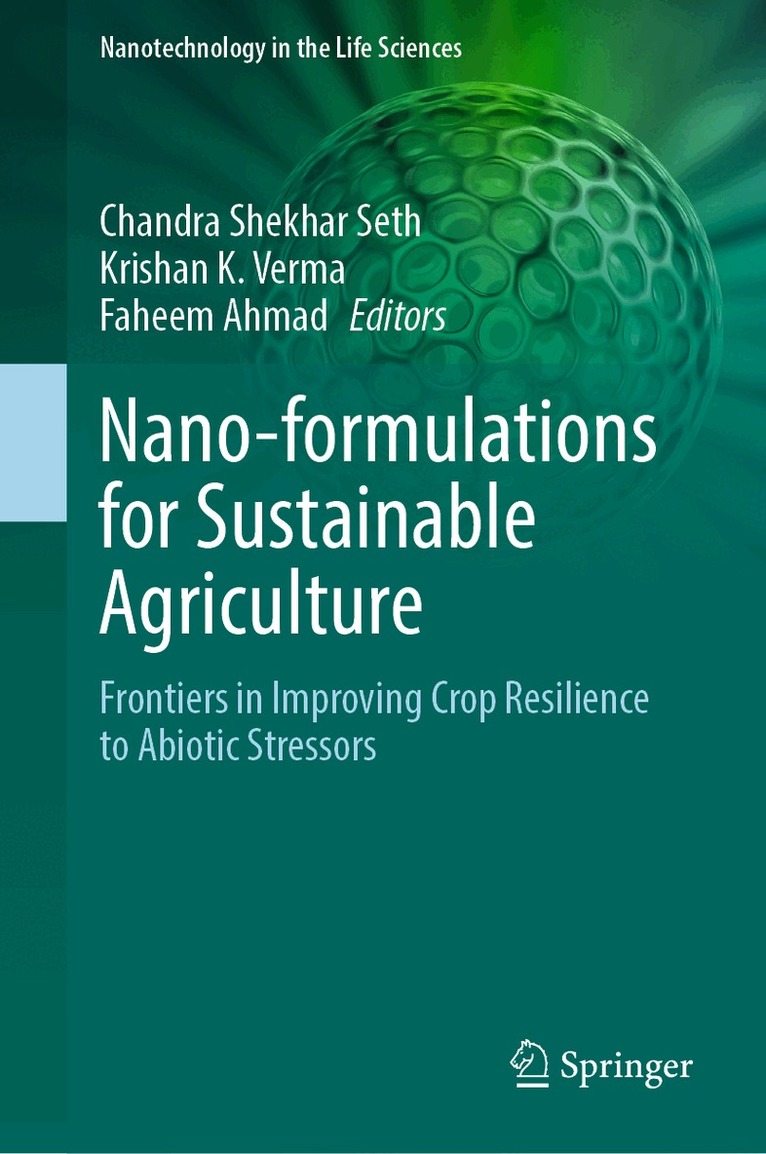
    Nano-formulations for Sustainable Agriculture

    Frontiers in Improving Crop Resilience to Abiotic Stressors

    AvChandra Shekhar Seth,Krishan K. Verma, Ph. D.

    Inbunden, Engelska, 2025

    Del i serien Nanotechnology in the Life Sciences

    2 165 kr

    Beställningsvara. Skickas inom 10-15 vardagar. Fri frakt över 249 kr.

    Beskrivning

    Global agricultural production faces various environmental stresses that affect crop growth and development. The response of plants to abiotic stresses and climate change depends on factors such as the type of crop, the type of stress, and the frequency and duration of exposure. Sustainable agriculture and crop production practices can help improve soil quality, water management, and other resources essential for plant growth. To meet the growing demand for food security and safety, scientific communities are working towards reducing the harmful effects of environmental stresses on crops, improving crop production, and ensuring food sustainability and security.Nanoscience is a fascinating and rapidly developing area of research that has led to major innovations. Nano-technology based formulations provide significant solutions to agro-ecosystems-related problems and achieve a sustainable and safe future for agriculture. Nanobiotechnology has attracted a lot of attention in recent years due to its large number of applications in different aspects. In sustainable agriculture, nanobiotechnology is mainly utilized in nano-fertilizers and nano pesticides to amplify the quality of output and level of nutrients for promoting growth, development, and productivity/ quality of grains/ fruits and enhancing plant stress resistance efficiency to unfavorable environmental conditions.Nanoformulatedmaterials offer the possibility to produce more effective and less damaging agrochemicals in the eco-environment. Smart delivery systems for nanosensors, molecules that may assist in finding environmental stressors before they can affect crop productivity/ quality, are being developed and applied. It provides advanced applications for the transformation of genetics. The application of nanoformulated particles in agriculture is being used to increase the value of foods, decrease agricultural inputs, upgrade nutrients delivery systems, and develop a longer shelf life for different products. It is important to discover the role of nanomaterials in mutation breeding, seedling growth and development, as well as their interaction with metabolites. This presents both opportunities and challenges that needs to be explored at the earliest.This book highlights the advanced strategies of these nanoformulated forms in the field of plant biology. The chapters will be contributed by an international group of experts from across this broad area. This excellent book content will surely be beneficial for graduate-postgraduate students, researchers, and policy-makers associated with the application of nanoscience in sustainable agriculture.

    Produktinformation

    • Utgivningsdatum:2025-11-24
    • Mått:155 x 235 x 31 mm
    • Vikt:861 g
    • Format:Inbunden
    • Språk:Engelska
    • Serie:Nanotechnology in the Life Sciences
    • Antal sidor:447
    • Förlag:Springer International Publishing AG
    • ISBN:9783031906169

    Utforska kategorier

    • Teknik: allmänt inom Naturvetenskap och teknik
    • Biokemisk teknik inom Naturvetenskap och teknik
    • Agronomi inom Naturvetenskap och teknik

    Mer om författaren

    Dr. Chandra Shekhar Seth is an Associate Professor at the Department of Botany. He obtained his M.Sc. degree in Botany from Banaras Hindu University, Varanasi (U.P.) in 2003 and Ph.D. degree in Botany from University of Lucknow (U.P.) in 2008. Dr. Krishan K. Verma is working as a Foreign Expert at Sugarcane Research Institute, Guangxi Academy of Agricultural Sciences. He has 13 years of research experience in the field of biotic and abiotic stresses, i.e., environmental toxicology, plant-molecular biology, metallic nanoparticles. Dr. Faheem Ahmad, PhD, is a Senior Assistant Professor in the Department of Botany at Aligarh Muslim University. His research is based on the study of plant-nematode interaction, plant disease, microbe-mediated biotic stress management, and agricultural biotechnology and microbiology.

    Innehållsförteckning

    • Fostering nano-formulation strategies: An update.- Potential of nanomaterials on seedlings: their involvement in pre-treatment, growth and development of plants.- Combating adverse agroclimatic variables on plants byfoliar and soil application of nano-micronutrients.- Can formulated nanomaterials boost plant resistance efficacy to abioticstressors?.- Application of nanomaterials stimulate agronomic productivity in combating the climate change scenarios.- Formulated nanomaterials stimulate photosynthetic and antioxidative enzymatic activities to upregulate productivity in environmental stress.- Nanoformulations and plant saline stress resistance.- Nanoengineered particles ease the water-deficit in contaminated soil.- Engineered nanomaterials and their potential involvement in relieving cold and heat stress in plants.- Nanomaterials-mediated mitigation of toxic metals in plants: a way forward towards precision agriculture.- Engineered nanomaterials enhancing sustainability and tolerance in advanced agri-farming systems.- Use of nanomaterials as nanofertilizers for crop betterment.- Nano-engineered particles as an eco-enviro-friendly approach for crop-betterment.- Opportunities and challenges of nano-engineering.- The variations of stress responsive genes in plants during adverse climatic conditions with nanoformulated particles.- Interaction of metallic and non-metallic nanoparticles on secondary metabolites during adverse climatic circumstances.- Field crop responses and mitigation strategies on advance agricultural systems.- Role of nanobioformulations on preharvest and postharvest crop management.- Nanotechnology based Biosensors for early detection of abiotic stress in crops.- Update on Synthesis of microbial magnetic nanomaterials for plant biology.- Nanotechnology based mutation breeding for crop improvement for abiotic stress tolerance.- Green nanotechnology-based formulations for abiotic stress tolerance for sustainable agriculture.- Environmental and safety considerations of nano-formulations for sustainable agriculture.- Emerging nanoformulated approachesfor sustainable agriculture current understanding and future directions.