• Fri frakt över 249 kr
  • •
  • Snabba leveranser
  • •
  • Billiga böcker
Kundservice

Du är på sajten för privatpersoner.

Företag, bibliotek eller offentlig verksamhet?

Du handlar på classic.bokus.com, där alla dina funktioner finns intakta.
Till classic.bokus.com
Bokus logotyp. Gå till startsidan.
  • Erbjudanden
  • Student
  • Topplistor
  • Barn & ungdom
  • Bokus Play
  • E-böcker
  • Ljudböcker
  • Pocketböcker
  • Spel och pussel

Pocketfynda! Hundratals böcker för 49 kr/st →

Sidfot

Mina sidor

    Hjälp

    • Kundservice
    • Vanliga frågor och svar
    • Frakt och leverans
    • Retur vid ångerrätt
    • Reklamera vara
    • Betalning
    • Köpvillkor
    • Allmänna villkor
    • Information om webbplatsens tillgänglighet

    Om Bokus

    • Om oss
    • Pressrum
    • För studenter
    • För företag
    • För bibliotek och offentlig verksamhet
    • För leverantörer
    • Hållbarhet

    Populärt

    • Aktuella erbjudanden
    • Presentkort
    • Studentlitteratur
    • Nya böcker
    • Topplistor
    • Signerade böcker
    • Engelska böcker

    Inspiration

    • Boktips
    • BookTok
    • Barnbokskaraktärer
    • Populära författare
    Logotyp för Bokus
    Följ oss på Facebook (extern länk)Följ oss på Instagram (extern länk)Följ oss på YouTube (extern länk)Följ oss på TikTok (extern länk)
    bokus @ CookiesAnpassa cookiesIntegritetspolicyKöpvillkor
    Till Citymail hemsida (extern länk)Till Budbee hemsida (extern länk)Till Postnord hemsida (extern länk)Till Schenker hemsida (extern länk)Till Early Bird hemsida (extern länk)Till Walleys hemsida (extern länk)
    1. Samhälle och politik
    2. Politik och statsskick
    3. Regionalt styre och förvaltning

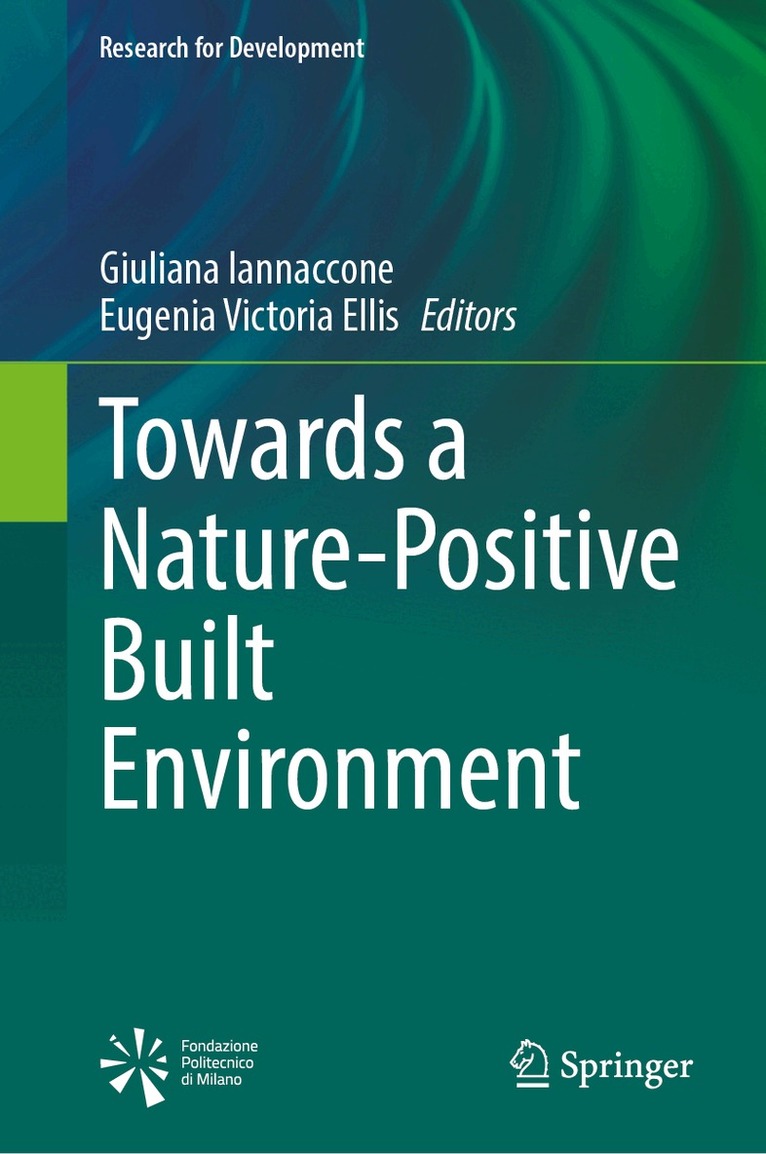
    Towards a Nature-Positive Built Environment

    AvGiuliana Iannaccone,Eugenia Victoria Ellis

    Inbunden, Engelska, 2026

    Del i serien Research for Development

    2 149 kr

    Beställningsvara. Skickas inom 10-15 vardagar. Fri frakt över 249 kr.

    Beskrivning

    This book explores the concept of a nature-positive built environment highlighting its importance for both human and planetary health. It promotes a cross-disciplinary dialogue and provides a critical perspective to those interested in the search for integrated and systemic solutions for the sustainable future of the built environment and all the living species that inhabit it.The global challenges posed by climate change have led to goals for the built environment that are primarily focused on reducing energy and resource consumption, with the aim of achieving decarbonization in the sector by 2050. However, the growing awareness, not only in the scientific community, of the impact of the construction industry on natural systems, on which it depends, and of the role of the built environment on the well-being and health of people, makes it necessary to define a new framework to align ongoing efforts with greater social and environmental responsibility. The concept of nature-positive thus becomes a new paradigm to go beyond the logic of zero impact and promote the generation of positive impacts for natural ecosystems and human health.The book brings together contributions from experts from different sectors who have researched and experimented with possible strategies to address the main challenges facing urban areas and the construction industry, seeking to give back to natural ecosystems and the human-nature relationship the space that has been lost due to urbanization.The presentation of case studies from Italy and the United States provides concrete examples of nature-positive solutions that at various levels have been proven in cities and are helping to ensure long-term sustainability.

    Produktinformation

    • Utgivningsdatum:2026-01-23
    • Mått:155 x 235 x 22 mm
    • Vikt:598 g
    • Format:Inbunden
    • Språk:Engelska
    • Serie:Research for Development
    • Antal sidor:270
    • Förlag:Springer International Publishing AG
    • ISBN:9783031952913

    Utforska kategorier

    • Regionalt styre och förvaltning inom Samhälle och politik
    • Biovetenskap inom Naturvetenskap och teknik
    • Miljövetenskap och miljöpolitik inom Naturvetenskap och teknik

    Mer om författaren

    Giuliana Iannaccone  is a Full Professor of Architectural Engineering at Politecnico di Milano. She holds a degree in Architecture (1998) and a PhD in Architectural Technology (2003) from the University of Naples.  She is the Director of Studies of the Master’s Degree Program in Building Engineering for Sustainability and is an active member of various academic boards and commissions. Her teaching focuses on construction technology and integrated building design, with a strong emphasis on innovative and international teaching methods, including Collaborative Online International Learning (COIL). Her research centers on energy-efficient and zero-carbon buildings, with a cross-disciplinary approach to decarbonizing the built environment. She also explores futures thinking methods and is involved in technology foresight activities at Politecnico di Milano. She has extensive international collaborations and serves as a visiting professor at universities in the U.S. and China. An author of numerous scientific publications, she has presented at international conferences and evaluated research projects for the European Commission, Swiss National Science Foundation, and Italian Ministry of University and Research.Eugenia Victoria Ellis is Professor Emerita at Drexel University, USA. A practicing architect who designs energy-conscious buildings shaped by the natural world, Professor Ellis investigates engineering solutions for the built environment at the intersection of light and health. Driven by the prospect of climate change, she researches strategies for the urban environment by considering the city as a responsive urban ecosystem where buildings and infrastructure interact with nature to promote the wellbeing of its citizens. Dr. Ellis’ research considers the city as a complex network of interrelated systems that rely on each other to maintain system balance. Her research team has partnered with the Politecnico di Milano to use the comparable cities of Philadelphia and Milan as a testbed to develop prototypical strategies other cities around the globe can use to reduce their carbon footprint and increase human health and wellbeing. Dr. Ellis previously taught at Temple University in 1991 and the University of Idaho 1992-1995. She joined the Drexel faculty in 2000 after twenty years in private practice designing civic and municipal projects, laboratories for high-tech industry, and healthcare/skilled nursing facilities. Her work has been exhibited at numerous galleries and her built projects have been recognized for design by the American Institute of Architects. A principal at BAU Architecture, she designs novel technological buildings that perform like machines to sync the indoor environment with outdoor environmental conditions and reduce energy use. Dr. Ellis has directed Drexel’s dLUX light lab since 2012 where students, faculty, and partners from a variety of disciplines investigate light in the built environment and its effect on life and energy use.

    Innehållsförteckning

    • A reference framework addressing nature positive goals in cities.- The future of Urban Greening Strategies between policies shared governance models and technologies.- From neighborhoods regeneration to cities decarbonization.- Nature based Solutions to overheating for equitable heat health protection.- Urban Ecology Biodiversity.- Partnering with Spontaneous Nature in the City and the Suburbs.- Buildings as Habitat: Adaptive Investments in Public Health.- The Cosmogenesis of Building: Ancient eco Logical Construction Practices.- Park in a Truck a Community led green initiative.- Climate Resilient Coastal Protection guidelines for development of multifunctional infrastructure.- Urban and Nature The activation of Nature based Solutions as a silver bullet for urban resilience The case of the industrial zone of the city of Bolzano.- Baltimore s Community Resiliency Hub Program A Model for Advancing Climate Justice and Preparedness.- Reducing Greenhouse Gas Emissions lessons from case studies.- The regenerative contribution of biogenic materials for the rapid decarbonization of the built environment.- Author Biographies.