• Fri frakt över 249 kr
  • •
  • Snabba leveranser
  • •
  • Billiga böcker
Kundservice

Du är på sajten för privatpersoner.

Företag, bibliotek eller offentlig verksamhet?

Du handlar på classic.bokus.com, där alla dina funktioner finns intakta.
Till classic.bokus.com
Bokus logotyp. Gå till startsidan.
  • Erbjudanden
  • Nyheter
  • Student
  • Topplistor
  • Barn & ungdom
  • Bokus Play
  • E-böcker
  • Pocketböcker
  • Spel & pussel

10% rabatt på allt med kod NYSTART10 →

Sidfot

Mina sidor

    Hjälp

    • Kundservice
    • Vanliga frågor och svar
    • Frakt och leverans
    • Retur vid ångerrätt
    • Reklamera vara
    • Betalning
    • Köpvillkor
    • Allmänna villkor
    • Information om webbplatsens tillgänglighet

    Om Bokus

    • Om oss
    • Pressrum
    • För studenter
    • För företag
    • För bibliotek och offentlig verksamhet
    • För leverantörer
    • Hållbarhet

    Populärt

    • Aktuella erbjudanden
    • Presentkort
    • Studentlitteratur
    • Nya böcker
    • Topplistor
    • Signerade böcker
    • Engelska böcker

    Inspiration

    • Boktips
    • BookTok
    • Populära bokserier
    • Barnbokskaraktärer
    • Populära författare
    Logotyp för Bokus
    Följ oss på Facebook (extern länk)Följ oss på Instagram (extern länk)Följ oss på YouTube (extern länk)Följ oss på TikTok (extern länk)
    bokus @ CookiesAnpassa cookiesIntegritetspolicyKöpvillkor
    Till Citymail hemsida (extern länk)Till Budbee hemsida (extern länk)Till Postnord hemsida (extern länk)Till Schenker hemsida (extern länk)Till Early Bird hemsida (extern länk)Till Walleys hemsida (extern länk)
    1. Filosofi och religion
    2. Filosofi
    3. Filosofiska discipliner

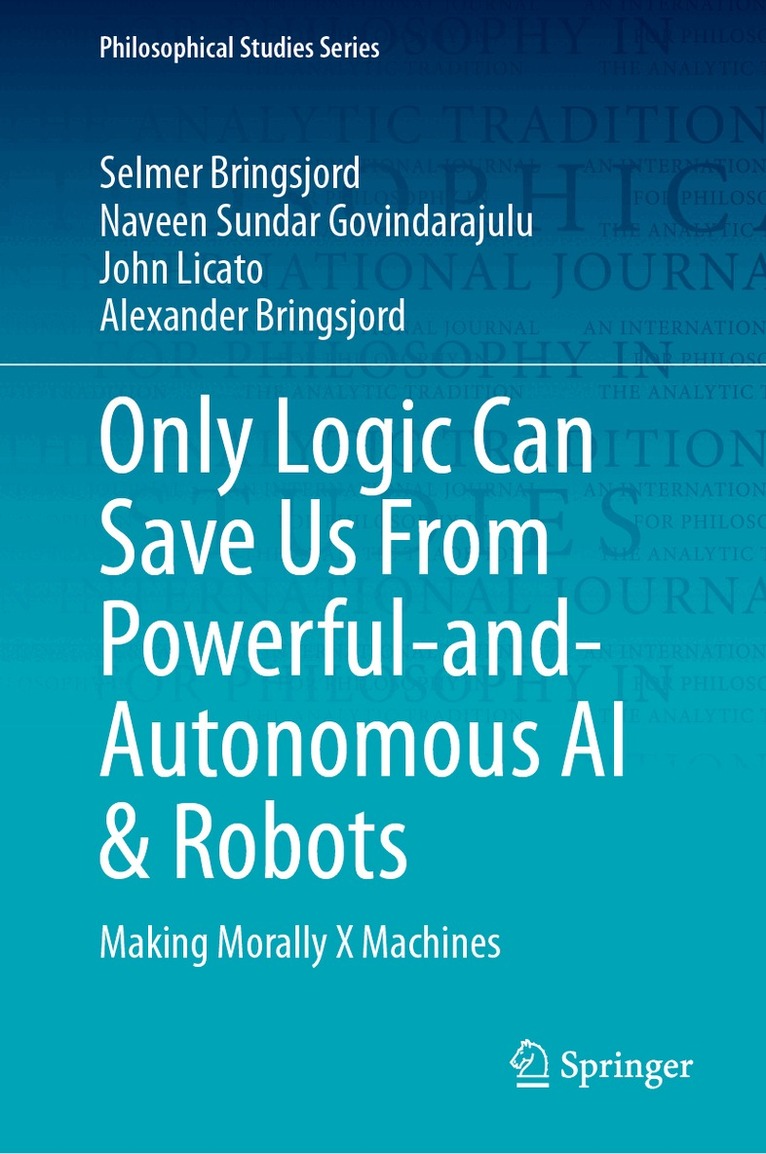
    Only Logic Can Save Us From Powerful-and-Autonomous AI & Robots

    Making Morally X Machines

    AvSelmer Bringsjord,Naveen Sundar Govindarajulu

    Inbunden, Engelska, 2026

    Del 159 i serien Philosophical Studies Series

    998 kr

    Kommande

    Beskrivning

    This book provides the logic-based path by which humanity can neutralize the existential threat posed by machines that are at once powerful, autonomous, intelligent, and potentially immoral. The path is made clear by analysis of four Star Trek TOS episodes in which malevolent, destructive machines are thwarted by logic. Anyone who wishes to ward off a future in which humanity is harmed or even outright destroyed by AI, or perhaps even wishes to directly contribute to this warding off, is a member of the book’s intended audience.

    Produktinformation

    • Utgivningsdatum:2026-09-26
    • Mått:155 x 235 x undefined mm
    • Format:Inbunden
    • Språk:Engelska
    • Serie:Philosophical Studies Series
    • Antal sidor:260
    • Förlag:Springer Nature Switzerland AG
    • ISBN:9783032082169

    Utforska kategorier

    • Filosofiska discipliner inom Filosofi och religion
    • Artificiell intelligens inom Data och IT

    Mer om författaren

    ​Bringsjord is the founding Director of the Rensselaer AI & Reasoning Laboratory at RPI; this lab is devoted to the science and engineering of logic-based AI and CogSci, and cognitive robotics. He is Professor of: Logic & Philosophy; Computer Science; Cognitive Science; and Management & Technology. Bringsjord specializes in the building of robust AI systems and cognitive robots, and at the same time the logical/mathematical and philosophical foundations of AI (as well as that of CompSci & CogSci). Funding for Bringsjord’s R&D has come from the Luce Foundation, NSF, the Templeton Foundation, AT&T, IBM, Apple, AFRL, ARDA/DTO/ IARPA, ONR, DARPA, AFOSR, and other sponsors (with funding with him as PI or Co-PI totaling over $25M). He has consulted to and advised many companies in the realm of intelligent systems, and continues to do so; in this realm he has three patents and three pending. Bringsjord is widely known for bringing AI and cognitive robotics to the public;two examples include his TEDx talk “Could a Robot be a Bona Fide Hero?’’, and a demonstration of self-consciousness in robots watched by millions.Naveen Sundar Govindarajulu is an artificial intelligence (AI) and machine learning (ML) researcher and engineer with research experience in various subfields of AI, computational logic, and ML. His recent research experience includes (1) building autonomous systems that reason with ethical principles, (2) making machine learning models more fair, and (3) combining reasoning systems with learning systems. He has performed fundamental research in a wide range of research labs. His experience includes ML-based time series forecasting at Workday, natural language processing research at Yahoo Research, fraud detection at Wepay, image recognition at HP Labs, and an experimental fingerprint-recognition system for the Indian Space Research Organization. He also has worked briefly as a visiting scholar on modeling fundamental physics problems at the Tata Institute for Fundamental Research. In addition to research in AI and ML, his background also includes building and deploying AI and ML systems in real-world applications with rigorous performance requirements. He obtained his PhD in computer science from RPI, partly sponsored by the International Fulbright Science and Technology Scholarship. He also has an MSc in physics and BE in electrical and electronics engineering from the Birla Institute of Technology and Science, Pilani (BITS-Pilani).Dr. John Licato is Assistant Professor of Computer Science and Engineering, and Director of the Advancing Machine and Human Reasoning (AMHR) Lab at the University of South Florida, in Tampa, FL. He earned his PhD in Computer Science in 2015 at Rensselaer Polytechnic Institute under the supervision of Selmer Bringsjord. He is a 2017 awardee of the AFOSR Young Investigator’s Program (YIP) grant. His research interests lie in the intersection of reasoning, cognitive science, logic, and natural language processing. The mission of Dr. Licato’s AMHR lab is to not only make computers better at reasoning, but to help people reason better, as well. Thus, his lab develops algorithms for automated reasoning in formal-logic domains, but also studies ways to automatically process informal reasoning — e.g., the kinds of arguments made by normal people in casual discussions, whether in-person or online. This requires extensive use of state-of-the-art techniques in the field of natural language processing. He has also worked extensively in the area of cognitive modeling, focusing particularly on developmental models of cognition. Current dominant models in AI, however, fail at replicating the kinds of brilliant insights displayed by children starting at very young ages. He and his lab are devoted to figuring out why this is the case.

    Innehållsförteckning

    • Preface.- Chapter 1. Existential Threats: Genuine vs. That and Virtually Guaranteed.- Chapter 2. The PAID Problem Shows AI to be a Virtually Guaranteed Existential Threat (= a vget).- Chapter 3. The Captain-Kirk Naïve-Logic Approach Won't Save Us.- Chapter 4. Non-Logicist AI (e.g. \Machine Learning') Won't Save Us.- Chapter 5. Logic Machines, of the Powerful, Autonomous, Intelligent Kind.- Chapter 6. Ethically Correct Logic Machines Can Save Us.- Epilogue: How to Support Salvational AI.