• Fri frakt över 249 kr
  • •
  • Snabba leveranser
  • •
  • Billiga böcker
Kundservice

Du är på sajten för privatpersoner.

Företag, bibliotek eller offentlig verksamhet?

Du handlar på classic.bokus.com, där alla dina funktioner finns intakta.
Till classic.bokus.com
Bokus logotyp. Gå till startsidan.
  • Erbjudanden
  • Nyheter
  • Student
  • Topplistor
  • Barn & ungdom
  • Bokus Play
  • E-böcker
  • Pocketböcker
  • Spel & pussel

10% rabatt på allt med kod: NYSTART10 →

Sidfot

Mina sidor

    Hjälp

    • Kundservice
    • Vanliga frågor och svar
    • Frakt och leverans
    • Retur vid ångerrätt
    • Reklamera vara
    • Betalning
    • Köpvillkor
    • Allmänna villkor
    • Information om webbplatsens tillgänglighet

    Om Bokus

    • Om oss
    • Pressrum
    • För studenter
    • För företag
    • För bibliotek och offentlig verksamhet
    • För leverantörer
    • Hållbarhet

    Populärt

    • Aktuella erbjudanden
    • Presentkort
    • Studentlitteratur
    • Nya böcker
    • Topplistor
    • Signerade böcker
    • Engelska böcker

    Inspiration

    • Boktips
    • BookTok
    • Populära bokserier
    • Barnbokskaraktärer
    • Populära författare
    Logotyp för Bokus
    Följ oss på Facebook (extern länk)Följ oss på Instagram (extern länk)Följ oss på YouTube (extern länk)Följ oss på TikTok (extern länk)
    bokus @ CookiesAnpassa cookiesIntegritetspolicyKöpvillkor
    Till Citymail hemsida (extern länk)Till Budbee hemsida (extern länk)Till Postnord hemsida (extern länk)Till Schenker hemsida (extern länk)Till Early Bird hemsida (extern länk)Till Walleys hemsida (extern länk)
    1. Samhälle och politik
    2. Samhälle och kultur
    3. Kultur och medier
    4. Referensverk och tvärvetenskap

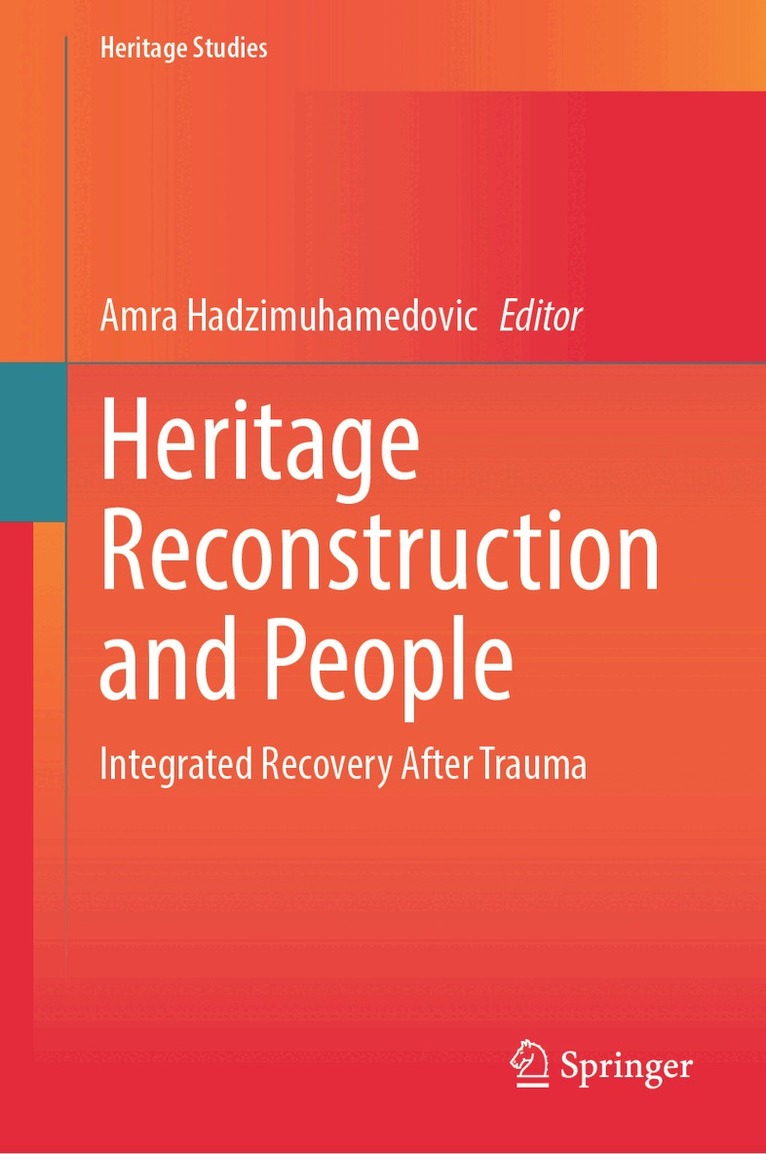
    Heritage Reconstruction and People

    Integrated Recovery After Trauma

    AvAmra Hadzimuhamedovic

    Inbunden, Engelska, 2026

    Del i serien Heritage Studies

    1 776 kr

    Kommande

    Beskrivning

    This book examines heritage reconstruction and its relationship to community recovery after cultural trauma. Its content and structure situate it within a new body of theory concerned to shift focus from physical buildings and ensembles to people, from the material to the social. The contributions integrate the social meaning of heritage with the subjective feelings and needs of individuals engaged in processing cultural trauma. The collection of studies touches upon sociological, psychological, healing, and anthropological dimensions of heritage recovery.The new question that this book brings to the heritage discourse is: Can cultural heritage serve as a medium for healing societal trauma? The volume is divided into five thematic sections: 1. Coming to terms with the past; 2. Inclusiveness; 3. Building Resilience; 4. People in Focus; 5. Crossing borders. The nexus between people and heritage is explored through case studies on diverse recovery contexts - Bosnia, Gazza, Syria, Iraq, Uganda, Albania, Nepal, Zanzibar, Lebanon – different practices of international organisations, and formative documents of contemporary international doctrine. Difficult issues of justice, ethics, human rights, sustainable development, and the lengthy process of coming to terms with life after trauma are brought into contact with technical challenges and cultural, historical, and economic contexts. The book establishes the theory of inclusive heritage discourse, which reconciles informal heritage practices and authorised heritage discourse, and will be relevant for academic researchers, students and professionals in the field of heritage studies but also in conflict, human rights, and humanitarian studies.

    Produktinformation

    • Utgivningsdatum:2026-11-08
    • Mått:155 x 235 x undefined mm
    • Format:Inbunden
    • Språk:Engelska
    • Serie:Heritage Studies
    • Antal sidor:448
    • Förlag:Springer Nature Switzerland AG
    • ISBN:9783032098085

    Utforska kategorier

    • Referensverk och tvärvetenskap inom Samhälle och politik
    • Kulturvetenskap inom Samhälle och politik
    • Arkeologi inom Historia och arkeologi

    Mer om författaren

    Amra Hadžimuhamedović is the Director of the Centre for Cultural Heritage of the International Forum Bosnia. She is a cultural heritage expert and historian of architecture focusing on post-conflict recovery and reconstruction. She holds a PhD in architectural conservation from the University of Sarajevo. From 2001 to 2016, she has been the leading country expert overseeing the implementation of Annex 8 of the Dayton Peace Accord for Bosnia and Herzegovina as a member of the postwar Commission to Preserve National Monuments. In that capacity, she has managed diverse projects integrating cultural heritage into postwar recovery. Amra has also worked as a consultant for UNESCO (Harnessing Reconciliation through the Recovery of Cultural Heritage), ICCROM (as a lecturer since 1998 and ICCROM fellow in 2008), the World Bank (Culture in City Reconstruction and Recovery - CURE), ICOMOS International (Global Case Study Project on Recovery and Reconstruction), OSCE (International Expert on Integrated Cultural Heritage Management), ARC-WH (Integrated Reconstruction and Post-Trauma Impact on Communities and Socio-Economic Aspects of Recovery); WELFARE (Old City of Jerusalem Revitalisation Program), and for a number of other regional and global heritage institutions and initiatives. She has held courses in the history of architecture and architectural conservation at the International University of Sarajevo from 2010 to 2019 and guest-lectured on heritage during and after the war, as well as on the theories and philosophies of conservation, at numerous European and American universities. Amra's research has been published widely and includes Heritage, War and Peace (authored book, published as Naslijeđe, rat i mir in the Bosnian language by Sarajevo University in 2014; Human Rights and Destruction of Cultural Memory (editor, Norwegian Helsinki Committee, 2008);  Bosnia: Destruction of Cultural Heritage (co-author, Ashgate/Routledge, 2016), as well as numerous chapters in books, including in Politicisation of Religion, the Power of Symbolism (Palgrave Macmillan), Time Frames: Conservation Policies for Twentieth-Century Architectural Heritage (Routledge), Architecture of Coexistence , Building Pluralism (ArchiTangle), etc. Amra is the founder of HIDR (House of International Dialogue and Research) which for 17 years has organised an international school focused on the sustainable, inclusive, resilient and holistic recovery of heritage.

    Innehållsförteckning

    • Part 1. Introduction.- Chapter 1. A Postscript at the Threshold: The Ever-Evolving Urge to Recover the Residues of Culture from the Ruins (Hadžimuhamedović).- Chapter 2. An Introduction to Heritage Reconstruction and People in Post-Trauma Social Recovery (Hadžimuhamedović).- Part 2. Coming to Terms with the Past.- Chapter 3. Edges or Limits: Architectural Ghosts in the Maze of Reconstruction (Kealy).- Chapter 4. Heritage Economics in Post-Disaster Reconstruction (Ost).- Chapter 5. The Recovery and Reconstruction of Cultural Heritage: The Socio-Economic Approach (Marcinkowska).- Chapter 6. Can Digital Heritage Technologies Support the Post-Trauma Recovery of Communities? Opportunities and Challenges (Quintero).- Chapter 7. Towards Sustainable Post-War Recovery of the Old City of Aleppo: Evaluation of the Rehabilitation of the Suq al-Saqatiyya as a Pilot Project (Kasmo and Kuteifan).- Part 3. Inclusiveness.- Chapter 8. Destruction of Heritage as a Strategy of Mass Violence: Assessing Harm to Inform Meaningful Measures of Repair (Viejo-Rose and Killean).- Chapter 9. Historical Trauma and Cultural Heritage: INTIQAL-2030 in the Gaza Strip (AlAmasi et al).- Chapter 10. ALIPH’s Experience Protecting Heritage to Build Peace: The Early Lessons of ALIPH’s Efforts to Protect Heritage in Conflict and Post-Conflict Areas (Freland et al).- Chapter 11. Peacebuilding through Heritage Rebuilding: Inclusive Heritage Discourse and Post-war Recovery in Bosnia (Hadžimuhamedović).- Part 4. Building Resilience.- Chapter 12. War Scars between Erasure and Semantic Transformation: Lessons from Post-Trauma Reconstruction in Beirut. (Haïdar)- Chapter 13. People and Heritage in Yemen: Where to? (Alshawesh and Hadžimuhamedović).- Chapter 14. Time Travel in Heritage Reconstruction: The Case of the Kasubi Royal Tombs at Kampala, Uganda (Nsubuga).- Chapter 15. National Reconciliation as a Pre-requisite for National Heritage Conservation: The House of Wonders and Zanzibar Stone Town (Sheriff).- Part 5. People in Focus.- Chapter 16. The Bigger Picture of Recovery: Conservation Challenges related to Living Heritage and Value and Belief Systems in the Preservation and Reconstruction of Cultural Heritage at Patan Durbar Square (Haselberger et al).- Chapter 17. Cultural Heritage: A Gateway for Exiting the Syrian Crisis (Rajab)- Chapter 18. The Post-Earthquake Recovery of Tower C in Durrës, Albania (Mamani et al).- Chapter 19. Reviving the Spirit of Mosul: The Reconstruction of Cultural Landmarks as a Tool to Foster Reconciliation in Post-Conflict Recovery (Acetoso et al).- Part 6. Crossing borders.- Chapter 20. Responding to Challenges in the Reconstruction and Recovery of World Heritage Sites (Rössler).- Chapter 21. Political Will in Strategic and Integrated Reconstruction: The Example of Angkor (Bouchenaki).- Chapter 22. The Development of ICCROM Approaches in the Reconstruction of Cultural Properties during Post-Conflict Recovery Processes (Aslan).- Chapter 23. World Monuments Fund Lessons from the Field: Heritage Recovery in Post-Crisis Areas (Montlaur).