• Fri frakt över 249 kr
  • •
  • Snabba leveranser
  • •
  • Billiga böcker
Kundservice

Du är på sajten för privatpersoner.

Företag, bibliotek eller offentlig verksamhet?

Du handlar på classic.bokus.com, där alla dina funktioner finns intakta.
Till classic.bokus.com
Bokus logotyp. Gå till startsidan.
  • Erbjudanden
  • Nyheter
  • Student
  • Topplistor
  • Barn & ungdom
  • Bokus Play
  • E-böcker
  • Pocketböcker
  • Spel & pussel

10% rabatt på allt med kod NYSTART10 →

Sidfot

Mina sidor

    Hjälp

    • Kundservice
    • Vanliga frågor och svar
    • Frakt och leverans
    • Retur vid ångerrätt
    • Reklamera vara
    • Betalning
    • Köpvillkor
    • Allmänna villkor
    • Information om webbplatsens tillgänglighet

    Om Bokus

    • Om oss
    • Pressrum
    • För studenter
    • För företag
    • För bibliotek och offentlig verksamhet
    • För leverantörer
    • Hållbarhet

    Populärt

    • Aktuella erbjudanden
    • Presentkort
    • Studentlitteratur
    • Nya böcker
    • Topplistor
    • Signerade böcker
    • Engelska böcker

    Inspiration

    • Boktips
    • BookTok
    • Populära bokserier
    • Barnbokskaraktärer
    • Populära författare
    Logotyp för Bokus
    Följ oss på Facebook (extern länk)Följ oss på Instagram (extern länk)Följ oss på YouTube (extern länk)Följ oss på TikTok (extern länk)
    bokus @ CookiesAnpassa cookiesIntegritetspolicyKöpvillkor
    Till Citymail hemsida (extern länk)Till Budbee hemsida (extern länk)Till Postnord hemsida (extern länk)Till Schenker hemsida (extern länk)Till Early Bird hemsida (extern länk)Till Walleys hemsida (extern länk)
    1. Naturvetenskap och teknik
    2. Geovetenskap
    3. Miljövetenskap och miljöpolitik

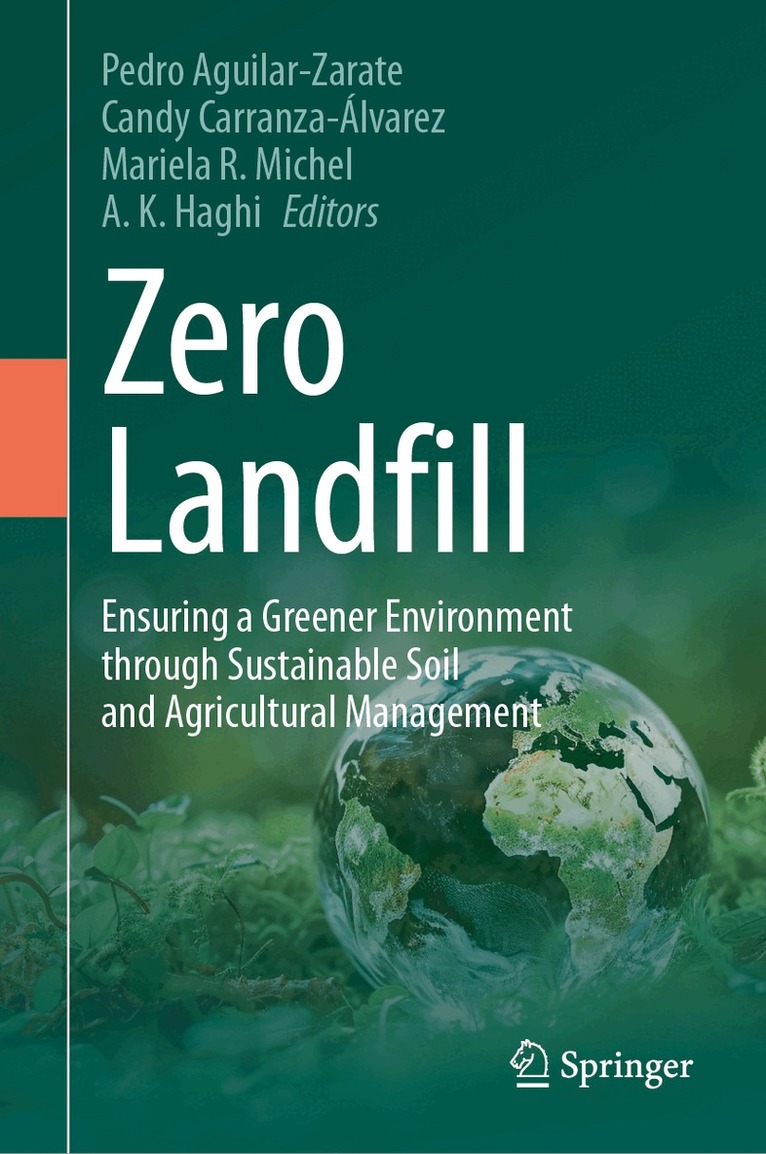
    Zero Landfill

    Ensuring a Greener Environment through Sustainable Soil and Agricultural Management

    AvPedro Aguilar-Zarate,Candy Carranza-Álvarez

    Inbunden, Engelska, 2026

    1 733 kr

    Beställningsvara. Skickas inom 10-15 vardagar. Fri frakt över 249 kr.

    Beskrivning

    This book offers an overview of innovative waste treatment technologies for sustainable agriculture. It evaluates the efficacy, scalability, and adaptability of these technologies, discussing their potential in addressing the challenges in waste treatment to achieve healthy soil. Waste management has been a severe issue globally. Every year, over 11 billion metric tons of waste is produced, with humans accounting for 90% of this total. Millions of tons of waste in the United States end up in landfills and pollute the environment and soil health, where they are dumped. If sustainability is practiced, we can reduce and control environmental waste to improve agricultural soil health. The book assesses current disposal methods and the development of sustainable solutions. It delves into the impact assessment and evaluation of these solutions, promoting a comprehensive understanding of sustainable disposal practices and their significance in mitigating environmental hazards. The increasing level of waste is, nowadays, a severe problem in the urban areas of the world. High rates of growth in population and increasing per-capita income have resulted in the generation of enormous waste, posing a severe threat to environmental quality and human health and more so in the case of developing countries where large quantities of waste are dumped haphazardly, thereby putting pressure on scarce land and water resources and, at the same time, adversely affecting the health of human beings, mainly that of the poor persons who have greater exposure to it. Providing a cost analysis of waste management, this book explores the economic dimensions of solid waste management. It discusses funding, investment opportunities, and economic impact assessments, offering insights into the financial implications and considerations in implementing waste management practices.This research-oriented book also investigates the main determinants of residents' waste-sorting behavior and how the approach mainly contributes to it. The findings provide policymakers with critical factors for the successful implementation of waste sorting. We also propose policy implications to maintain and improve sorting efficiency from the perspective of residents (education, communication, and publicity), neighborhood committees (degree and efficiency of supervision), and property management companies (good infrastructure, services, and processes). It will also explore the intricacies of transporting hazardous solid waste. It covers the regulations, compliance, and risk mitigation strategies involved, presenting best practices in transportation and highlighting the complexities in ensuring safe and compliant transit of hazardous solid waste.

    Produktinformation

    • Utgivningsdatum:2026-02-20
    • Mått:155 x 235 x 30 mm
    • Vikt:826 g
    • Format:Inbunden
    • Språk:Engelska
    • Antal sidor:425
    • Förlag:Springer Nature Switzerland AG
    • ISBN:9783032106131

    Utforska kategorier

    • Miljövetenskap och miljöpolitik inom Naturvetenskap och teknik
    • Miljöteknik inom Naturvetenskap och teknik
    • Agronomi inom Naturvetenskap och teknik

    Mer om författaren

    Pedro Aguilar-Zárate, PhD.Professor at Laboratorio Nacional CONAHCYT de Apoyo a la Evaluación de Productos Bióticos, Tecnológico Nacional de México/ I. T. de Ciudad Valles, Mexico.Pedro Aguilar-Zárate earned his PhD in Food Science and Technology from the Autonomous University of Coahuila. Currently, he serves as a Professor at Tecnológico Nacional de México/I. T. de Ciudad Valles. His research primarily focuses on developing bioprocesses for extracting and purifying secondary plant metabolites, as well as advancing microbial fermentation in both solid and liquid media to produce industrially relevant metabolites. Additionally, he conducts studies on protein-polyphenol interactions. Dr. Aguilar has contributed to over 70 articles in indexed journals, authored 30 book chapters, and written six books. Beyond his written work, he has supervised and co-supervised 33 undergraduate theses, 7 MSc theses, and 2 PhD projects. Moreover, he actively participates in various scientific and academic events, presenting his research findings. Dr. Aguilar serves as an editor for prestigious journals, including Frontiers in Food Science and Technology, Polymers, Plants, Plant Science Today, the International Journal of Research and Technological Innovation (RIIIT), Foods, and the International Journal of Food Studies. Also, has been editor for Apple Academic Press, Nova Science Publishers, and Springer Nature. His valuable contributions have led to his induction into the esteemed National System of Researchers level 2 in Mexico. His remarkable achievements have garnered recognition from various professional bodies and institutions such as the Mexican Association of Food Science (2014), the Mexican Society of Biotechnology and Bioengineering (2015), the Mexican Association of Food Engineering and Biotechnology (2020), and the Potosino Council of Science and Technology (2021 and 2024). Candy Carranza-Álvarez, PhD.Professor at Autonomous University of San Luis Potosí FEPS Huasteca Zone, Mexico.Dr. Candy Carranza Álvarez has a postdoctoral degree in Environmental Sciences, a PhD in Chemical Sciences in Plant Biotechnology, a master's degree in environmental Geochemistry and presently working in the Department of Biochemistry, as Research professor and Head of the Environmental Sciences Research Laboratory. Dr. Carranza-Alvarez has been teaching graduate and postgraduate students of environmental sciences for the past 15 years and has been recognized by the National System of Researchers as a National Researcher Level 2 and has received five research awards. She is an author of more than 70 research articles (h-index 21; total citation >1283) and 15 book chapters with international publishers (Springer, Elsevier, CRC Press Taylor, and Francis) and has published 4 education books. She specializes in environmental remediation, evaluation, and control through physicochemical and biological processes (Plant Biotechnology and phytoremediation) phytochemistry. Besides, she has worked as a manager in more than 10 environmental projects and has participated in national and international conferences, has organized workshops on technological innovation aimed at the productive sector and the public, research seminars and international academic events for the dissemination of science. Dr. Candy is the leader of a research group and a member of different thematic networks on the environment. She has been the director of 50 undergraduate students, 14 master's theses and 6 doctoral theses. Mariela R. Michel, PhD.Professor at Laboratorio Nacional CONAHCYT de Apoyo a la Evaluación de Productos Bióticos, Tecnológico Nacional de México/ I. T. de Ciudad Valles, Mexico.Mariela Ramona Michel Michel is an accomplished researcher who earned her Ph.D. from the University of Coahuila, Mexico, in 2020. Before her doctoral studies, she completed her M.Sc. in Food Science and Technology at the same institution in 2016, following her undergraduate degree in Chemistry Pharmacobiology with a specialization in Industrial Pharmacy in 2014. Throughout her academic journey, Mariela has demonstrated a keen interest and expertise in various aspects of food science and technology. Her research endeavors have focused on several key areas, including the production of enzymes essential to the food industry, the extraction, purification, preservation, and in vitro digestion of bioactive compounds, and advancements in food technology. Mariela's dedication to advancing scientific knowledge has taken her to esteemed institutions worldwide. She has completed research stays at the University of Barcelona, where she delved into molecular phylogeny within the Department of Genetics, and at the Universidad Autonoma Agraria Antonio Narro, where she contributed to research efforts in the Animal Science laboratory. Additionally, she honed her skills at the Portuguese Catholic University, gaining valuable insights and expertise in biotechnology. Mariela's outstanding academic achievements have not gone unnoticed. Her doctoral thesis was recognized as the best by the University of Coahuila, earning her prestigious accolades. She was also awarded the esteemed Medal "Juan Antonio de la Fuente" for Academic Merit upon the successful completion of her doctoral studies, further highlighting her commitment to excellence in academia. Her contributions have led to her induction into the esteemed National System of Researchers level 1 in Mexico. A. K. Haghi, PhD.Professor Emeritus of Engineering Sciences and Senior Material Engineering Consultant, UK.A. K. Haghi is a retired professor who has written, co-written, edited, or co-edited more than 1000 publications, including books, book chapters, and papers in refereed journals. He holds a BSc in urban and environmental engineering from the University of North Carolina (USA) and holds two MSc degrees, one in mechanical engineering from North Carolina State University (USA) and another one in applied mechanics, acoustics, and materials from the Université de Technologie de Compiègne (France). Prof. Haghi was also awarded a PhD in engineering sciences at Université de Franche-Comté (France). His extensive educational background and supervisory roles underscore his expertise and contributions to the field of engineering sciences. He is an appointed Honorary Research Associate (HRA) at the University of Coimbra, Portugal, and a regular reviewer of leading international journals. He has secured UK design patents for multiple inventions.

    Innehållsförteckning

    • 1. An overview of zero landfill.- 2. How Hazardous Waste Disposal and Pollution Affects The Environment and Agricultural Soil: An Introduction.- 3. Public Health Implication of Toxic Waste Generated by Households: The Environmental Hazards of Improper Waste Disposal.- 4. Sustainable Practices in Hazardous Waste Management to Control Environmental and Agricultural Soil Pollutions.- 5. Agricultural Soil Health Management: From Theory to Practice.- 6. Protecting Agricultural Soils from Contamination to Produce Healthy Foods.- 7: Solid Waste in Agricultural Soils: Guidelines to Reduce Risks to Human, Plant and Environment.- 8. Sources of Agricultural Soil Pollution: The Impact of Waste Sorting Policy on Air Pollution and Agricultural Soil.- 9. The Presence of Various Hazardous Pollutants in Agricultural Soils and Toxic Health Effects on Humans.- 10: Waste Treatment Technologies for Sustainable Agriculture.