• Fri frakt över 249 kr
  • •
  • Snabba leveranser
  • •
  • Billiga böcker
Kundservice

Du är på sajten för privatpersoner.

Företag, bibliotek eller offentlig verksamhet?

Du handlar på classic.bokus.com, där alla dina funktioner finns intakta.
Till classic.bokus.com
Bokus logotyp. Gå till startsidan.
  • Erbjudanden
  • Student
  • Topplistor
  • Barn & ungdom
  • Bokus Play
  • E-böcker
  • Ljudböcker
  • Pocketböcker
  • Spel och pussel

Pocketfynda! Hundratals böcker för 49 kr/st →

Sidfot

Mina sidor

    Hjälp

    • Kundservice
    • Vanliga frågor och svar
    • Frakt och leverans
    • Retur vid ångerrätt
    • Reklamera vara
    • Betalning
    • Köpvillkor
    • Allmänna villkor
    • Information om webbplatsens tillgänglighet

    Om Bokus

    • Om oss
    • Pressrum
    • För studenter
    • För företag
    • För bibliotek och offentlig verksamhet
    • För leverantörer
    • Hållbarhet

    Populärt

    • Aktuella erbjudanden
    • Presentkort
    • Studentlitteratur
    • Nya böcker
    • Topplistor
    • Signerade böcker
    • Engelska böcker

    Inspiration

    • Boktips
    • BookTok
    • Barnbokskaraktärer
    • Populära författare
    Logotyp för Bokus
    Följ oss på Facebook (extern länk)Följ oss på Instagram (extern länk)Följ oss på YouTube (extern länk)Följ oss på TikTok (extern länk)
    bokus @ CookiesAnpassa cookiesIntegritetspolicyKöpvillkor
    Till Citymail hemsida (extern länk)Till Budbee hemsida (extern länk)Till Postnord hemsida (extern länk)Till Schenker hemsida (extern länk)Till Early Bird hemsida (extern länk)Till Walleys hemsida (extern länk)
    1. Samhälle och politik
    2. Sociologi och antropologi
    3. Sociologi

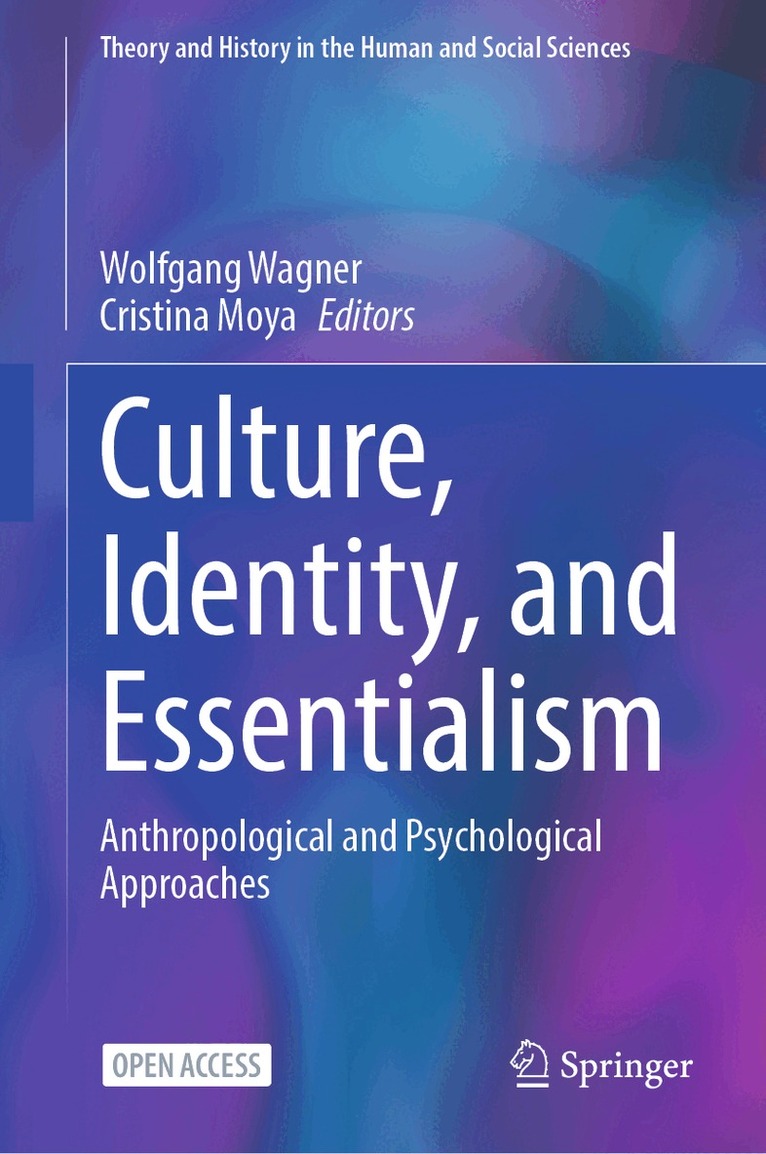
    Culture, Identity, and Essentialism

    Anthropological and Psychological Approaches

    AvWolfgang Wagner,Cristina Moya

    Inbunden, Engelska, 2026

    Del i serien Theory and History in the Human and Social Sciences

    527 kr

    Beställningsvara. Skickas inom 10-15 vardagar. Fri frakt över 249 kr.

    Beskrivning

    This Open Access book examines how people often treat social group membership as inherent, immutable, informative and even intergenerationally inherited. Such essentialism remains one of the more puzzling folk intuitions, at odds with social science maintaining that people become culturally competent group members through enculturation, and that norms can change how group boundaries are defined quite substantially. Essentialism also features prominently in much rhetoric that justifies intergroup hostility and in researchers' attempts to explain it. Nonetheless, social scientists have not reached a consensus about essentialism's causal role in intergroup relations.In this Open Access book, contributors from a range of perspectives tackle fundamental questions in this field:Do humans share a tendency to essentialise groups?If so, where does this tendency come from?How is essentialism expressed in cognition, behavior, and institutions?What are its consequences for cooperation and social conflict?Psychologists, cultural anthropologists, and evolutionary biologists weigh in on these questions in this volume, often using specific cultural contexts as case studies to elucidate both the particularities and common patterns in the ways essentialism does, or does not, work in the real world.

    Produktinformation

    • Utgivningsdatum:2026-05-01
    • Mått:155 x 235 x 24 mm
    • Vikt:674 g
    • Format:Inbunden
    • Språk:Engelska
    • Serie:Theory and History in the Human and Social Sciences
    • Antal sidor:330
    • Förlag:Springer Nature Switzerland AG
    • ISBN:9783032119179

    Utforska kategorier

    • Sociologi inom Samhälle och politik
    • Antropologi inom Samhälle och politik
    • Socialpsykologi och gruppsykologi inom Psykologi och pedagogik

    Mer om författaren

    Wolfgang Wagner is professor of social psychology at the University of Tartu, Estonia. His interests are in theoretical and empirical issues on social and cultural knowledge, intergroup relations, public understanding of science, and social representation theory. He authored and edited several books and is board member of several scholarly journals. He held visiting positions at various universities in California, Brazil, France, Japan, Mexico, Spain, and UK.Cristina Moya is associate professor of Anthropology at the University of California, Davis. She takes an evolutionary approach to understanding why human social behavior and cognition is different from that of our primate relatives, and how it is culturally patterned. She conducts research in the Peruvian Altiplano along the Quechua-Aymara language boundary and using cross-cultural datasets to investigate how people think about ethnic categories, why social relations influence reproductive decisions, and why some people adopt new and costly behaviors such as religious pilgrimage, while others resist.

    Innehållsförteckning

    • Chapter 1. Introduction to Culture, Identity, and Essentialism—Anthropological and Psychological Approaches .- Part I. Evolutionary and Developmental Roots of Essentialism.- Chapter 2. Can Evolutionary Epistemology Shed Light on the Role of Essentialism in Group-Thinking?.- Chapter 3. Cognitive Adaptation to Culturally-Evolved Ethnic Landscapes.- Chapter 4. Ethnic Identity, Enculturated Essentialism, and Instrumental (De)Essentializing.- Chapter 5. The Cognitive, Cultural, and Motivational Foundations of Social Essentialism: A Developmental Perspective.- Part II. Cultural Roots and Historical Trajectories of Essentialism.- Chapter 6. Culture, Group, and Identity: The Case of Diversity Ideology.- Chapter 7. The Origin of WEIRD Essentialism.- Part III. Individuals’ Roles in the Construal of Identity and Essentialism.- Chapter 8. A Functionalist Account of Social Identity.- Chapter 9. Essence and Class: Conceptualising the Experience of Intergenerational Social Mobility in the UK.- Chapter 10. The Limits of Essentialism Within and Across Territories.- Part IV. The Collective Construal of Identity and Essentialism .- Chapter 11. Mutual Maltese and Arab Representations in Malta—A Project of Reconciliation.- Chapter 12. Identities as Projects, Essentialism as Rhetoric.- Chapter 13. The Interface of Ethnicity and Institutions: Power, Regulations, and Ethnic Distinctions.- Chapter 14. Intergroup Violence Without Essentialist Beliefs: The Case of Turkana Cattle Raiders.- Part V. Instead of an Afterword.- Chapter 15. Of Elephants and Aspirins: Similarity, Gestalt Perception, and Inductive Inference in Essentialism.