• Fri frakt över 249 kr
  • •
  • Snabba leveranser
  • •
  • Billiga böcker
Kundservice

Du är på sajten för privatpersoner.

Företag, bibliotek eller offentlig verksamhet?

Du handlar på classic.bokus.com, där alla dina funktioner finns intakta.
Till classic.bokus.com
Bokus logotyp. Gå till startsidan.
  • Erbjudanden
  • Nyheter
  • Student
  • Topplistor
  • Barn & ungdom
  • Bokus Play
  • E-böcker
  • Pocketböcker
  • Spel & pussel

10% rabatt på allt med kod: NYSTART10 →

Sidfot

Mina sidor

    Hjälp

    • Kundservice
    • Vanliga frågor och svar
    • Frakt och leverans
    • Retur vid ångerrätt
    • Reklamera vara
    • Betalning
    • Köpvillkor
    • Allmänna villkor
    • Information om webbplatsens tillgänglighet

    Om Bokus

    • Om oss
    • Pressrum
    • För studenter
    • För företag
    • För bibliotek och offentlig verksamhet
    • För leverantörer
    • Hållbarhet

    Populärt

    • Aktuella erbjudanden
    • Presentkort
    • Studentlitteratur
    • Nya böcker
    • Topplistor
    • Signerade böcker
    • Engelska böcker

    Inspiration

    • Boktips
    • BookTok
    • Populära bokserier
    • Barnbokskaraktärer
    • Populära författare
    Logotyp för Bokus
    Följ oss på Facebook (extern länk)Följ oss på Instagram (extern länk)Följ oss på YouTube (extern länk)Följ oss på TikTok (extern länk)
    bokus @ CookiesAnpassa cookiesIntegritetspolicyKöpvillkor
    Till Citymail hemsida (extern länk)Till Budbee hemsida (extern länk)Till Postnord hemsida (extern länk)Till Schenker hemsida (extern länk)Till Early Bird hemsida (extern länk)Till Walleys hemsida (extern länk)
    1. Naturvetenskap och teknik
    2. Matematik och naturvetenskap
    3. Kemi
    4. Fysikalisk kemi

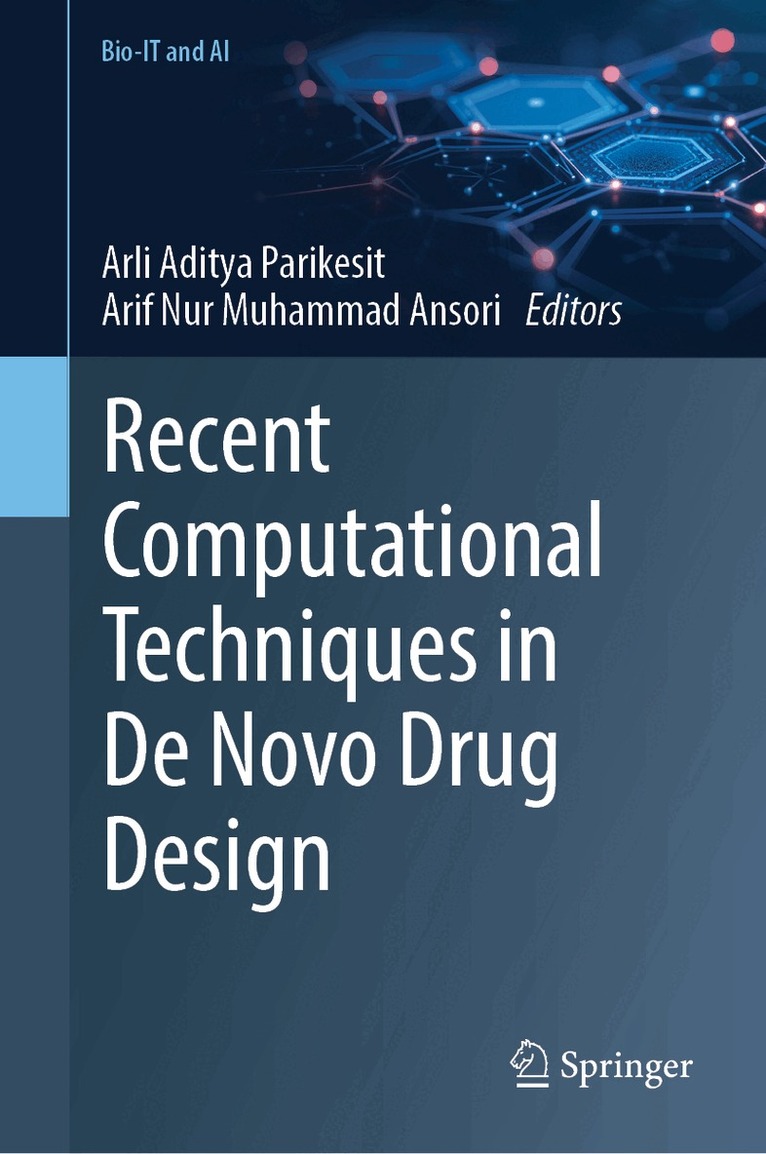
    Recent Computational Techniques in De Novo Drug Design

    AvArli Aditya Parikesit,Arif Nur Muhammad Ansori

    Inbunden, Engelska, 2026

    Del i serien Bio-IT and AI

    1 842 kr

    Beställningsvara. Skickas inom 10-15 vardagar. Fri frakt över 249 kr.

    Beskrivning

    “Recent Computational Techniques in De Novo Drug Design” gives a thorough overview of modern computational methods used to discover new chemical compounds. The book looks at how fragment-based design, evolutionary algorithms, free-energy-guided optimization, and deep generative models have helped advance molecular discovery. It also discusses important challenges such as synthetic accessibility and ADME/Tox issues. The book explains how structural bioinformatics, cheminformatics, and machine learning work together to speed up hit generation and lead optimization in both academic and industry settings.The chapters start by introducing the basics of de novo drug design and explain how it differs from virtual screening and QSAR methods. The book describes the shift from rule-based techniques to those driven by artificial intelligence that use a wide range of molecular data. The content is organized into sections on structure-based and ligand-based methods, MD and QM approaches, deep learning applications, and case studies from different therapeutic areas.

    Produktinformation

    • Utgivningsdatum:2026-05-15
    • Mått:155 x 235 x 25 mm
    • Vikt:697 g
    • Format:Inbunden
    • Språk:Engelska
    • Serie:Bio-IT and AI
    • Antal sidor:343
    • Förlag:Springer Nature Switzerland AG
    • ISBN:9783032204271

    Utforska kategorier

    • Fysikalisk kemi inom Naturvetenskap och teknik
    • Biovetenskap inom Naturvetenskap och teknik
    • Tillämpad datateknik inom Data och IT

    Mer om författaren

    Prof. Dr.rer.nat. Arli Aditya Parikesit is a Bioinformatics Streaming Professor at i3L University (formerly Indonesia International Institute for Life Sciences). He earned his bachelor's and master's degrees in chemistry from the University of Indonesia with Biotechnology specialization. Awarded by the German Academic Exchange Service (DAAD), he pursued his doctorate in bioinformatics at the University of Leipzig, Germany, with a focus on protein domain annotation across the three domains of life. Prof. Parikesit specializes in immunoinformatics, structural bioinformatics, in silico drug design, and transcriptomics. He developed pipelines for COVID-19 drug and vaccine design and is currently advancing LAMP-CRISPR diagnostics for infectious diseases, combining cutting-edge bioinformatics with practical applications in global health.Dr. Arif Nur Muhammad Ansori has extensive experience in virology, molecular biology, and bioinformatics. He earned his doctoral degree from Universitas Airlangga, Indonesia. Currently, he serves as a researcher at the Postgraduate School, Universitas Airlangga, and at the Division of Genomics and Transcriptomics, Joint Research Center for Human Retrovirus Infection, Kumamoto University, Japan. He is also an Adjunct Faculty Member at the Uttaranchal Institute of Pharmaceutical Sciences, Uttaranchal University, India, and the Director of the Virtual Research Center for Bioinformatics and Biotechnology (VRCBB), Indonesia. Dr. Ansori contributes as a board member for esteemed journals, including Scientific Reports (Springer Nature), Frontiers in Virology (Frontiers Media SA), BMC Microbiology (BioMed Central), Journal of Translational Medicine (BioMed Central), Canadian Journal of Infectious Diseases and Medical Microbiology (John Wiley & Sons), and Frontiers in Drug Discovery (Frontiers Media SA). In addition, he is also an Advisory Board Member of Clinical Nutrition ESPEN (Elsevier). Dr. Ansori is also an active member of multiple scientific societies, such as the European Virus Bioinformatics Center (EVBC), the Indonesian Young Academy of Science (ALMI), the American Society for Virology (ASV), the American Society of Microbiology (ASM), the World Society for Virology (WSV), and the Council of Asian Science Editors (CASE). Recognized for his contributions to public science communication, Dr. Ansori was honored with the TCID Author Award in 2023, selected by The Conversation Indonesia.

    Innehållsförteckning

    • Chapter 1. Fundamentals of Generative AI in Drug Development.- Chapter 2. Computational Design of mRNA-based Cancer Immunotherapies.- Chapter 3. Protein and Peptide Design with Generative AI.- Chapter 4. Exploring Chemical Space with Generative Models.- Chapter 5. Prediction of Drug Likeness and Synthetic Accessibility Using AI: A Case Study on Potential Therapeutic Compounds from Plants for SARS-CoV-2 Treatment.- Chapter 6. Challenges in AI-Generated Drug Candidates.- Chapter 7. AI-Driven Network Pharmacology in Natural Product-Based Drug Design: A Systems Bioinformatics Perspective.- Chapter 8. Applications of Generative AI in Small Molecule Drug Discovery.- Chapter 9. Generative AI for Antimicrobial and Antiviral Drug Design.- Chapter 10. Integration of AI-Driven Drug Design in Industry and Academia.- Chapter 11. Trends of Open-Source Tools and Frameworks for AI Drug Design.- Chapter 12. Future Horizons: Collaboration of Advanced Pharmaceutical Labs and Computational Sciences.