• Fri frakt över 249 kr
  • •
  • Snabba leveranser
  • •
  • Billiga böcker
Kundservice

Du är på sajten för privatpersoner.

Företag, bibliotek eller offentlig verksamhet?

Du handlar på classic.bokus.com, där alla dina funktioner finns intakta.
Till classic.bokus.com
Bokus logotyp. Gå till startsidan.
  • Erbjudanden
  • Nyheter
  • Student
  • Topplistor
  • Barn & ungdom
  • Bokus Play
  • E-böcker
  • Pocketböcker
  • Spel & pussel

10% rabatt på allt med kod: NYSTART10 →

Sidfot

Mina sidor

    Hjälp

    • Kundservice
    • Vanliga frågor och svar
    • Frakt och leverans
    • Retur vid ångerrätt
    • Reklamera vara
    • Betalning
    • Köpvillkor
    • Allmänna villkor
    • Information om webbplatsens tillgänglighet

    Om Bokus

    • Om oss
    • Pressrum
    • För studenter
    • För företag
    • För bibliotek och offentlig verksamhet
    • För leverantörer
    • Hållbarhet

    Populärt

    • Aktuella erbjudanden
    • Presentkort
    • Studentlitteratur
    • Nya böcker
    • Topplistor
    • Signerade böcker
    • Engelska böcker

    Inspiration

    • Boktips
    • BookTok
    • Populära bokserier
    • Barnbokskaraktärer
    • Populära författare
    Logotyp för Bokus
    Följ oss på Facebook (extern länk)Följ oss på Instagram (extern länk)Följ oss på YouTube (extern länk)Följ oss på TikTok (extern länk)
    bokus @ CookiesAnpassa cookiesIntegritetspolicyKöpvillkor
    Till Citymail hemsida (extern länk)Till Budbee hemsida (extern länk)Till Postnord hemsida (extern länk)Till Schenker hemsida (extern länk)Till Early Bird hemsida (extern länk)Till Walleys hemsida (extern länk)
    1. Ekonomi och Ledarskap
    2. Nationalekonomi
    3. Ekonomisk historia

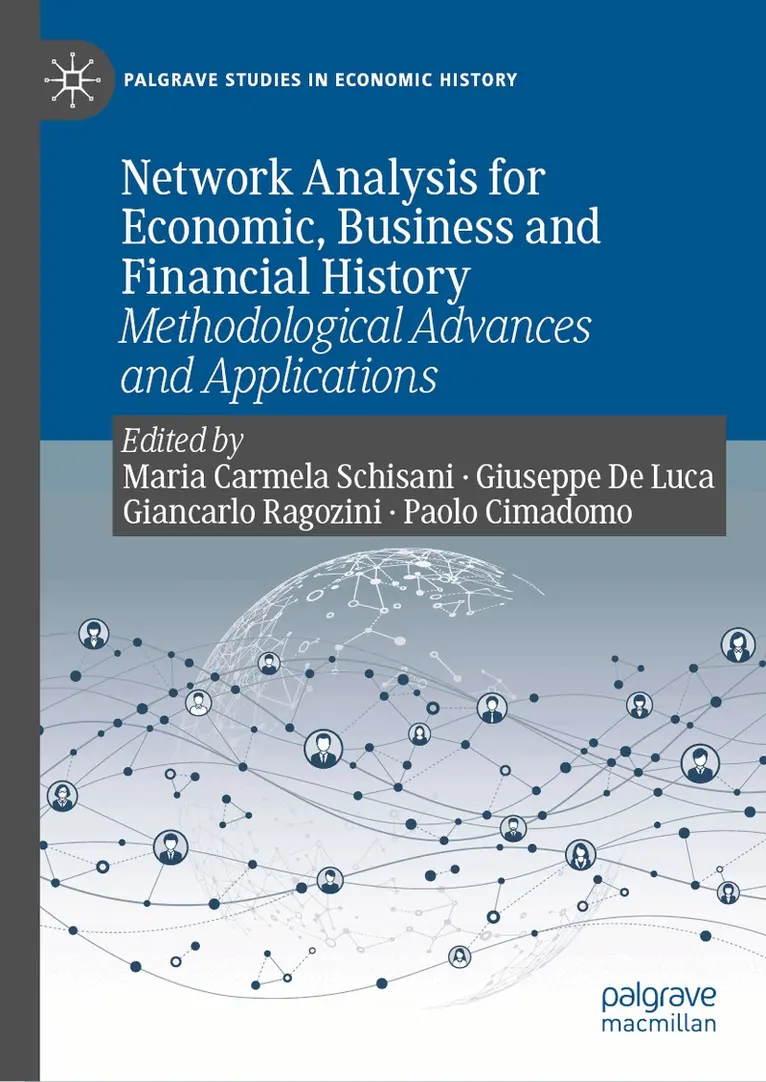
    Network Analysis for Economic, Business and Financial History

    Methodological Advances and Applications

    AvMaria Carmela Schisani,Giuseppe De Luca

    Inbunden, Engelska, 2026

    Del i serien Palgrave Studies in Economic History

    1 949 kr

    Beställningsvara. Skickas inom 5-8 vardagar. Fri frakt över 249 kr.

    Beskrivning

    This book presents a state-of-the-art picture of advances in social network research for economic, business, and financial historians. It showcases recent development in the methodology and application of social network analysis to historical research and draws out the unique benefits for economic history and related fields. Social network analysis is increasingly understood to be an important part of historical research, allowing scholars to balance qualitative investigation with rigorous quantitative techniques. Through a global set of case studies spanning ancient, medieval, early modern and modern history, this edited volume demonstrates the interpretative potential of various SNA approaches to different sets of historical data. The chapters contribute to methodological understanding of SNA in economic history, as well as showing through the case studies how network analysis can decode complex social and economic interactions over time, making visible those relational patterns that were invisible to contemporary historical actors. This cutting-edge resource will be appeal widely to academics in economic, business and financial history, as well as statistics researchers and social scientists looking to strengthen their quantitative research skills.

    Produktinformation

    • Utgivningsdatum:2026-05-19
    • Mått:148 x 210 x 34 mm
    • Vikt:806 g
    • Format:Inbunden
    • Språk:Engelska
    • Serie:Palgrave Studies in Economic History
    • Antal sidor:496
    • Förlag:Springer Nature Switzerland AG
    • ISBN:9783032213549

    Utforska kategorier

    • Ekonomisk historia inom Ekonomi och Ledarskap
    • Finansiering inom Ekonomi och Ledarskap
    • Matematisk statistik inom Naturvetenskap och teknik

    Mer om författaren

    Maria Carmela Schisani is Professor of Economic History at the University of Naples Federico II.  She is affiliated researcher with the ISEM and ISMed institutes of the National Research Council (CNR). Her research interests focus mainly on financial and business history. She also specializes in network analysis applied to historical economic and financial data. She is author of several publications, some of them in high-impact international scientific journals such as Cliometrica, European Review of Economic History and Business History. Giuseppe De Luca (Italy) is Professor of Economic History at the University of Milan and Director of the Bachelor’s programme in Economics and Management. He is Associated Researcher at the National Research Council of Italy (CNR), Institute of Mediterranean Europe History (ISEM). His research focuses on pre-industrial public debt, the role of notaries in lending markets, and the historical development of infrastructure and healthcare financing in Europe. He has led several major international research projects, including A-RING (2019–2022), and is co-editor of the journal Cheiron. Giancarlo Ragozini is Professor of Social Statistics at the Department of Political Science, University of Naples Federico II. His research interests range from statistical methods for social network analysis to computational statistics and multivariate methods for data analysis, sport analytics, quantitative history, life course studies. He is author of over 150 publications (72 in Scopus), many of them in high-impact international scientific journals such as Social Network, Network Science, Computational Statistics and Data Analysis, Cliometrica, European Review of Economic History and Business History. Paolo Cimadomo (Italy/USA) is a Marie Skłodowska-Curie Actions (MSCA) fellow at Sapienza University of Rome, heading the EARTH (Earthquakes And Community Resilience Through Historical Analysis) project. He has held research positions at institutions like the University of Naples “Federico II”, the University of Haifa, Georgetown University in Washington DC and the University Sapienza of Rome. Cimadomo has also contributed to museum initiatives and possesses teaching experience at several universities. His research centers on the Eastern Mediterranean through Greek, Roman, and Late Roman periods, with focuses on network reconstruction, land use, climate influences, and environment-human interactions. Since 2019, he has applied social network analysis to studying the ancient past.

    Innehållsförteckning

    • Introduction.- Part I  Thinking in Networks: Approaches to Economic, Business, and Financial History.- Decoding Complex Socio-Economic Interactions in History through Social Network Analysis.- Improving Business History through Social Network Analysis and data.- Webs of Money: Social Network Analysis and Financial History.- Network-Based Bibliometric Analysis in Economic History.- Part II   Connecting the Past: Case-Based Approaches to Networks in Economic History.- II.1 Threads of Antiquity: Economic and Cultural Networks Across the  Mediterranean.- Trade and Cultural Transmission in lived spaces from central Italy from the Final Bronze Age to the Archaic Period (1100-500 BC): an Exploratory Network Analysis.- Exploring pottery distributions and regional economies through network analysis and GIS: Kalapodi and its region in the Roman period as a case study.- Maritime Trade in the Eastern Mediterranean: A Quantitative Analysis of Shipwreck Data from the Hellenistic Period through Late Antiquity (4th Century BCE – 7th Century CE).- II.2  Forging Markets: Credit, Networks, and Intermediation in Pre-Modern Europe.- Credit Networks in the 14th-century rural countryside of Tyrol. Importance and Functioning.- Forced Loans and Lenders’ Networks in Seville: Coercion, Credit, and the Origins of a Proto-Financial Market (1523-1563) .- Relational Capital, Weak Ties, and Economic Intermediation. The Global Network built by Jerónimo de Cataño (1536-1589).- High Finance Networks in Renaissance Florence.- II.3  Networks of Influence: Business, Trust, and Governance Across Borders and Centuries in the Contemporary age.- Weaving Trust: Notaries and Credit Market (Networks) in 19th century Milan.- Studying insularity through business networks: the isle of Procida in 19th-century South of Italy.- Not a destiny. National corporate networks compared: Argentina and Italy 1913-2010.- Fellowship Society Members in Corporate Boards: Evidence from the Netherlands in the 20th Century.