• Fri frakt över 249 kr
  • •
  • Snabba leveranser
  • •
  • Billiga böcker
Kundservice

Du är på sajten för privatpersoner.

Företag, bibliotek eller offentlig verksamhet?

Du handlar på classic.bokus.com, där alla dina funktioner finns intakta.
Till classic.bokus.com
Bokus logotyp. Gå till startsidan.
  • Erbjudanden
  • Nyheter
  • Student
  • Topplistor
  • Barn & ungdom
  • Bokus Play
  • E-böcker
  • Pocketböcker
  • Spel & pussel

10% rabatt på allt med kod: NYSTART10 →

Sidfot

Mina sidor

    Hjälp

    • Kundservice
    • Vanliga frågor och svar
    • Frakt och leverans
    • Retur vid ångerrätt
    • Reklamera vara
    • Betalning
    • Köpvillkor
    • Allmänna villkor
    • Information om webbplatsens tillgänglighet

    Om Bokus

    • Om oss
    • Pressrum
    • För studenter
    • För företag
    • För bibliotek och offentlig verksamhet
    • För leverantörer
    • Hållbarhet

    Populärt

    • Aktuella erbjudanden
    • Presentkort
    • Studentlitteratur
    • Nya böcker
    • Topplistor
    • Signerade böcker
    • Engelska böcker

    Inspiration

    • Boktips
    • BookTok
    • Populära bokserier
    • Barnbokskaraktärer
    • Populära författare
    Logotyp för Bokus
    Följ oss på Facebook (extern länk)Följ oss på Instagram (extern länk)Följ oss på YouTube (extern länk)Följ oss på TikTok (extern länk)
    bokus @ CookiesAnpassa cookiesIntegritetspolicyKöpvillkor
    Till Citymail hemsida (extern länk)Till Budbee hemsida (extern länk)Till Postnord hemsida (extern länk)Till Schenker hemsida (extern länk)Till Early Bird hemsida (extern länk)Till Walleys hemsida (extern länk)
    1. Naturvetenskap och teknik
    2. Matematik och naturvetenskap
    3. Biologi
    4. Biovetenskap

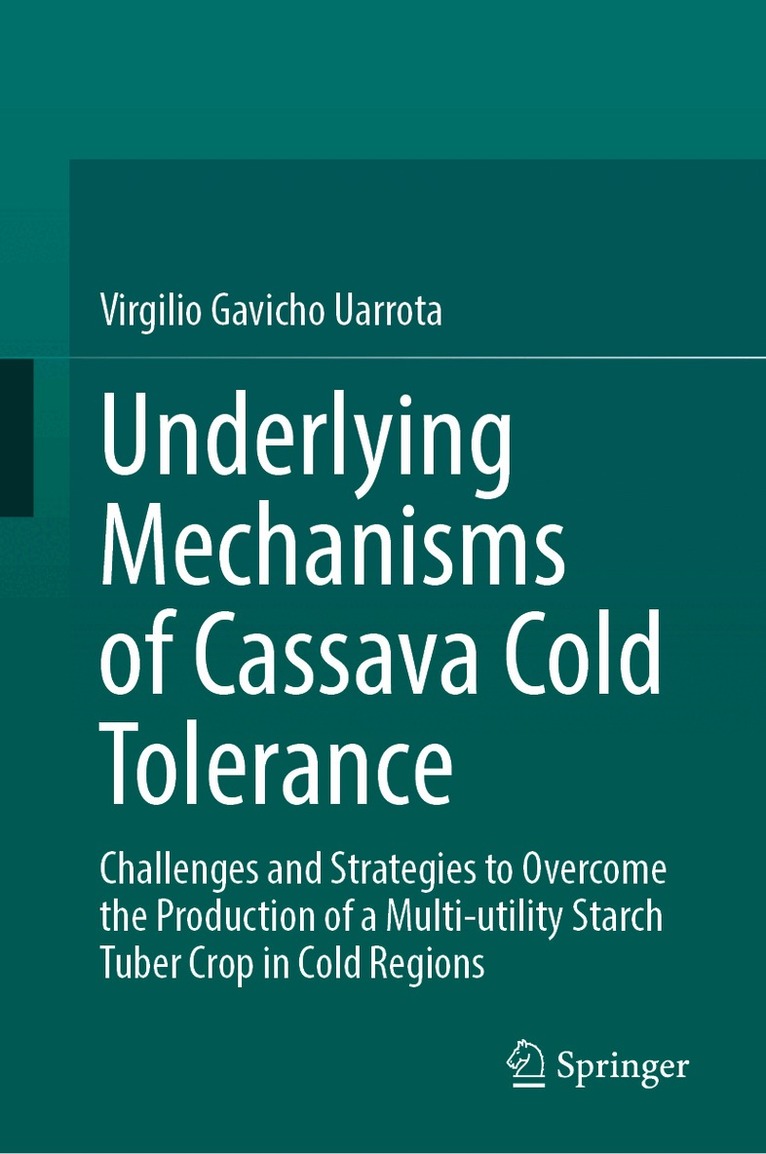
    Underlying Mechanisms of Cassava Cold Tolerance

    Challenges and Strategies to Overcome the Production of a Multi-utility Starch Tuber Crop in Cold Regions

    AvVirgilio Gavicho Uarrota,Virgilio Gavicho Uarrota

    Inbunden, Engelska, 2026

    1 725 kr

    Kommande

    Beskrivning

    Cassava (Manihot esculenta Crantz) is a vital crop for millions, serving as a staple food and a key resource for industries ranging from starch production to bioethanol. Known for its adaptability to poor soils and unpredictable rainfall, cassava has earned its place as a "future crop" in the face of climate change. However, its sensitivity to cold stress has limited its potential in temperate regions, leaving a gap in understanding how this resilient plant can thrive in colder climates.This book brings together the latest research on cassava's response to cold stress, exploring its physiological, genetic, and metabolic mechanisms. Drawing on insights from agronomy and biotechnology, it examines the possibilities of developing cold-tolerant cultivars using the genetic diversity found in international germplasm banks. The authors also discuss practical strategies to scale up cassava production in new regions, offering hope for expanded cultivation and industrial use.Ideal for researchers, plant breeders, and policymakers, Underlying Mechanisms of Cassava Cold Tolerance highlights the untapped potential of this crop. By addressing one of its greatest challenges, this book opens the door to a more sustainable and food-secure future.

    Produktinformation

    • Utgivningsdatum:2026-11-17
    • Mått:155 x 235 x undefined mm
    • Format:Inbunden
    • Språk:Engelska
    • Antal sidor:209
    • Förlag:Springer Nature Switzerland AG
    • ISBN:9783032237231

    Utforska kategorier

    • Biovetenskap inom Naturvetenskap och teknik
    • Växtböcker inom Djur och Natur
    • Botanik inom Naturvetenskap och teknik

    Mer om författaren

    Prof. Dr. Virgilio Gavicho Uarrota is from Mozambique, is an agronomic engineer at Eduardo Mondlane University (Mozambique) with an MSc in Biotechnology and a PhD in Plant Genetic Resources from the Federal University of Santa Catarina (Brazil). Dr. Uarrota is currently an Assistant Professor at Universidad de O’Higgins. Lecturer of Plant Physiology, Seed Production, Horticulture I, Plant Propagation and Nursery Management, and Statistics for Agronomic and Environmental Engineering at the Institute of Agri-Food, Animal and Environmental Sciences (ICA3). He took up his third postdoctoral position in the Department of Postharvest and Industrialization, Faculty of Agronomy, Pontificia Universidad Catolica de Valparaiso, Quillota, Chile. His first postdoctoral position was in biotechnology and biosciences with focus on bioinformatics and chemometrics, and his second postdoctoral position was in crop production with research line in physiology of crop plants. He has over 8 years of experience in teaching mathematics, biology, and physics and more than 13 years of research experience in plant biochemistry, metabolomics, and chemometrics. Dr. Virgilio Uarrota has participated as collaborator professor in plant biochemistry, crop production physiology, and physiology and biochemistry of seed development, and applied multivariate statistics at Universidad Tecnica de Manabí (Ecuador), Ecophysiology, Plant Propagation and seedling nursery and Biotechnological tools applied to agronomy. Dr. Uarrota has received the Twas-Associateship Scheme Project as visiting researcher (2013 and 2017) at Unisa and at the International Centre of Tropical Agriculture (CIAT). He is a reviewer of many international journals, and has authored and co-authored over 40 research papers in high impact factor international journals, and more than 8 books and chapters with Springer, CRC, and Burleigh Dodds publishing. He has co-supervised 1 MSc student and participated in more than 10 examination committees of PhD and MSc students. Dr. Uarrota has delivered many short courses in data mining and an introduction to multivariate statistics, and he is an editorial board member of the journal Computational Biology and Bioinformatics and International Journal of Food Science and Biotechnology. He is also Guest Editor of Horticulturae Journal and Frontiers in Plant Science. Dr Uarrota is also a section Editor of “Revista Agropecuaria Catarinense” Journal and Supervisor of 04 Graduate thesis in Agronomy at Universidad de O’Higgins.

    Innehållsförteckning

    • Cassava growth and development basic characteristics and relationship with cold stress.-  Cassava cold tolerance from seasonally low temperatures in higher latitudes and relatively constant low temperatures in highland environments.- Management practices of plant materials to support cassava production in cooler climates and potential for further adaptation.- Advances in understanding cold tolerance regulatory mechanisms in cassava.- Effects of photoperiod on cassava growth and development and genotype environment interaction Implications for adapting new varieties to cold climates.- Mechanisms and approaches towards enhanced cold tolerance in cassava.- Cell signaling during cold stress in cassava.- Global Gene Expression Analysis in cold stressed cassava plants.- Agronomic and physiological Responses of cassava cultivars to cold stress.- Ability of cassava plants to endure seasonal low but non freezing temperatures.- Strategies to improve cold tolerance in cassava accessions.- Up and Downregulation of novel candidate genes to cold stress in cassava.- Effect of cold stress on cassava amino acid and carbohydrate metabolisms and antioxidant responses.- Effect of photoperiod prior to cold acclimation on freezing tolerance and cassava secondary metabolism.- Toward Engineering Cold Stress Tolerance in cassava.- Advances and challenges in uncovering cold tolerance regulatory mechanisms in cassava.- Physiological and Molecular Mechanism Involved in Cold Stress Tolerance in cassava.- Recent insights into cell responses to cold stress in cassava.- Modelling cassava production to undergoing climate change Challenges and strategies.