• Fri frakt över 249 kr
  • •
  • Snabba leveranser
  • •
  • Billiga böcker
Kundservice

Du är på sajten för privatpersoner.

Företag, bibliotek eller offentlig verksamhet?

Du handlar på classic.bokus.com, där alla dina funktioner finns intakta.
Till classic.bokus.com
Bokus logotyp. Gå till startsidan.
  • Erbjudanden
  • Nyheter
  • Student
  • Topplistor
  • Barn & ungdom
  • Bokus Play
  • E-böcker
  • Pocketböcker
  • Spel & pussel

10% rabatt på allt med kod: NYSTART10 →

Sidfot

Mina sidor

    Hjälp

    • Kundservice
    • Vanliga frågor och svar
    • Frakt och leverans
    • Retur vid ångerrätt
    • Reklamera vara
    • Betalning
    • Köpvillkor
    • Allmänna villkor
    • Information om webbplatsens tillgänglighet

    Om Bokus

    • Om oss
    • Pressrum
    • För studenter
    • För företag
    • För bibliotek och offentlig verksamhet
    • För leverantörer
    • Hållbarhet

    Populärt

    • Aktuella erbjudanden
    • Presentkort
    • Studentlitteratur
    • Nya böcker
    • Topplistor
    • Signerade böcker
    • Engelska böcker

    Inspiration

    • Boktips
    • BookTok
    • Populära bokserier
    • Barnbokskaraktärer
    • Populära författare
    Logotyp för Bokus
    Följ oss på Facebook (extern länk)Följ oss på Instagram (extern länk)Följ oss på YouTube (extern länk)Följ oss på TikTok (extern länk)
    bokus @ CookiesAnpassa cookiesIntegritetspolicyKöpvillkor
    Till Citymail hemsida (extern länk)Till Budbee hemsida (extern länk)Till Postnord hemsida (extern länk)Till Schenker hemsida (extern länk)Till Early Bird hemsida (extern länk)Till Walleys hemsida (extern länk)
    1. Medicin
    2. Medicin: allmänt
    3. Samhällsmedicin och preventiv medicin
    4. Folkhälsa och hälsopedagogik

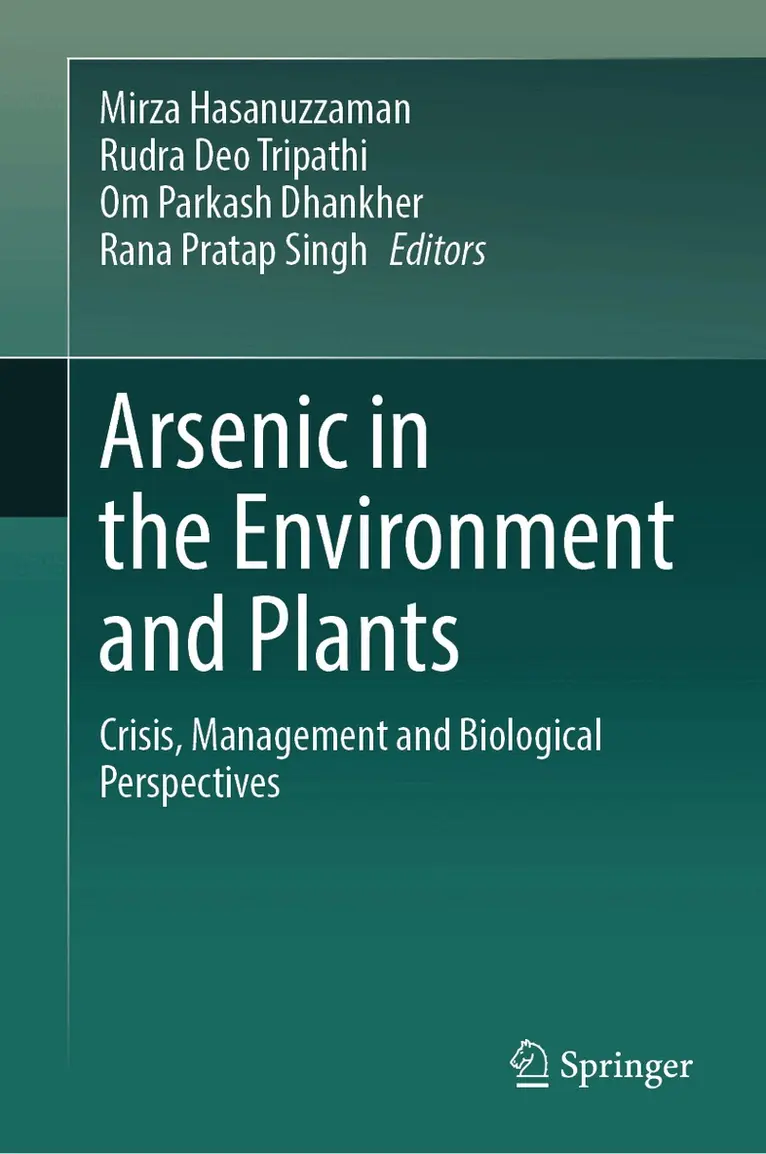
    Arsenic in the Environment and Plants

    Crisis, Management and Biological Perspectives

    AvMirza Hasanuzzaman,Rudra Deo Tripathi

    Inbunden, Engelska, 2026

    3 133 kr

    Kommande

    Beskrivning

    This book compiles the latest research and insights on arsenic's impact on the environment, emphasizing the urgency and scale of this issue. The complexity of As contamination demands a multidisciplinary approach. This book brings together experts from environmental science, biology, public health, and policy to provide a comprehensive overview of arsenic’s environmental impact, biological consequences, and the strategies for its management. The book serves as an essential resource for students, researchers, and professionals in environmental sciences, offering a detailed study of As behavior in the environment and its biological effects. It bridges the gap between theoretical knowledge and practical applications.    By including sections on management strategies and policy recommendations, the book serves as a guide for policymakers and environmental managers. It offers evidence-based strategies for mitigating arsenic contamination and protecting public health. The book provides an updated compilation of the latest research, including cutting-edge methods for As detection, removal, and management. This makes it a valuable resource for staying abreast of recent advancements in the field. Incorporating case studies from different regions of the world, the book highlights the global nature of arsenic contamination while also providing insights into local challenges and solutions. This helps in understanding the diverse impacts and management strategies across various geographical contexts. Given the toxicological significance of As, the book emphasizes its implications for public health. The collaborative nature of this book project fosters networking among professionals and researchers from different fields, promoting interdisciplinary collaboration and knowledge exchange.Ultimately, the book aims to have a long-term impact on how arsenic contamination is understood, managed, and mitigated, contributing to safer, healthier environments and communities. Editing this book is not only about compiling scientific knowledge but also about making a tangible impact in the field of environmental management and public health, addressing a critical issue that affects both ecosystems and human societies worldwide.

    Produktinformation

    • Utgivningsdatum:2026-10-27
    • Mått:155 x 235 x undefined mm
    • Format:Inbunden
    • Språk:Engelska
    • Antal sidor:797
    • Förlag:Springer Nature Switzerland AG
    • ISBN:9783032271952

    Utforska kategorier

    • Folkhälsa och hälsopedagogik inom Medicin
    • Växtböcker inom Djur och Natur
    • Botanik inom Naturvetenskap och teknik

    Mer om författaren

    Dr. Mirza Hasanuzzaman is a Professor of Agronomy at Sher-e-Bangla Agricultural University, Dhaka. He earned his Ph.D. from Ehime University, Japan, completed postdoctoral research at the University of the Ryukyus, and later served as an Adjunct Senior Researcher at the University of Tasmania. He has supervised 50+ Master’s, 5 Ph.D., and 4 postdoctoral researchers, and published over 300 Scopus-indexed papers, 25 books, and 50+ book chapters, with 38,000+ citations (h-index 98). He is an editor/reviewer for 80+ journals, a recipient of major awards including TWAS (2014), UGC Gold Medal (2018), and BAS Gold Medal (2022), and a fellow of several international scientific societies.Dr. Om Parkash Dhankher is a Professor of Agricultural Biotechnology at the University of Massachusetts Amherst, USA. He earned his M.Sc. and M.Phil from Kurukshetra University, India, his Ph.D. from Durham University, UK, and completed postdoctoral training at the University of Georgia, USA. He is a recognized leader in climate-resilient crops, environmental remediation, and sustainable biotechnology, with 150+ publications, 7 edited books, and 6 international patents. He has received several awards including the Commonwealth Scholarship and honors from the American Chemical Society and UMass Amherst, and is a Fellow of multiple international scientific societies including AAAS, CSSA, ASA, and ASPB.Dr. Rudra Deo Tripathi earned his Ph.D. (1979) in Botany from DDU Gorakhpur University and later joined CSIR–National Botanical Research Institute, Lucknow, where he became Chief Scientist and Professor. He also served as CSIR-Emeritus Scientist and is currently NASI Senior Scientist Fellow and Emeritus Professor (AcSIR). He has led 21 research projects and conducted postdoctoral research in India, the UK, and Germany, with contributions to metal uptake and phytochelatin regulation. A Fellow of several academies, he has received multiple awards including the INSA Young Scientist Medal (1981) and Panchanan Maheshwari Medal (2023). With 250+ publications (23,000+ citations; h-index 85), he has guided 15 Ph.D. scholars and works on phytoremediation, arsenic metabolism, and low-arsenic rice development.Dr. Rana Pratap Singh is a former Senior Professor at Babasaheb Bhimrao Ambedkar University, Lucknow, and currently serves as Editor-in-Chief and Honorary Director at PHSS Foundation. He earned his Ph.D. from Devi Ahilya University and held several key academic and administrative roles, including Dean, Controller of Examinations, and Chairman of SEIAA, UP. A Fellow of NASI and other societies, he has mentored 8 postdocs and 42 Ph.D. scholars, with 200+ publications and over 8,000 citations (h-index 48), contributing extensively to biochemistry, biotechnology, and environmental sciences.

    Innehållsförteckning

    • The current status and historical context of arsenic toxicity in the world.- Arsenic in thesoil-plant-water continuum of bangladesh: mechanisms, health impacts, and evidence-based interventions.- Prevalence and mitigation of arsenic in soil and ground water in the global ecosystems.- Factors influencing bioavailability of arsenic to crops.- Arsenic dynamics in the soil–water continuum: sources, bioavailability, and remediation strategies.- Arsenic toxicity in crop plants: responses and remediation strategies.- Arsenic contamination and plant responses: from uptake to genetic mitigation strategies.- Plants response and tolerance to arsenic-induced oxidative stress.- Modulation of antioxidant defense in arsenic stressed rice (oryza sativa l.) by phytoextract pretreatment: mechanistic insights.- Biotransformation of arsenic salts in rhizosphere, uptake and genomic regulation for tolerance in crop plants: a chemical signaling.- Biotransformation of arsenic in soil and adequate environments.- Arsenic stress in plants: a minireview on toxicity, uptake, and prospects for phytoremediation.- Managing arsenic in crops: advances in soil interactions and plant transport mechanisms.- Understanding the toxic effects of arsenic on environment and human health: challenges and mitigation strategies.- Recent advances in selenium and nano-selenium mediated mitigation of arsenic stress in plants.- Using gene editing tools in conferring arsenic tolerance in plants.- adsorbent-based remediation of arsenic pollution in the environment.- Removal of arsenic from water by adsorption.- Arbuscular mycorrhizal associations as a bioremediation strategy for arsenic contaminated soils.- Algae based systems for bioremediation of arsenic contaminated environments.- Plant growth-promoting microorganisms in arsenic stress alleviation: physiological, biochemical, and molecular perspectives.- Arsenic stress reduction: function of endophytic microbes.- microbial mechanisms and applications in arsenic bioremediation.- The mutual influence of arsenic, iron and zinc on their bioavailability in soil and their uptake in crop plants: challenges for micronutrient deficiency.- Potential use of soil amendments in mitigating arsenic stress in plants.- Sustainable interventions for arsenic stress management in crop plants.- Enrichment and modification of biochar for mitigation of arsenic toxicity.- Soil amendment and remediation arsenic toxicity in crop fields: case studies and challenges.- Nanotechnology for the mitigation of arsenic toxicity.- Omics advancements towards exploring arsenic stress and its regulation in plants.