• Fri frakt över 249 kr
  • •
  • Snabba leveranser
  • •
  • Billiga böcker
Kundservice

Du är på sajten för privatpersoner.

Företag, bibliotek eller offentlig verksamhet?

Du handlar på classic.bokus.com, där alla dina funktioner finns intakta.
Till classic.bokus.com
Bokus logotyp. Gå till startsidan.
  • Erbjudanden
  • Nyheter
  • Student
  • Topplistor
  • Barn & ungdom
  • Bokus Play
  • E-böcker
  • Pocketböcker
  • Spel & pussel

10% rabatt på allt med kod: NYSTART10 →

Sidfot

Mina sidor

    Hjälp

    • Kundservice
    • Vanliga frågor och svar
    • Frakt och leverans
    • Retur vid ångerrätt
    • Reklamera vara
    • Betalning
    • Köpvillkor
    • Allmänna villkor
    • Information om webbplatsens tillgänglighet

    Om Bokus

    • Om oss
    • Pressrum
    • För studenter
    • För företag
    • För bibliotek och offentlig verksamhet
    • För leverantörer
    • Hållbarhet

    Populärt

    • Aktuella erbjudanden
    • Presentkort
    • Studentlitteratur
    • Nya böcker
    • Topplistor
    • Signerade böcker
    • Engelska böcker

    Inspiration

    • Boktips
    • BookTok
    • Populära bokserier
    • Barnbokskaraktärer
    • Populära författare
    Logotyp för Bokus
    Följ oss på Facebook (extern länk)Följ oss på Instagram (extern länk)Följ oss på YouTube (extern länk)Följ oss på TikTok (extern länk)
    bokus @ CookiesAnpassa cookiesIntegritetspolicyKöpvillkor
    Till Citymail hemsida (extern länk)Till Budbee hemsida (extern länk)Till Postnord hemsida (extern länk)Till Schenker hemsida (extern länk)Till Early Bird hemsida (extern länk)Till Walleys hemsida (extern länk)
    1. Naturvetenskap och teknik
    2. Matematik och naturvetenskap
    3. Biologi
    4. Biokemi

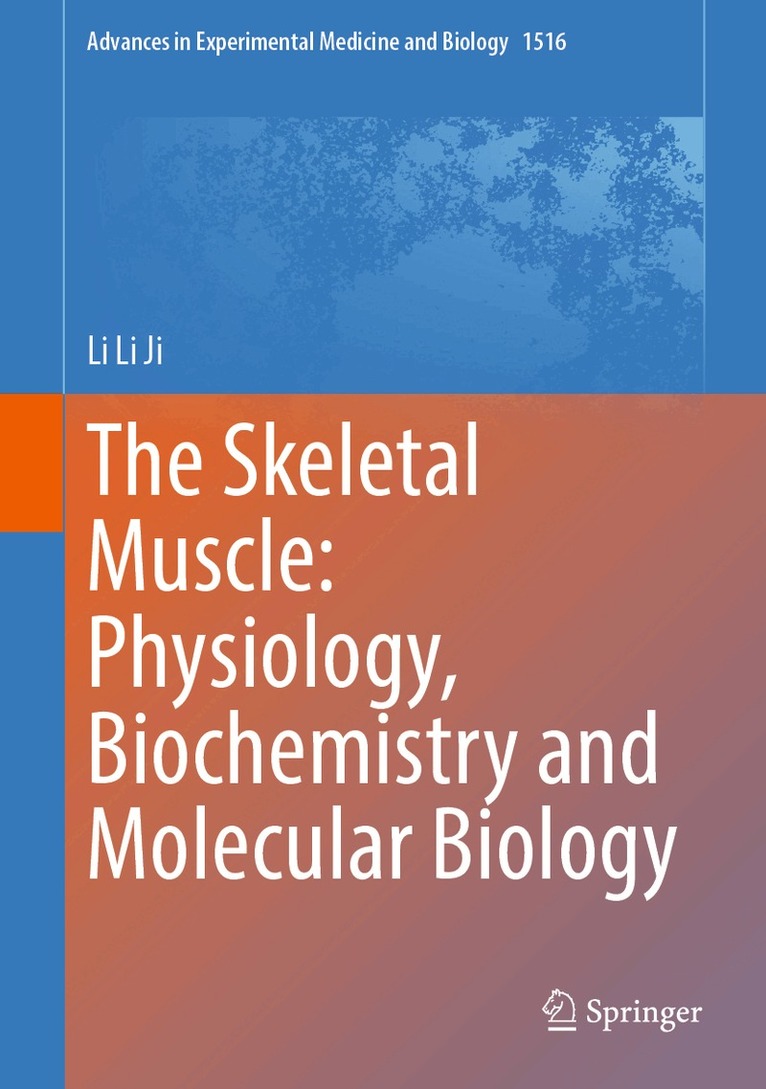
    Skeletal Muscle: Physiology, Biochemistry and Molecular Biology

    AvLi Li Ji

    Inbunden, Engelska, 2026

    Del i serien Advances in Experimental Medicine and Biology

    2 385 kr

    Kommande

    Beskrivning

    Skeletal muscle has long been viewed as an organ primarily responsible for locomotion, characterized by seemingly simple anatomical and biochemical features. The growing recognition that exercise is medicine—and that physical activity plays a vital role in health and disease prevention—has greatly increased interest in, and demand for, a deeper understanding of skeletal muscle.This book describes the fundamental biological features of skeletal muscle, including its development, gross and fine structure, contractile mechanism, bioenergetics, metabolic regulation, gene regulation, redox homeostasis, and cell signaling. It provides an up to date, chapter-by-chapter overview of knowledge derived from both historical and contemporary research, offering sufficient detail on each aspect. In-depth scientific foundations at the genetic and molecular levels are presented to enable a comprehensive understanding of how this organ supports not only locomotion but also whole-body homeostasis.A distinctive feature of the book is its emphasis on signal transduction arising from various physiological demands, highlighting hormones, cytokines, transcription factors, and reactive oxygen and nitrogen species as key messengers. This field—known as redox biology or redox signaling—has expanded rapidly over the past two decades, driven by advancements in information technology and biotechnology.

    Produktinformation

    • Utgivningsdatum:2026-09-22
    • Mått:178 x 254 x undefined mm
    • Format:Inbunden
    • Språk:Engelska
    • Serie:Advances in Experimental Medicine and Biology
    • Antal sidor:700
    • Förlag:Springer Nature Switzerland AG
    • ISBN:9783032275509

    Utforska kategorier

    • Biokemi inom Naturvetenskap och teknik
    • Biologi inom Naturvetenskap och teknik
    • Cellbiologi inom Naturvetenskap och teknik

    Mer om författaren

    Li Li Ji has been Professor and Director of the Laboratory of Physiological Hygiene and Exercise at the University of Minnesota Twin Cities since 2011. He served as the Director of School of Kinesiology during 2011-2017. Li Li Ji received his PhD (1985) and postdoctoral training (1985-87) in the Institute for Enzyme Research at University of Wisconsin-Madison and served as Assistant and Associate Professor at University of Illinois at Urbana-Champaign (1987-1993) and Full Professor at University of Wisconsin-Madison (1994-2011), including 10 years as the Chair of Kinesiology Department. Professor Ji’s research expertise is cellular and molecular exercise physiology, especially the roles of free radicals and antioxidants in muscle function, adaptation to exercise, pathogenic mechanism, cell signaling and aging. He has published over 200 peer-reviewed articles and book chapters and given over 180 invited international and domestic lectures. His recent research focus has been on mitochondrial quality control and redox signaling in skeletal muscle. Professor Ji has served on many editorial boards and currently is the senior deputy editor-in-chief of Sport Medicine and Health Science. He has been a Fellow of the American College of Sports Medicine (ACSM) since 1990, member of the National Academy of Kinesiology (NAK) since 2006, and Fellow of the Society for Redox Biology and Medicine (SfRBM) since 2022. His scholarly work has received over 26,266 citations and earned a Google Scholar h-index of 84. Professor Ji received the prestigious Citation Award from ACSM in 2023 and was granted an Honorary Doctorate Degree (Doctor Honoris Causa) from Hungarian National University of Sport Science in 2020. He has established broad collaborations with universities and research institutions over the world. In 2023 Professor Ji received a Special Contribution Award from the Chinese Exercise Physiological Society for his decades-long collaboration with China in Exercise Physiology.

    Innehållsförteckning

    • Part I. Origin of the Skeletal Muscle.- Chapter 1. History of Skeletal Muscle Research.- Chapter 2. Development of Skeletal Muscle.- Part II. Skeletal Muscle Architecture and Function.- Chapter 3. Morphology of Skeletal Muscle.- Chapter 4. Molecular Structure of Muscle Proteins.- Chapter 5. Excitation-Contraction Coupling.- Chapter 6. Skeletal Muscle Fiber Type.- Chapter 7. Neural Control of Muscle Function.- Chapter 8. Regulation of Muscle Blood Flow.- Part III. Bioenergetics of Muscle Contraction.- Chapter 9. Thermodynamic and Enzymatic Governance of Bioenergetics.- Chapter 10. Endogenous Energy Sources for Muscle Contraction.- Chapter 11. Glucose Metabolism in Muscle.- Chapter 12. Fatty Acid Utilization in Muscle.- Chapter 13. Integration of Muscle Fuel Utilization.- Chapter 14. Mitochondrial Intermediary Metabolism.- Chapter 15. Oxidative Phosphorylation.- Part IV. Protein Homeostasis in Skeletal Muscle.- Chapter 16. Amino Acid Metabolism.- Chapter 17. Muscle Proteins.- Chapter 18. Protein Degradation.- Chapter 19. Protein Synthesis.- Part V. Communication of Muscle Cells.- Chapter 20. Signal Transduction in Skeletal Muscle.- Chapter 21. Free Radical Homeostasis in Skeletal Muscle.- Chapter 22. Redox Signaling in Skeletal Muscle.