• Fri frakt över 249 kr
  • •
  • Snabba leveranser
  • •
  • Billiga böcker
Kundservice

Du är på sajten för privatpersoner.

Företag, bibliotek eller offentlig verksamhet?

Du handlar på classic.bokus.com, där alla dina funktioner finns intakta.
Till classic.bokus.com
Bokus logotyp. Gå till startsidan.
  • Erbjudanden
  • Nyheter
  • Student
  • Topplistor
  • Barn & ungdom
  • Bokus Play
  • E-böcker
  • Pocketböcker
  • Spel & pussel

Må bättre, för mindre! Upp till 50% rabatt på hälsoböcker

Sidfot

Mina sidor

    Hjälp

    • Kundservice
    • Vanliga frågor och svar
    • Frakt och leverans
    • Retur vid ångerrätt
    • Reklamera vara
    • Betalning
    • Köpvillkor
    • Allmänna villkor
    • Information om webbplatsens tillgänglighet

    Om Bokus

    • Om oss
    • Pressrum
    • För studenter
    • För företag
    • För bibliotek och offentlig verksamhet
    • För leverantörer
    • Hållbarhet

    Populärt

    • Aktuella erbjudanden
    • Presentkort
    • Studentlitteratur
    • Nya böcker
    • Topplistor
    • Signerade böcker
    • Engelska böcker

    Inspiration

    • Boktips
    • BookTok
    • Populära bokserier
    • Barnbokskaraktärer
    • Populära författare
    Logotyp för Bokus
    Följ oss på Facebook (extern länk)Följ oss på Instagram (extern länk)Följ oss på YouTube (extern länk)Följ oss på TikTok (extern länk)
    bokus @ CookiesAnpassa cookiesIntegritetspolicyKöpvillkor
    Till Citymail hemsida (extern länk)Till Budbee hemsida (extern länk)Till Postnord hemsida (extern länk)Till Schenker hemsida (extern länk)Till Early Bird hemsida (extern länk)Till Walleys hemsida (extern länk)
    1. Naturvetenskap och teknik
    2. Geovetenskap
    3. Miljövetenskap och miljöpolitik
    • Nyhet

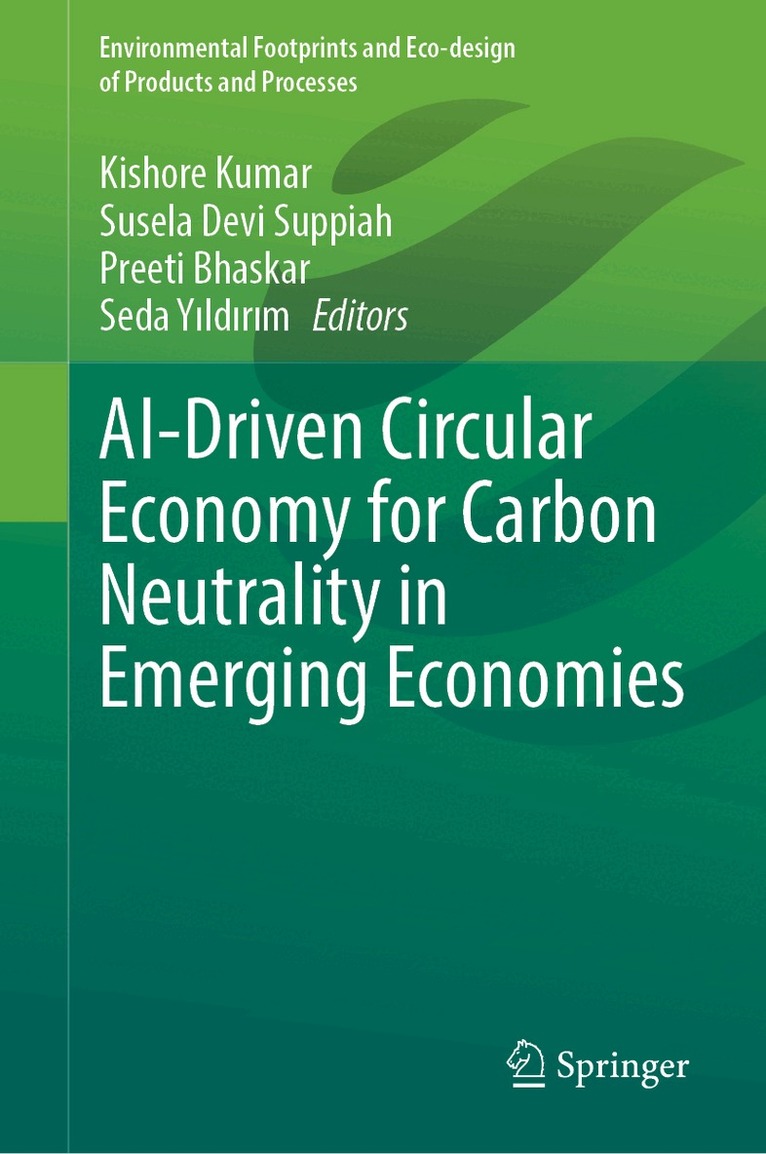
    AI-Driven Circular Economy for Carbon Neutrality in Emerging Economies

    AvKishore Kumar,Susela Devi Suppiah

    Inbunden, Engelska, 2026

    Del i serien Environmental Footprints and Eco-design of Products and Processes

    1 734 kr

    Beställningsvara. Skickas inom 10-15 vardagar. Fri frakt över 249 kr.

    Beskrivning

    This book examines the role of artificial intelligence in advancing circular economy practices, environmental sustainability, and net-zero transitions, with particular attention to developing economies. It explores how AI-based systems and technologies are being applied to support closed-loop production and consumption models, improve resource efficiency, and reduce waste across different sectors.The volume also addresses the challenges developing economies face in adopting AI-driven circular economy approaches, including resource constraints, limited technological infrastructure, policy gaps, financial limitations, weak regulatory environments, and socioeconomic barriers. By examining these issues alongside emerging opportunities and practical applications, the book contributes to ongoing discussions on inclusive and equitable sustainability transitions.

    Produktinformation

    • Utgivningsdatum:2026-08-18
    • Mått:155 x 235 x undefined mm
    • Format:Inbunden
    • Språk:Engelska
    • Serie:Environmental Footprints and Eco-design of Products and Processes
    • Antal sidor:377
    • Förlag:Springer Nature Switzerland AG
    • ISBN:9783032302977

    Utforska kategorier

    • Miljövetenskap och miljöpolitik inom Naturvetenskap och teknik
    • Artificiell intelligens inom Data och IT
    • Internationell ekonomi inom Ekonomi och Ledarskap

    Mer om författaren

    Dr. Kishore Kumar is the Faculty of Sustainability Management, Chair of the BU Centre for Sustainable Development and Area Chair of General Management at the School of Management, Bennett University (Times of India Group). He brings strong expertise in sustainability reporting, ESG, and Business Responsibility and Sustainability Reporting (BRSR), along with extensive experience in sustainability training and executive capacity building. He has conducted several training sessions and workshops on sustainability reporting and BRSR for academic and professional audiences and has also served as a speaker at many international conferences on sustainability, ESG, and climate-related topics.His academic and professional work spans corporate sustainability, ESG integration, CSR, and climate change. Dr. Kumar has published over 50 research articles in high-impact journals indexed in Scopus, ABDC, and Web of Science, garnering more than 1,800 citations, with an H-index of 18 and an i10-index of 25 (Google Scholar). He is the editor of several Scopus-indexed books on sustainability and climate change and holds multiple editorial roles with reputed international journals. A GRI-certified Sustainability Reporting professional and UGC-NET/JRF qualifier, he is deeply committed to advancing sustainability-driven business education, executive training, and ESG-informed decision-making.Prof. Dr. Susela Devi Suppiah is an Honorary Professor at Universiti Selangor (UNISEL), Malaysia, and an Adjunct Professor at Sunway Business School, and a leading scholar in sustainability accounting, ESG governance, and regulatory reform in emerging economies. With over four decades of academic and professional engagement, her work examines the intersection of digital transformation, AI governance, accounting professionalisation, and sustainable development.She served as Director of the Sunway Centre for ESG and has led multiple initiatives on integrating ESG, artificial intelligence, and digital competencies into professional and higher education frameworks. Her research critically explores regulatory capture, institutional reform, and the role of professional bodies in advancing accountability and carbon transition strategies in developing economies. Professor Susela serves as Associate Editor for leading international journals and has previously served as Chief Editor of the Asian Journal of Business and Accounting.  Dr. Preeti Bhaskar is an Assistant Professor at the College of Banking and Financial Studies, Muscat, with over 14 years of academic experience in Human Resource Management. Her research spans Human Resource Management, the adoption of emerging technologies in higher education, and sustainability-oriented practices. She places particular emphasis on digital transformation, responsible innovation, and sustainable institutional development. Her work has been published in reputed Scopus-indexed and ABDC-ranked journals. She has authored books and case studies, and her research excellence has been recognized through Best Research Paper awards. In addition to her research contributions, she actively engages in faculty and student development initiatives at both national and international levels.Prof. Dr. Seda Yıldırım currently works at Tekirdag Namık Kemal University in Turkey. She has a doctoral degree (PhD) in marketing. She studies on sustainable development, 2030 sustainable development goals, greenwashing, sustainable consumption patterns, consumption patterns, environmental quality and food security. She has over 1900 citations by Google scholar. She has many publications in journals indexed by Web of Science (SSCI, SCI-Exp, ESCI and others) and SCOPUS. She published several book chapters in IGI Global publishing. She won Emerald literati award-Outstanding Paper award 2022.

    Innehållsförteckning

    • 1 Governing Artificial Intelligence for Circular Economy Transitions: Policy Architecture and Emerging Economy Realities.- 2 Ethical Leadership in the Age of AI: Fostering Sustainability, Building Trust and Accountability in Data-Driven Organizations.- 3 AI-Powered Decision Making and Responsible Approaches to Ethical Dilemmas.- 4 Sustainability and Ethics in the Digital Economy: Exploring Corporate Responsibility Among Nifty 50 Companies.- 5 Corporate Responsibility: Sustainability and Ethics in the Digital Economy.- 6 Artificial Intelligence, Sustainability and the Future of Human Resources in the Organisation.- 7 Dynamic Capabilities for Socially Sustainable Digital-Circular Transformation: A Four-Pillar Framework for Emerging Economies.- 8 Reimagining Growth: ICT-Driven Green Growth Transition in Emerging BRICS.- 9 From Algorithms to Action: AI’s Contribution to Achieving the SDGs.- 10 The Role of Technology and Innovation in Carbon Accounting and Climate Policy: A Bibliometric Mapping of Knowledge Evolution and Structural Fragmentation.- 11 Conceptualizing Climate Change Vulnerability and Adaptation: A CIMO-Based Strategic and Policy Perspective.- 12 Roadmap for AI-Powered Circular Value Chains for Carbon Neutrality and Corporate Sustainability in Emerging Economies.- 13 Beyond Today: Strategic Foresight in AI-Powered Circular Economies for Environmental Sustainability.- 14 If ‘AI Waste Sorting Robots Are the Future of Circular Economy,’ How are Emerging Economies Responding?.- 15 Integrating Generative AI for Sustainable and Resilient Supply Chains.- 16 The Greta Effect and AI-Driven Circular Practices in Sustainable Hospitality: A Pathway to Guest Engagement and Innovation.- 17 Automated Decisions and Market Fairness in DEFI (Decentralised Finance): Exploring the Ethical Dimensions of AI-powered Trading.- 18 The Ethical Landscape of DeFi: Challenges and Opportunities in a Tokenised Economy for Emerging Economies.- 19 Time-Varying Interactions Between Artificial Intelligence and Sustainable Finance in the Post-Pandemic Era.- 20 Generative AI A Boon or A Threat: Rising Impact of Deepfake on Circular Economy in Southeast Asia.- 21 Strategizing Urban Sustainability for Emission Reduction: A Best-Worst Method (BWM) Approach.- 22 Carbon Markets in the Global South: Neoliberal Foundations Amid Neocolonial Critiques.