• Fri frakt över 249 kr
  • •
  • Snabba leveranser
  • •
  • Billiga böcker
Kundservice

Du är på sajten för privatpersoner.

Företag, bibliotek eller offentlig verksamhet?

Du handlar på classic.bokus.com, där alla dina funktioner finns intakta.
Till classic.bokus.com
Bokus logotyp. Gå till startsidan.
  • Erbjudanden
  • Nyheter
  • Student
  • Topplistor
  • Barn & ungdom
  • Bokus Play
  • E-böcker
  • Pocketböcker
  • Spel & pussel

10% rabatt på allt med kod: NYSTART10 →

Sidfot

Mina sidor

    Hjälp

    • Kundservice
    • Vanliga frågor och svar
    • Frakt och leverans
    • Retur vid ångerrätt
    • Reklamera vara
    • Betalning
    • Köpvillkor
    • Allmänna villkor
    • Information om webbplatsens tillgänglighet

    Om Bokus

    • Om oss
    • Pressrum
    • För studenter
    • För företag
    • För bibliotek och offentlig verksamhet
    • För leverantörer
    • Hållbarhet

    Populärt

    • Aktuella erbjudanden
    • Presentkort
    • Studentlitteratur
    • Nya böcker
    • Topplistor
    • Signerade böcker
    • Engelska böcker

    Inspiration

    • Boktips
    • BookTok
    • Populära bokserier
    • Barnbokskaraktärer
    • Populära författare
    Logotyp för Bokus
    Följ oss på Facebook (extern länk)Följ oss på Instagram (extern länk)Följ oss på YouTube (extern länk)Följ oss på TikTok (extern länk)
    bokus @ CookiesAnpassa cookiesIntegritetspolicyKöpvillkor
    Till Citymail hemsida (extern länk)Till Budbee hemsida (extern länk)Till Postnord hemsida (extern länk)Till Schenker hemsida (extern länk)Till Early Bird hemsida (extern länk)Till Walleys hemsida (extern länk)
    1. Historia och arkeologi
    2. Historia
    3. Historia: särskilda händelser och ämnen
    4. Socialhistoria och kulturhistoria

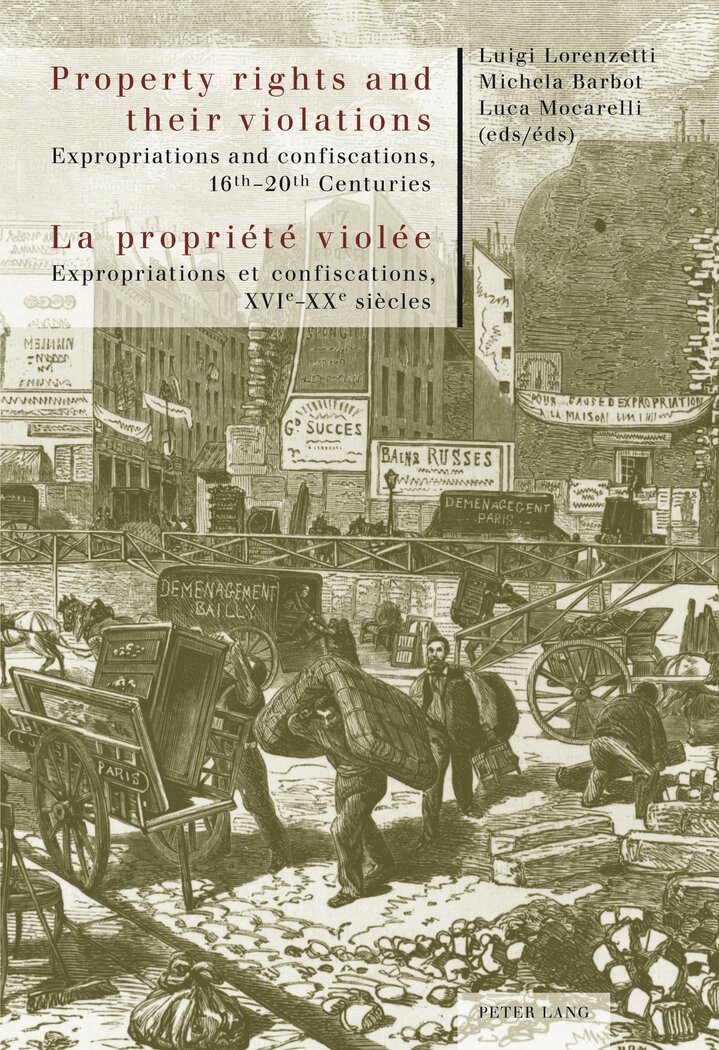
    Property rights and their violations - La propriété violée

    Expropriations and confiscations, 16 th –20 th Centuries- Expropriations et confiscations, XVI e –XX e siècles

    AvLuigi Lorenzetti,Michela Barbot

    Häftad, Engelska, 2012

    1 232 kr

    Beställningsvara. Skickas inom 5-8 vardagar. Fri frakt över 249 kr.

    Beskrivning

    Interest in the history of ownership rights is growing and spreading to different disciplines. Historians are turning their attention mainly to the rise of private and individual ownership as it was codified in 19th-century liberal Europe. In writing this history, however, their perspective has too often ignored the other side of the coin, namely the restrictions which the sovereign imposed on such rights, allegedly in the interest of the community.The papers collected in the present volume suggest that private property is not necessarily the most safeguarded legal model, hence it is not less vulnerable to violation. They construct a close analysis of the most common forms of abuse of private property on record – expropriation, seizure, and confiscation – perpetrated by public authorities. They also seek to define the uneasy, often intricate relation between legal and legitimate. In a perspective of lights and shadows, the role of confiscation and expropriation changes : now seen as powerful instruments of change, now as enduring factors of conservation in the evolution of private ownership rights.Les droits de propriété sont depuis longtemps au cœur de l’intérêt de diverses disciplines. L’attention des historiens s’est focalisée surtout sur la naissance de la propriété privée et individuelle telle qu’elle a été codifiée dans l’Europe libérale du XIXe siècle. Toutefois, son histoire a trop souvent négligé l’autre face de la médaille, à savoir les limites fixées à ce droit par le souverain au nom de l’intérêt de la collectivité. Les contributions figurant dans ce volume suggèrent que la propriété privée individuelle ne représente pas le modèle juridique le plus apte à la protéger face aux risques d’infraction. Au cœur des analyses il y a les formes historiques de la violation de la propriété privée – expropriations, saisies, confiscations – perpétrées par les autorités et le rapport, souvent complexe et ambigüe, entre les dimensions de la légalité et de la légitimité. Dans un jeu d’ombres et de lumières, les confiscations et les expropriations se dessinent à la fois comme de puissants instruments de changement et de tenaces facteur de conservation dans l’évolution des formes de propriété.

    Produktinformation

    • Utgivningsdatum:2012-08-07
    • Mått:150 x 225 x 21 mm
    • Vikt:560 g
    • Format:Häftad
    • Språk:Engelska, Franska
    • Antal sidor:322
    • Förlag:Peter Lang AG, Internationaler Verlag der Wissenschaften
    • ISBN:9783034306683

    Utforska kategorier

    • Socialhistoria och kulturhistoria inom Historia och arkeologi
    • Europas historia inom Historia och arkeologi
    • Afrikas historia inom Historia och arkeologi

    Mer om författaren

    Luigi Lorenzetti is coordinator of the Laboratorio di Storia delle Alpi at the Università della Svizzera italiana (Mendrisio). His researches focus on the history of the family and the history of rural societies, as well as the property and land markets in the alpine area. He recently published Destini periferici. Modernizzazione, risorse e mercati in Ticino, Valtellina e Vallese, 1850–1930 (Udine 2010). Michela Barbot holds a «Research Based University Chair of Excellence» in Social and Economic History at the CNRS Research Unit 8533 «Institutions et Dynamiques Historiques de l’Economie» at the Ecole Normale Supérieure de Cachan (France). Member of the editorial board of «Quaderni Storici», her research focuses on social and economic history of wealth, value and property in Europe in the long run (16th–20th centuries).Luca Mocarelli is professor of economic history at the Faculty of Economics in Milano-Bicocca University. He has worked extensively on urban and regional economy, with special regard to early modern Lombardy and to manufactures, guilds and the building sector. Among his recent works: Costruire la città. Edilizia e vita economica nella Milano del secondo Settecento (Bologna, 2009).Luigi Lorenzetti est le coordinateur du Laboratorio di Storia delle Alpi de l’Università della Svizzera italiana (Mendrisio). Ses domaines de recherche portent sur l’histoire de la famille et des sociétés rurales ainsi que sur la propriété et les marchés fonciers de l’arc alpin. Il a récemment publié l’ouvrage Destini periferici. Modernizzazione, risorse e mercati in Ticino, Valtellina e Vallese, 1850–1930 (Udine 2010). Historienne de l’économie et de la société, Michela Barbot est titulaire d’une « Research Based University Chair of Excellence » auprès de l’Unité Mixte de Recherche du CNRS « Institutions et Dynamiques Historiques de l’Economie » à l’Ecole Normale Supérieure de Cachan (France). Membre du comité de rédaction de la revue « Quaderni Storici », elle travaille sur l’histoire économique et sociale de la richesse, de la valeur et de la propriété en Europe dans la longue durée (XVIe–XXe siècles).Luca Mocarelli est professeur d’histoire économique à la Faculté des sciences économiques, Université de Milano-Bicocca. Il a travaillé sur l’économie de la Lombardie durant l’époque moderne, notamment sur les activités manufacturières, les corporations et l’industrie du bâtiment. Parmi ses publications, on mentionne l’ouvrage de 2009 : Costruire la città. Edilizia e vita economica nella Milano del secondo Settecento (Bologna 2009).

    Innehållsförteckning

    • Contents/Contenu: Michela Barbot/Luigi Lorenzetti/Luca Mocarelli: Introduction - Property and Its Antithesis: Confiscations and Expropriations at the Heart of History/Introduction - La propriété et son revers : confiscations et expropriations au cœur de l’histoire – Annamaria Monti: Illegitimate Appropriation or just Punishment ? The Confiscation of Property in ancien régime Criminal Law and Doctrine – Marica Forni: The «Negotiations for the Palazzo that Belonged to the Deceased Tomaso Marino». Palazzo Marino and its Real Estate Evaluations and Use from the Sixteenth to the Eighteenth Centuries – Fulgence Delleaux : Les confiscations militaires au sein des exploitations agricoles du Hainaut français au cours des guerres de la fin du règne de Louis XIV – Marino Viganò: Jewish Assets in Italy: Attachment, Confiscation and Restitution (1938-1945/1943-2001) – Claudia Conforti/Francesca Funis : Expropriations (et confiscations) d’immeubles pour la construction des Offices – Maria Grazia D’Amelio: Expropriation, Forced Sale, and Compensation: Legal Institutions and Professional Practice in Rome during the Pontificate of Alexander VII Chigi (1655-1667) – Daniele Andreozzi: «For Service of the Most August and of the Public». Expropriations and the Building of the Mercantile Spaces in Trieste in the XVIIIth Century – Denis Gandouet : Confiscations puis indemnisation des nobles émigrés (1792-1826) dans le district de Rochefort (Charente-Inférieure, France) – Paola Nardone: From Barons to Peasant Farmers: The Privatisation of Feudal Lands in Southern Italy in the Nineteenth Century – Nicolas Krautberger : L’expropriation d’utilité publique pour cause de risque naturel dans les départements alpins et algériens, seconde moitié du XIXe siècle – Natascia Ridolfi: Expropriation for Public Use: Construction of the Railway Line in Abruzzo – Stefano Zaggia: Expropriation as a Planning Tool. Limitations and Contradictions: The Town Plan for the Central Neighbourhoods of Padua (1921-1927) – Manuel Vaquero Piñeiro: Wheat-Storage in Fascist Italy: Evolution and Policies – Frederique Beauvois : De la liberté comme violation de la propriété privée : indemnités et abolitions de l’esclavage dans le Nouveau Monde (1777-1888) – Donatella Strangio: The Italy-Libya Agreement of 2 October 1956. The Bank of Italy’s Assets in Libya after World War II – Manoela Pedroza : Expropriations qui créent des propriétaires : le cas des ventes et indemnisations de terres à Rio de Janeiro (Brésil), 1870-1910.