• Fri frakt över 249 kr
  • •
  • Snabba leveranser
  • •
  • Billiga böcker
Kundservice

Du är på sajten för privatpersoner.

Företag, bibliotek eller offentlig verksamhet?

Du handlar på classic.bokus.com, där alla dina funktioner finns intakta.
Till classic.bokus.com
Bokus logotyp. Gå till startsidan.
  • Erbjudanden
  • Nyheter
  • Student
  • Topplistor
  • Barn & ungdom
  • Bokus Play
  • E-böcker
  • Pocketböcker
  • Spel & pussel

10% rabatt på allt med kod NYSTART10 →

Sidfot

Mina sidor

    Hjälp

    • Kundservice
    • Vanliga frågor och svar
    • Frakt och leverans
    • Retur vid ångerrätt
    • Reklamera vara
    • Betalning
    • Köpvillkor
    • Allmänna villkor
    • Information om webbplatsens tillgänglighet

    Om Bokus

    • Om oss
    • Pressrum
    • För studenter
    • För företag
    • För bibliotek och offentlig verksamhet
    • För leverantörer
    • Hållbarhet

    Populärt

    • Aktuella erbjudanden
    • Presentkort
    • Studentlitteratur
    • Nya böcker
    • Topplistor
    • Signerade böcker
    • Engelska böcker

    Inspiration

    • Boktips
    • BookTok
    • Populära bokserier
    • Barnbokskaraktärer
    • Populära författare
    Logotyp för Bokus
    Följ oss på Facebook (extern länk)Följ oss på Instagram (extern länk)Följ oss på YouTube (extern länk)Följ oss på TikTok (extern länk)
    bokus @ CookiesAnpassa cookiesIntegritetspolicyKöpvillkor
    Till Citymail hemsida (extern länk)Till Budbee hemsida (extern länk)Till Postnord hemsida (extern länk)Till Schenker hemsida (extern länk)Till Early Bird hemsida (extern länk)Till Walleys hemsida (extern länk)
    1. Naturvetenskap och teknik
    2. Matematik och naturvetenskap
    3. Matematik
    4. Tillämpad matematik

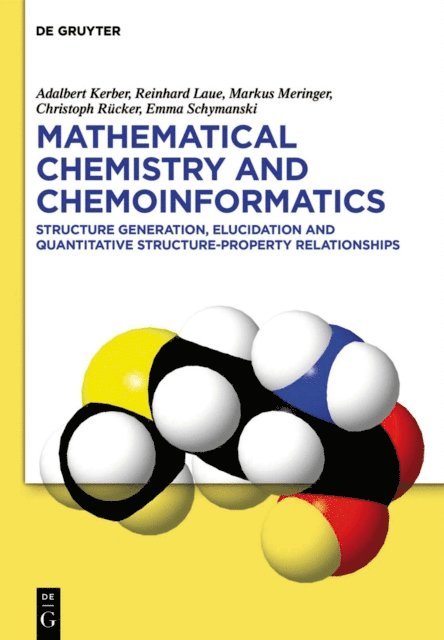
    Mathematical Chemistry and Chemoinformatics

    Structure Generation, Elucidation and Quantitative Structure-Property Relationships

    AvAdalbert Kerber,Reinhard Laue

    Inbunden, Engelska, 2013

    2 795 kr

    Beställningsvara. Skickas inom 5-8 vardagar. Fri frakt över 249 kr.
    Beskrivning

    More than 20 years of experience in molecular structure generation, from conceptualization through to applications Innovative, interdisciplinary text demonstrating example queries with software packages such as MOLGEN-online Detailed explanations on establishing QSPRs and QSARs as well as structure elucidation using mass spectrometry and structure generation.Aims and ScopeThis work provides an introduction to mathematical modeling of molecules and the resulting applications (structure generation, structure elucidation, QSAR/QSPR etc.). Most chemists have experimented with some software that represents molecules in an electronic form, and such models and applications are of increasing interest in diverse and growing fields such as drug discovery, environmental science and metabolomics. Furthermore, structure generation remains the only way to systematically create molecules that are not (yet) present in a database. This book starts with the mathematical theory behind representing molecules, explaining chemical concepts in mathematical terms and providing exercises that can be completed online. The later chapters cover applications of the theory, with detailed explanations on QSPR and QSAR investigations and finally structure elucidation combining mass spectrometry and structure generation. This book is aimed in particular at the users of structure generation methods and corresponding techniques, but also for those interested in teaching and learning mathematical chemistry, and for software designers in chemoinformatics.

    Produktinformation

    • Utgivningsdatum:2013-12-13
    • Mått:170 x 240 x 42 mm
    • Vikt:1 013 g
    • Format:Inbunden
    • Språk:Engelska
    • Antal sidor:520
    • Upplaga:13001
    • Förlag:De Gruyter
    • ISBN:9783110300079

    Utforska kategorier

    • Tillämpad matematik inom Naturvetenskap och teknik
    • Fysikalisk kemi inom Naturvetenskap och teknik
    • Biovetenskap inom Naturvetenskap och teknik

    Mer om författaren

    A.Kerber, R.Laue, U. Bayreuth; M.Meringer, DLR Oberpfaffenhofen; C.Rücker, Leuphana U. Lüneburg; E.Schymanski, EAWAG Dübendorf

    Innehållsförteckning

    • Chapter 1: Molecules in silico1.1 Graphs, labeled and unlabeled 1.2 Molecular graphs, constitutional isomers 1.3 SummaryChapter 2: Substructures, reactions, descriptors2.1 Substructures 2.2 Molecular substructures 2.3 Chemical reactions 2.4 Mesomerism 2.5 Existing chemical compounds 2.6 Molecular descriptors 2.7 SummaryChapter 3: Chirality3.1 Orientation and chirality 3.2 Permutational isomers 3.3 Permutational isomers by content, in particular by racemic content 3.4 Enumeration by symmetry 3.5 Constructive aspects 3.6 SummaryChapter 4: Stereoisomers4.1 Stereoisomers 4.2 Radon partitions 4.3 Binary Grassmann-Plücker relations 4.4 An example, cyclohexane 4.5 SummaryChapter 5: Molecular structure generation5.1 Formula based molecular generation 5.2 Reaction based structure generation 5.3 Examples: Combinatorial libraries 5.4 Generic structural formulas 5.5 Example: Patents in chemistry 5.6 Canonizing molecules and graphs 5.7 Data structure for molecular graphs 5.8 SummaryChapter 6: Supervised statistical learning6.1 Variables and predicting functions 6.2 Models for predicting functions 6.3 SummaryChapter 7: Structure-property relationships7.1 Optimization of experiments in combinatorial chemistry 7.2 The use of molecular descriptors 7.3 Quantitative structure--property relationships 7.4 Example: Boiling points of alkanes 7.5 Example: Physical density of propyl acrylates 7.6 Example: Antibacterial activity of quinolones 7.7 Remarks on the real library 7.8 SummaryChapter 8: Molecular structure elucidation8.1 Spectroscopic methods 8.2 The principle of automated molecular structure elucidation 8.3 Basics of mass spectrometry 8.4 Ranking functions for mass spectra 8.5 Classification of mass spectra 8.6 Automated structure elucidation via MS 8.7 High resolution MS 8.8 Molecular formulas from high-resolution MS and MS/MS 8.9 SummaryChapter 9: Case studies of CASE9.1 Automated structure elucidation with MOLGEN-MS 9.2 Calculated properties to improve CASE 9.3 Examples of CASE at workChapter 10: Appendix10.1 Lists of molecular descriptors 10.2 Substructures for MS classifiers 10.3 Molecular formulas, according to mass and ion type 10.4 Isomers, by formula and mass 10.5 Summary