• Fri frakt över 249 kr
  • •
  • Snabba leveranser
  • •
  • Billiga böcker
Kundservice

Du är på sajten för privatpersoner.

Företag, bibliotek eller offentlig verksamhet?

Du handlar på classic.bokus.com, där alla dina funktioner finns intakta.
Till classic.bokus.com
Bokus logotyp. Gå till startsidan.
  • Erbjudanden
  • Nyheter
  • Student
  • Topplistor
  • Barn & ungdom
  • Bokus Play
  • E-böcker
  • Pocketböcker
  • Spel & pussel

10% rabatt på allt med kod NYSTART10 →

Sidfot

Mina sidor

    Hjälp

    • Kundservice
    • Vanliga frågor och svar
    • Frakt och leverans
    • Retur vid ångerrätt
    • Reklamera vara
    • Betalning
    • Köpvillkor
    • Allmänna villkor
    • Information om webbplatsens tillgänglighet

    Om Bokus

    • Om oss
    • Pressrum
    • För studenter
    • För företag
    • För bibliotek och offentlig verksamhet
    • För leverantörer
    • Hållbarhet

    Populärt

    • Aktuella erbjudanden
    • Presentkort
    • Studentlitteratur
    • Nya böcker
    • Topplistor
    • Signerade böcker
    • Engelska böcker

    Inspiration

    • Boktips
    • BookTok
    • Populära bokserier
    • Barnbokskaraktärer
    • Populära författare
    Logotyp för Bokus
    Följ oss på Facebook (extern länk)Följ oss på Instagram (extern länk)Följ oss på YouTube (extern länk)Följ oss på TikTok (extern länk)
    bokus @ CookiesAnpassa cookiesIntegritetspolicyKöpvillkor
    Till Citymail hemsida (extern länk)Till Budbee hemsida (extern länk)Till Postnord hemsida (extern länk)Till Schenker hemsida (extern länk)Till Early Bird hemsida (extern länk)Till Walleys hemsida (extern länk)
    1. Naturvetenskap och teknik
    2. Matematik och naturvetenskap
    3. Matematik
    4. Tillämpad matematik

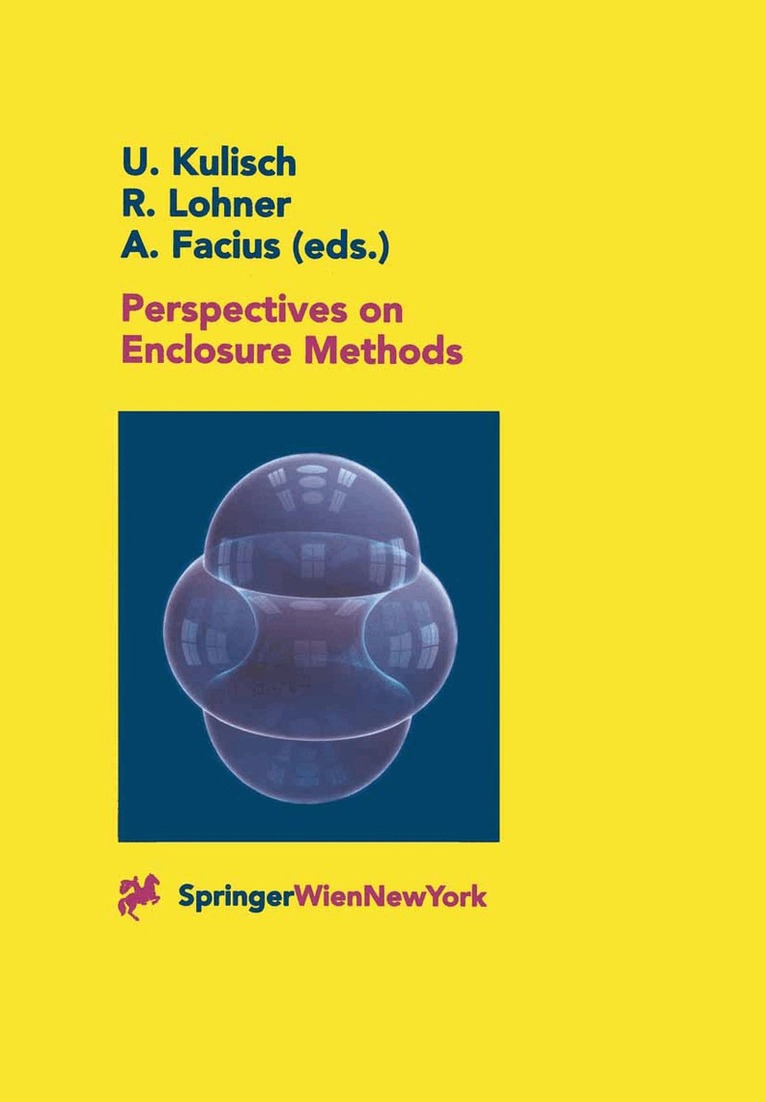
    Perspectives on Enclosure Methods

    AvUlrich Kulisch,Rudolf Lohner

    Häftad, Engelska, 2001

    546 kr

    Beställningsvara. Skickas inom 10-15 vardagar. Fri frakt över 249 kr.

    Beskrivning

    Enclosure methods and their applications have been developed to a high standard during the last decades. These methods guarantee the validity of the computed results. This means they are of the same standard as the rest of mathematics. The book deals with a wide variety of aspects of enclosure methods. All contributions follow the common goal to push the limits of enclosure methods forward. Topics that are treated include basic questions of arithmetic, proving conjectures, bounds for Krylow type linear system solvers, bounds for eigenvalues, the wrapping effect, algorithmic differencing, differential equations, finite element methods, application in robotics, and nonsmooth global optimization.

    Produktinformation

    • Utgivningsdatum:2001-06-18
    • Mått:170 x 244 x 20 mm
    • Vikt:635 g
    • Format:Häftad
    • Språk:Engelska
    • Antal sidor:345
    • Förlag:Springer Verlag GmbH
    • ISBN:9783211835906

    Utforska kategorier

    • Tillämpad matematik inom Naturvetenskap och teknik
    • Beräkning och matematisk analys inom Naturvetenskap och teknik

    Innehållsförteckning

    • Proving Conjectures by Use of Interval Arithmetic.- 1 Computer Assisted Proofs in Analysis.- 2 The Kepler Conjecture.- 3 The Double Bubble Conjecture.- 4 The Dirac-Schwinger Conjecture.- 5 ‘Chaos conjectures’.- References.- Advanced Arithmetic for the Digital Computer Interval Arithmetic Revisited.- 1 Introduction and Historical Remarks.- 2 Interval Arithmetic, a Powerful Calculus to Deal with Inequalities.- 3 Interval Arithmetic as Executable Set Operations.- 4 Enclosing the Range of Function Values.- 5 The Interval Newton Method.- 6 Extended Interval Arithmetic.- 7 The Extended Interval Newton Method.- 8 Differentiation Arithmetic, Enclosures of Derivatives.- 9 Interval Arithmetic on the Computer.- 10 Hardware Support for Interval Arithmetic.- References.- Highly Accurate Verified Error Bounds for Krylov Type Linear System Solvers.- 1 Introduction.- 2 Iterative Solvers and Finite Precision.- 3 Krylov Subspace Methods.- 4 Improved Arithmetic.- 5 Verified Error Bounds.- 6 Computational Results.- References.- Elements of Scientific Computing.- 1 Hardware Requirements.- 2 Software Requirements.- 3 Modelling Requirements.- 4 Conclusion.- References.- Biography.- The Mainstreaming of Interval Arithmetic.- 1 Introduction.- 2 Moore’s Law and Precision.- 3 Interval Physics.- 4 Summary.- References.- Bounds for Eigenvalues with the Use of Finite Elements.- 1 Introduction.- 2 Setting for the Problem.- 3 Calculation of Bounds.- 4 Verified Computation.- 5 Application: the Membrane Problem.- 6 Numerical Examples.- References.- Algorithmic Differencing.- 1 Algorithmic Representation of Functions.- 2 Transformation of Algorithms.- 3 Finite Precision Calculations.- 4 First Order Difference Operators.- 5 Differences of Inverse Functions.- 6 Higher Order Divided Differences.-References.- A Comparison of Techniques for Evaluating Centered Forms.- 1 Introduction.- 2 Methods for Computing Slope Vectors.- 3 A Numerical Example.- 4 Summary and Recommendations.- References.- On the Limit of the Total Step Method in Interval Analysis.- 1 Introduction.- 2 Notations.- 3 Results.- References.- How Fast can Moore’ Interval Integration Method Really be?.- 1 Introduction.- 2 Moore’s Algorithm.- 3 Estimation of the Integration Error.- 4 Conclusions.- References.- Numerical Verification and Validation of Kinematics and Dynamical Models for Flexible Robots in Complex Environments.- 1 Introduction.- 2 Error Propagation Control and Reliable Numerical Algorithms in MOBILE.- 3 Verified Calculation of the Solution of Discrete-Time Algebraic Riccati Equation.- 4 Accurate Distance Calculation Algorithms.- 5 Accurate Robot Reliability Estimation.- 6 Further Work.- 7 Acknowledgement.- References.- On the Ubiquity of the Wrapping Effect in the Computation of Error Bounds.- 1 Introduction or What is the Wrapping Effect?.- 2 Where does the Wrapping Effect appear?.- 3 How can we Reduce the Wrapping Effect?.- 4 Conclusion.- References.- A New Perspective on the Wrapping Effect in Interval Methods for Initial Value Problems for Ordinary Differential Equations.- 1 Introduction.- 2 Preliminaries.- 3 How the Wrapping Effect Arises in Interval Methods for IVPs for ODEs: A Traditional Explanation.- 4 The Wrapping Effect as a Source of Instability in Interval Methods for IVPs for ODEs.- 5 The Parallelepiped and Lohner’s QR-Factorization Methods.- 6 Why the Parallelepiped Method Often Fails.- 7 When Does the Parallelepiped Method Work Well.- 8 How the QR Method Improves Stability.- 9 Conclusions.- A Lemmas.- References.- A Guaranteed Bound of the Optimal Constant in theError Estimates for Linear Triangular Elements.- 1 Introduction.- 2 Strategy.- 3 The Method to Calculate a Rigorous Solution.- 4 Checking the Condition.- 5 Some Computational Techniques for Efficient Enclosure Methods.- 6 Numerical Results.- References.- Nonsmooth Global Optimization.- 1 Introduction.- 2 Preliminaries.- 3 A Pruning Technique for Global Optimizationx.- 4 Multidimensional Pruning Techniques for Global Optimization.- References.