• Fri frakt över 249 kr
  • •
  • Snabba leveranser
  • •
  • Billiga böcker
Kundservice

Du är på sajten för privatpersoner.

Företag, bibliotek eller offentlig verksamhet?

Du handlar på classic.bokus.com, där alla dina funktioner finns intakta.
Till classic.bokus.com
Bokus logotyp. Gå till startsidan.
  • Erbjudanden
  • Nyheter
  • Student
  • Topplistor
  • Barn & ungdom
  • Bokus Play
  • E-böcker
  • Pocketböcker
  • Spel & pussel

10% rabatt på allt med kod: NYSTART10 →

Sidfot

Mina sidor

    Hjälp

    • Kundservice
    • Vanliga frågor och svar
    • Frakt och leverans
    • Retur vid ångerrätt
    • Reklamera vara
    • Betalning
    • Köpvillkor
    • Allmänna villkor
    • Information om webbplatsens tillgänglighet

    Om Bokus

    • Om oss
    • Pressrum
    • För studenter
    • För företag
    • För bibliotek och offentlig verksamhet
    • För leverantörer
    • Hållbarhet

    Populärt

    • Aktuella erbjudanden
    • Presentkort
    • Studentlitteratur
    • Nya böcker
    • Topplistor
    • Signerade böcker
    • Engelska böcker

    Inspiration

    • Boktips
    • BookTok
    • Populära bokserier
    • Barnbokskaraktärer
    • Populära författare
    Logotyp för Bokus
    Följ oss på Facebook (extern länk)Följ oss på Instagram (extern länk)Följ oss på YouTube (extern länk)Följ oss på TikTok (extern länk)
    bokus @ CookiesAnpassa cookiesIntegritetspolicyKöpvillkor
    Till Citymail hemsida (extern länk)Till Budbee hemsida (extern länk)Till Postnord hemsida (extern länk)Till Schenker hemsida (extern länk)Till Early Bird hemsida (extern länk)Till Walleys hemsida (extern länk)
    1. Medicin
    2. Omvårdnad och medicinska stödfunktioner

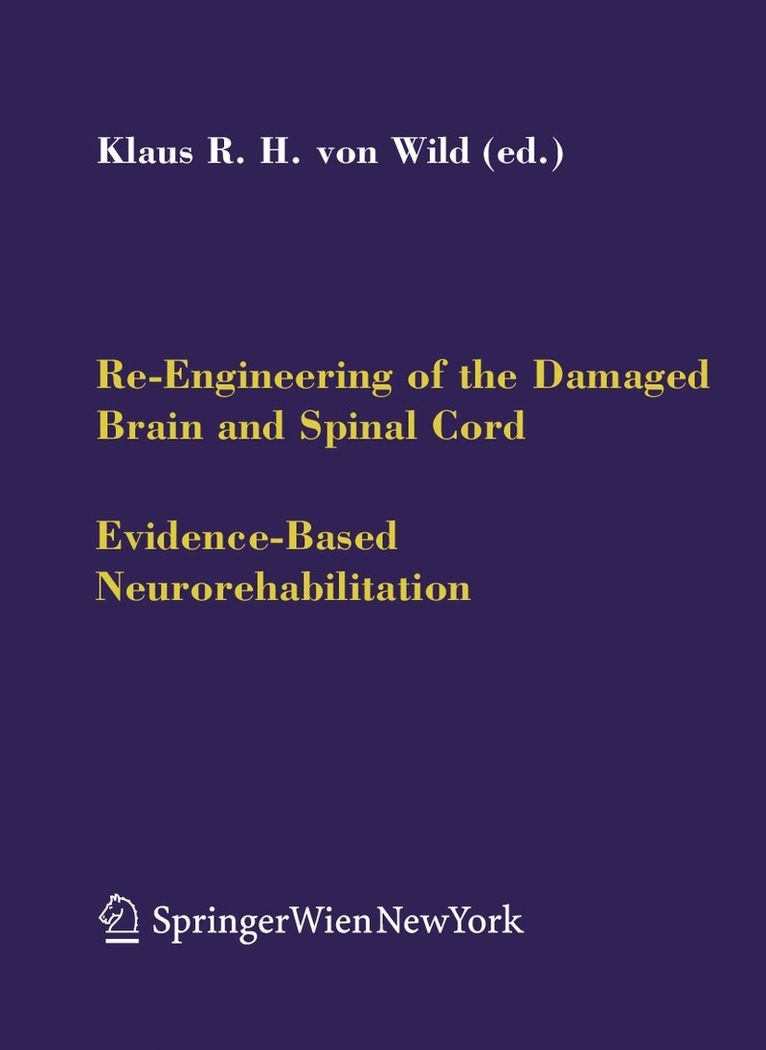
    Re-Engineering of the Damaged Brain and Spinal Cord

    Evidence-Based Neurorehabilitation

    AvKlaus R.H. Wild

    Häftad, Engelska, 2010

    Del i serien Acta Neurochirurgica Supplement

    2 230 kr

    Beställningsvara. Skickas inom 10-15 vardagar. Fri frakt över 249 kr.

    Beskrivning

    Re-EngineeringoftheDamagedBrainandSpinalCord isdedicatedtoTetsuoKanno,M. D. ProfessorofNeurosurgery Bypresenting theoriginal papers thatmakeupthis thefeaturesofthelocalmedicallandscapeinthe- third supplement we wish to make a further contri- gionswheretheyareenacted. Whatismore,progr- bution to the issue of functional rehabilitation, this sivenew?ndingsmustbealsosubjectedtoafrequent soimportantandfascinatingmodernareaofresearch revision. Ontopofthis,itshouldnotbeforgottenthat inthe?eldofneurosciences. Thecongresspaperswe even when committal therapy guidelines are c- haveselectedconstituteagoodre?ectionofthetrans- sistentlyapplied,thereareconsiderablevariationsin disciplinary objectives. The literature references are therangeofpotentialcomplicationsandintheo- designedasaguidetoleadtheinterestedreadertoa comeofprospectivecontrolledmulti-centreandmul- deeperandmoredetailedunderstandingoftheindi- nationalstudiesontheissueofqualitymanagement. vidualissues. Functionalrehabilitationhasbeenanoriginaltask The demand for "evidence-based medicine" is well ofneurosurgeryfromtheveryoutset. The1990shave justi?ed; however, it rapidly comes up against the enteredtheannalsofbrainresearchasthe"Decadeof limitsoffeasibility,especiallywherecontrolledthe- theBrain".Sincethentherehasbeenaneverstronger peuticstudiesareconcerned. TheCochrancollection growthofneuroscienti?cinterestworldwide,accom- of high-quality evidence-based healthcare databases paniedbysubstantial?nancialengagement. Thishas hasthusfarbeenofnohelptousindrawingupthe- primarily resulted in advances in basic neuro- peutic recommendations for the re-engineering of biologicalandneurophysiologicalresearchandalsoin brain and spinal-cord lesions. Today as ever, the thegrowthofneuroscienti?cknowledgeaboutbasic opinion of experts and empirically based medical mechanismsformotor control,paincontrol,aware- treatment and posttraumatic neurorehabilitation ness, cognition, learning and memory. The conse- continuetooccupyanindispensablepositionforthe quencemustbetoensurethattheadvancesmadeinthe everydayclinicalpracticeofneurosurgicalandneu- neuroscienti?cresearchareaareadequatelyexpanded traumatological therapies. Promising adjunct - intopracticalneurosurgicalcareandre-engineeringof proachesincludeneuropharmacology,forcascadesof brainandspinalcordlesionsandtoensureuponnew molecular interactions are known to be underlying approaches.Following this a fundamental path will activity-dependent plasticity and skills learning, as resultinanimprovedandmoree%ocientpreventionin many of these processes involve the major tra- thefuture,themeasuresthatstandrightatthefore- mitters. Furthermore,biologicalinterventionsby- front of all rehabilitation principles, meaning that ingendogenousneuronsandgliaaswellasexogenous conventionalconceptsmustbemodi?edtokeeppace stemcells,bone-marrowcells,macrophages,andother withthemoretask-speci?c,intensive,andprogressive types may promote the regeneration of nerve cells, demands. In this connection a series of guidelines, tissue, and neural circuitry. Class one studies have recommendations, and expert opinions and also beenmade,andnowclasstwostudieshavebeeni- algorithms have been elaborated by national and tiated, for example in connection with acute spinal international expert panels and multidisciplinary as- cord injury (SCI). The clinical application of fu- sociationsfortheacutemedicalcareofpatients.

    Produktinformation

    • Utgivningsdatum:2010-10-19
    • Mått:210 x 277 x undefined mm
    • Format:Häftad
    • Språk:Engelska
    • Serie:Acta Neurochirurgica Supplement
    • Antal sidor:240
    • Förlag:Springer Verlag GmbH
    • ISBN:9783211998779

    Utforska kategorier

    • Omvårdnad och medicinska stödfunktioner inom Medicin
    • Kirurgi inom Medicin
    • Behandling och behandlingsmetoder inom Medicin

    Innehållsförteckning

    • Evidence based neurorehabilitation.- Evidence based medicine in neurological rehabilitation — a critical review.- Quality management in traumatic brain injury (TBI) Lessons from the prospective study in 6.800 patients after acute TBI in respect of neurorehabilitation.- Posttraumatic epilepsy with special emphasis on prophylaxis and prevention.- Swallowing therapy — a prospective study on patients with neurogenic dysphagia due to unilateral paresis of the vagal nerve, Avellis’ syndrome, Wallenberg’s syndrome, posterior fossa tumours and cerebellar hemorrhage.- Impaired self-awareness after moderately severe to severe traumatic brain injury.- Assessment of health-related quality of life in persons after traumatic brain injury — development of the Qolibri, a specific measure.- Re-engineering of brain lesions.- RNA editing: a molecular mechanism for the fine modulation of neuronal transmission.- Inhibition of I?B? phosphorylation prevents glutamate-induced NF-?B activation and neuronal cell death.- Reorganization of cerebral circuits in human brain lesion.- Transcranial magnetic stimulation in neurorehabilitation.- Is there impairment of a specific frontal lobe circuit in head injury?.- Treating the aging brain: cortical reorganization and behavior.- The localization of central pattern generators for swallowing in humans — a clinical-anatomical study on patients with unilateral paresis of the vagal nerve, Avellis’ syndrome, Wallenberg’s syndrome, posterior fossa tumours and cerebellar hemorrhage.- Functional regeneration of the axotomized auditory nerve with combined neurotrophic and anti-inhibitory strategies.- Electrically evoked hearing perception by functional neurostimulation of the central auditory system.- Physiological recordings from electrodesimplanted in the basal ganglia for deep brain stimulation in Parkinson’s disease. The relevance of fast subthalamic rhythms.- DBS therapy for the vegetative state and minimally conscious state.- Deep brain stimulation for idiopathic or secondary movement disorders.- Extradural Motor Cortex Stimulation (EMCS) for Parkinson’s disease. History and first results by the study group of the Italian neurosurgical society.- Endocrine dysfunction following traumatic brain injury: mechanisms, pathophysiology and clinical correlations.- Taylored implants for alloplastic cranioplasty — clinical and surgical considerations.- Lessons from National and International TBI Societies and Funds like NBIRTT.- Re-engineering of spinal cord lesions.- Brachial plexus surgery (Honorary lecture).- Results in brachial plexus palsy after biceps neuro-muscular neurotization associated with neuro-neural neurotization and teno-muscular transfer.- Macrophages and dendritic cells treatment of spinal cord injury: from the bench to the clinic.- Electrophysiological effects of 4-aminopyridine on fictive locomotor activity of the rat spinal cord in vitro.- Alternative, complementary, energy-based medicine for spinal cord injury.- The effect of penile vibratory stimulation on male fertility potential, spasticity and neurogenic detrusor overactivity in spinal cord lesioned individuals.- Posttraumatic syringomyelia — a serious complication in tetra- and paraplegic patients.- Functional neurorehabilitation in locked-in syndrome following C0–C1 decompression.- Treatment options and results in cervical myelopathy.- The treatment of the sacral pressure sores in patients with spinal lesions.- Neurological-neurosurgical-neurobehavioral rehabilitation.- Phenomenological aspects of consciousness — itsdisturbance in acute and chronic stages.- Neuropsychological experiences in neurotraumatology.- Team care in ICU — Psychotherapeutic aspects and taking care of family of patients with traumatic brain injury.- Early clinical predictive factors during coma recovery.- Predicting one year clinical outcome in traumatic brain injury (TBI) at the beginning of rehabilitation.- Severe brain injuries in children.- The locked-in syndrome: a challenge for therapy.- Addendum.- WFNS committee for neurorehabilitation.- Academia Multidisciplinaria Neurotraumatologica AMN.- NBIRTT, the National Brain Injury Research, Treatment and Training Foundation.