• Fri frakt över 249 kr
  • •
  • Snabba leveranser
  • •
  • Billiga böcker
Kundservice

Du är på sajten för privatpersoner.

Företag, bibliotek eller offentlig verksamhet?

Du handlar på classic.bokus.com, där alla dina funktioner finns intakta.
Till classic.bokus.com
Bokus logotyp. Gå till startsidan.
  • Erbjudanden
  • Nyheter
  • Student
  • Topplistor
  • Barn & ungdom
  • Bokus Play
  • E-böcker
  • Pocketböcker
  • Spel & pussel

10% rabatt på allt med kod: NYSTART10 →

Sidfot

Mina sidor

    Hjälp

    • Kundservice
    • Vanliga frågor och svar
    • Frakt och leverans
    • Retur vid ångerrätt
    • Reklamera vara
    • Betalning
    • Köpvillkor
    • Allmänna villkor
    • Information om webbplatsens tillgänglighet

    Om Bokus

    • Om oss
    • Pressrum
    • För studenter
    • För företag
    • För bibliotek och offentlig verksamhet
    • För leverantörer
    • Hållbarhet

    Populärt

    • Aktuella erbjudanden
    • Presentkort
    • Studentlitteratur
    • Nya böcker
    • Topplistor
    • Signerade böcker
    • Engelska böcker

    Inspiration

    • Boktips
    • BookTok
    • Populära bokserier
    • Barnbokskaraktärer
    • Populära författare
    Logotyp för Bokus
    Följ oss på Facebook (extern länk)Följ oss på Instagram (extern länk)Följ oss på YouTube (extern länk)Följ oss på TikTok (extern länk)
    bokus @ CookiesAnpassa cookiesIntegritetspolicyKöpvillkor
    Till Citymail hemsida (extern länk)Till Budbee hemsida (extern länk)Till Postnord hemsida (extern länk)Till Schenker hemsida (extern länk)Till Early Bird hemsida (extern länk)Till Walleys hemsida (extern länk)
    1. Naturvetenskap och teknik
    2. Geovetenskap
    3. Miljövetenskap och miljöpolitik

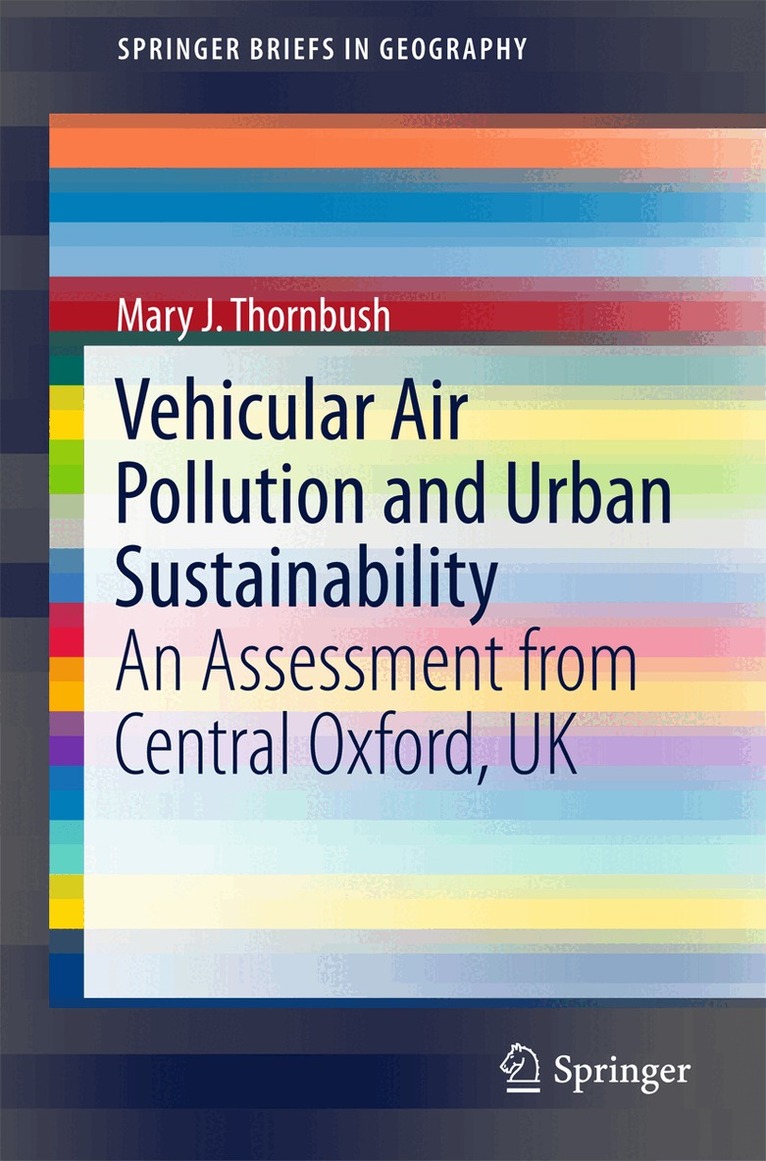
    Vehicular Air Pollution and Urban Sustainability

    An Assessment from Central Oxford, UK

    AvMary J. Thornbush

    Häftad, Engelska, 2015

    Del i serien SpringerBriefs in Geography

    563 kr

    Beställningsvara. Skickas inom 10-15 vardagar. Fri frakt över 249 kr.

    Fler format och utgåvor

    E-bok

    732 kr

    Beskrivning

    This Brief examines the impact of the Oxford Transport Strategy in central Oxford as a means of assessing the effect of reduced traffic congestion in the city centre on its sustainability. Air pollution (from vehicular traffic) has been monitored at three locations in central Oxford on the High Street, St Aldates and St Ebbes (background monitoring station). There is a further monitoring site situated in East Oxford, but this one is not considered to be central. Based on long-term monitoring at these monitoring stations, a deliberation of urban sustainability is presented. Implications are considered for long-term planning and green design in particular is part of the discussion. More specifically, urban greening strategies are presented as (soft engineering) approaches to controlling air pollution problems at this urban location. In the context of low carbon cities, green walls are assessed as they affect urban greening and energy conservation, as they enhance insulation on the exterior of solid wall buildings. Urban sustainability is best monitored using decades of data rather than just years. The Oxford Transport Strategy (OTS) was implemented in central Oxford, UK in 2001 and now a record of at least a decade of monitoring data is available for such a longer-term assessment. This work revisits the OTS from long after its implementation in the Oxford city centre and specifically examines the impact of reduced traffic congestion on sustainability. This includes address of traffic congestion, air pollution (from vehicular or traffic pollution) and the effects on the urban environment, including buildings. In parallel to this, the role of urban vegetation is considered as a sink for a variety of pollutants. Green walls, as part of urban greening, have implications for low carbon cities in the context of urban heat islands and global warming.

    Produktinformation

    • Utgivningsdatum:2015-07-10
    • Mått:155 x 235 x 5 mm
    • Vikt:145 g
    • Format:Häftad
    • Språk:Engelska
    • Serie:SpringerBriefs in Geography
    • Antal sidor:68
    • Upplaga:2015
    • Förlag:Springer International Publishing AG
    • ISBN:9783319206561

    Utforska kategorier

    • Miljövetenskap och miljöpolitik inom Naturvetenskap och teknik
    • Folkhälsa och hälsopedagogik inom Medicin
    • Geografi inom Naturvetenskap och teknik

    Mer om författaren

    Dr. Mary J. Thornbush was currently appointed as Adjunct Professor in Geography at Brock University, Canada. She is also part of a collaborative project as a research fellow in Biological Sciences at Brock. Her current research focus is on sustainability, both within urban environments as well as more broadly within the scope of climate change adaptation. She continues to explore issues around weathering and erosion, now examining coastal settings in Atlantic Canada as well as rock structures in the Niagara Region and further afield in Ontario. Dr. Thornbush is also interested in exploring cultural heritage sustainability and is currently developing research projects in this topical area through native rock art on the Canadian Shield.She graduated from the University of Toronto (Canada) in 2001 and earned her doctorate at the University of Oxford (UK) in 2006. Her doctoral thesis led to work on the Oxford Transport Strategy as part of environmental monitoring of the impacts on the built environment.This later led to research on traffic pollution and urban sustainability incorporating other relevant research interests, including landscape change, urban greening and energy conservation. She was Senior Research Associate with the Oxford University Centre for the Environment in 2007-2008, and more recently an Honorary Research Fellow at the University of Birmingham (UK).

    Innehållsförteckning

    • Preface.- 1. Introduction.- 2. The Oxford Transport Strategy (OTS) in Central Oxford.- 3. Reduced Traffic Congestion and Air Pollution.- 4. Implications for Urban Sustainability.- 5. Further Pollution Reduction.- 6. Energy Conservation.- 7. Implications.- 8. Conclusions.