• Fri frakt över 249 kr
  • •
  • Snabba leveranser
  • •
  • Billiga böcker
Kundservice

Du är på sajten för privatpersoner.

Företag, bibliotek eller offentlig verksamhet?

Du handlar på classic.bokus.com, där alla dina funktioner finns intakta.
Till classic.bokus.com
Bokus logotyp. Gå till startsidan.
  • Erbjudanden
  • Nyheter
  • Student
  • Topplistor
  • Barn & ungdom
  • Bokus Play
  • E-böcker
  • Pocketböcker
  • Spel & pussel

10% rabatt på allt med kod: NYSTART10 →

Sidfot

Mina sidor

    Hjälp

    • Kundservice
    • Vanliga frågor och svar
    • Frakt och leverans
    • Retur vid ångerrätt
    • Reklamera vara
    • Betalning
    • Köpvillkor
    • Allmänna villkor
    • Information om webbplatsens tillgänglighet

    Om Bokus

    • Om oss
    • Pressrum
    • För studenter
    • För företag
    • För bibliotek och offentlig verksamhet
    • För leverantörer
    • Hållbarhet

    Populärt

    • Aktuella erbjudanden
    • Presentkort
    • Studentlitteratur
    • Nya böcker
    • Topplistor
    • Signerade böcker
    • Engelska böcker

    Inspiration

    • Boktips
    • BookTok
    • Populära bokserier
    • Barnbokskaraktärer
    • Populära författare
    Logotyp för Bokus
    Följ oss på Facebook (extern länk)Följ oss på Instagram (extern länk)Följ oss på YouTube (extern länk)Följ oss på TikTok (extern länk)
    bokus @ CookiesAnpassa cookiesIntegritetspolicyKöpvillkor
    Till Citymail hemsida (extern länk)Till Budbee hemsida (extern länk)Till Postnord hemsida (extern länk)Till Schenker hemsida (extern länk)Till Early Bird hemsida (extern länk)Till Walleys hemsida (extern länk)
    1. Ekonomi och Ledarskap
    2. Nationalekonomi
    3. Ekonomisk politik

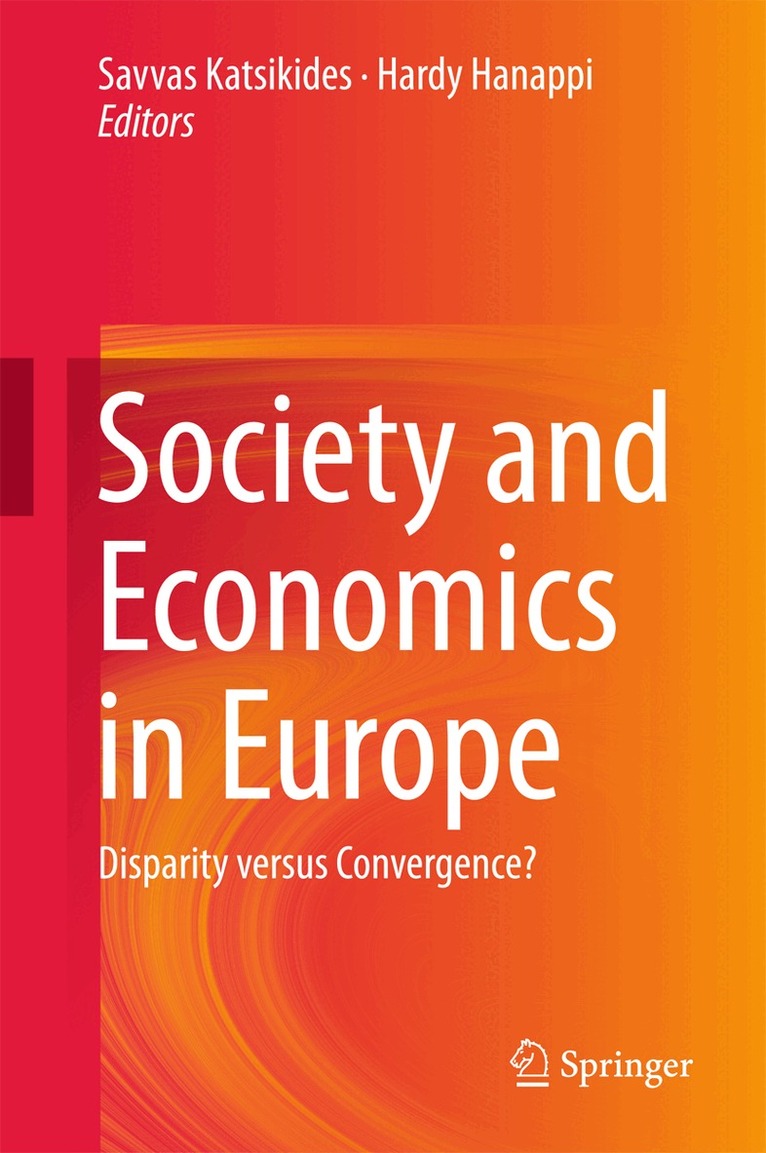
    Society and Economics in Europe

    Disparity versus Convergence?

    AvSavvas Katsikides,Hardy Hanappi

    Inbunden, Engelska, 2016

    1 086 kr

    Beställningsvara. Skickas inom 10-15 vardagar. Fri frakt över 249 kr.

    Beskrivning

    This book takes stock of the lessons to be learned from the experiences of different countries on their way to a transition into a unified Europe. It demonstrates how the project of a unified Europe is a social pilot project that is unique in human history, both with respect to the sheer number of people involved and with respect to the cultural diversity it aims to turn into a progressive advantage. With no historical experience at hand, the transition into a unified Europe is an exploratory process, often risky but sometimes also surprisingly successful. To improve the chances of establishing a successful unification it is particularly important that we learn from the mistakes made so far; and that we learn rapidly, since the forces working against the pilot project of Europe will gain power very fast if the unification success slows down. And as the recent developments in Greece show, the vision of the final goal itself can well change during this exciting quest. Apart from providing the pieces of a mosaic on which a more general theory can be built, this book can be read as a collection of experiences – mistakes as well as triumphs – which should help the European learning process. The structure of the book mirrors Europe’s diversity: specific country studies are combined with more general chapters, and quantitatively oriented econometric work is combined with qualitatively oriented sociological studies.

    Produktinformation

    • Utgivningsdatum:2016-06-30
    • Mått:155 x 235 x 19 mm
    • Vikt:530 g
    • Format:Inbunden
    • Språk:Engelska
    • Antal sidor:221
    • Upplaga:16001
    • Förlag:Springer International Publishing AG
    • ISBN:9783319214306

    Utforska kategorier

    • Ekonomisk politik inom Ekonomi och Ledarskap
    • Sociologi inom Samhälle och politik
    • Ekonomiska system inom Ekonomi och Ledarskap

    Mer om författaren

    Savvas Katsikides, (1953), has studied Social/Economic Sciences and Sociology at the Johannes Kepler University of Linz, Austria. He served as Lecturer and Assistant at the University of Technology in Vienna (TU), Austria (1988-1995). He has also held visiting professorships at Leeds Metropolitan University (PRU, UK, 1994-1995), Central Connecticut State University (Dept. of Sociology, USA, 1995), the University of Piraeus (ERASMUS, Greece), and Vienna University of Technology (2002). He lectured at the University of Technology, Limassol. In 2011 Distinguished Visiting Fellow at Queen Mary, University of London. From 1995 to 1998 has served as Assistant Professor at the University of Cyprus, 1998-2007 Associate Professor of Sociology and since 2007 Professor of Sociology. Deputy Dean. Elected President of the Cyprus Sociological Association. (2009-2010).Hardy Hanappi was born in Vienna (1951) and studied economics and Informatics at the University of Vienna and at the Technical University of Vienna. Before returning to university he has worked as econometrician for OPEC and as CEO for the consulting firm ECON GmbH. He then became university teacher and researcher at the TU-Vienna and concentrated on macroeconomics, political economy, simulation methods and game theory. From 1992 till 1997 he was deputy director of socioeconomics at the Austrian Academy of Sciences. After his return to the TU Vienna he became head of economics, from 2001 till 2005 he also was director of the Institute for Monetary Economics (Ludwig Boltzmann-Institute). He currently is ad personam chair for political economy of European integration, a position granted by the European Commission. He is professorial research associate at SOAS (University of London) where he spent a sabbatical in 2011. Hardy Hanappi now works and lives in Vienna.

    Innehållsförteckning

    • ​Introduction.- Chapter 1. Shangri-La Governance. A Sketch of an Integral Solution for European Economic Policy Based on a Synthesis of Europe's Problems; Hardy Hanappi.- Chapter 2. Convergence and Variability of Money and Capital Markets in Selected Eastern European Union countries; Kristis Hasapis.- Chapter 3. Polish Economic Policy, Internationalization, and Globalization; Marian Gorynia.- Chapter 4. A Geopolitical and Institutional Model of Poland's Participation in the New Baltic Europe; Janusz Ruszkowski.- Chapter 5. Main Economic Effects of Poland's Entrance into the European Union; Jaroslaw Kundera.- Chapter 6. Socioeconomic Development in Bulgaria; Mladen Maslarski.-Chapter 7. EU Strategy on the Governance of the Euro Area; Nicholas C. Baltas.- Chapter 8. Questioning the Social Efficiency of Computerazition in an Enlarged Europe: The Lithuanian Case; Kristina Levišauskaitė, Violeta Pukelienė, Jonė Šakalytė, Vytautas Magnus.- Chapter 9. Current Success, Future Headache: Economic Growth in Latvia; Martin Hansen.- Chapter 10. Bulgarian Social Partners and the Inform@tion Society: A cursory Acquaintance; Rumania Gladicheva.- Chapter 11. Regional Integration and the Transformations of Albanian Ethno-Nationalism; Pavlos Ioannis Koktsidis.- Chapter 12. The Dual Character of Hungarian Labor Relations: The Institution of Employee Participation from a European Perspective; Csaba Mako.- Chapter 13. Toward a New Cold War: NATO enlargement, Russia, and the Baltic States; Georgia Yiangou.- Chapter 14. The IT Industry and the Economic Crisis: Empirical Findings from the USA; Konstantinos Vergos, Apolostos G. Christopoulos, Quyan Pan and Petros Kalantonis.- Chapter 15. A Kaleckian Model of New Orders of Non-Defense Capital Goods in the USA 1992-2010; Evangelos Charos, Hossein Kazemi, Anthony J. Laramie and Douglas Mair.