• Fri frakt över 249 kr
  • •
  • Snabba leveranser
  • •
  • Billiga böcker
Kundservice

Du är på sajten för privatpersoner.

Företag, bibliotek eller offentlig verksamhet?

Du handlar på classic.bokus.com, där alla dina funktioner finns intakta.
Till classic.bokus.com
Bokus logotyp. Gå till startsidan.
  • Erbjudanden
  • Nyheter
  • Student
  • Topplistor
  • Barn & ungdom
  • Bokus Play
  • E-böcker
  • Pocketböcker
  • Spel & pussel

10% rabatt på allt med kod: NYSTART10 →

Sidfot

Mina sidor

    Hjälp

    • Kundservice
    • Vanliga frågor och svar
    • Frakt och leverans
    • Retur vid ångerrätt
    • Reklamera vara
    • Betalning
    • Köpvillkor
    • Allmänna villkor
    • Information om webbplatsens tillgänglighet

    Om Bokus

    • Om oss
    • Pressrum
    • För studenter
    • För företag
    • För bibliotek och offentlig verksamhet
    • För leverantörer
    • Hållbarhet

    Populärt

    • Aktuella erbjudanden
    • Presentkort
    • Studentlitteratur
    • Nya böcker
    • Topplistor
    • Signerade böcker
    • Engelska böcker

    Inspiration

    • Boktips
    • BookTok
    • Populära bokserier
    • Barnbokskaraktärer
    • Populära författare
    Logotyp för Bokus
    Följ oss på Facebook (extern länk)Följ oss på Instagram (extern länk)Följ oss på YouTube (extern länk)Följ oss på TikTok (extern länk)
    bokus @ CookiesAnpassa cookiesIntegritetspolicyKöpvillkor
    Till Citymail hemsida (extern länk)Till Budbee hemsida (extern länk)Till Postnord hemsida (extern länk)Till Schenker hemsida (extern länk)Till Early Bird hemsida (extern länk)Till Walleys hemsida (extern länk)
    1. Naturvetenskap och teknik
    2. Geovetenskap
    3. Miljövetenskap och miljöpolitik

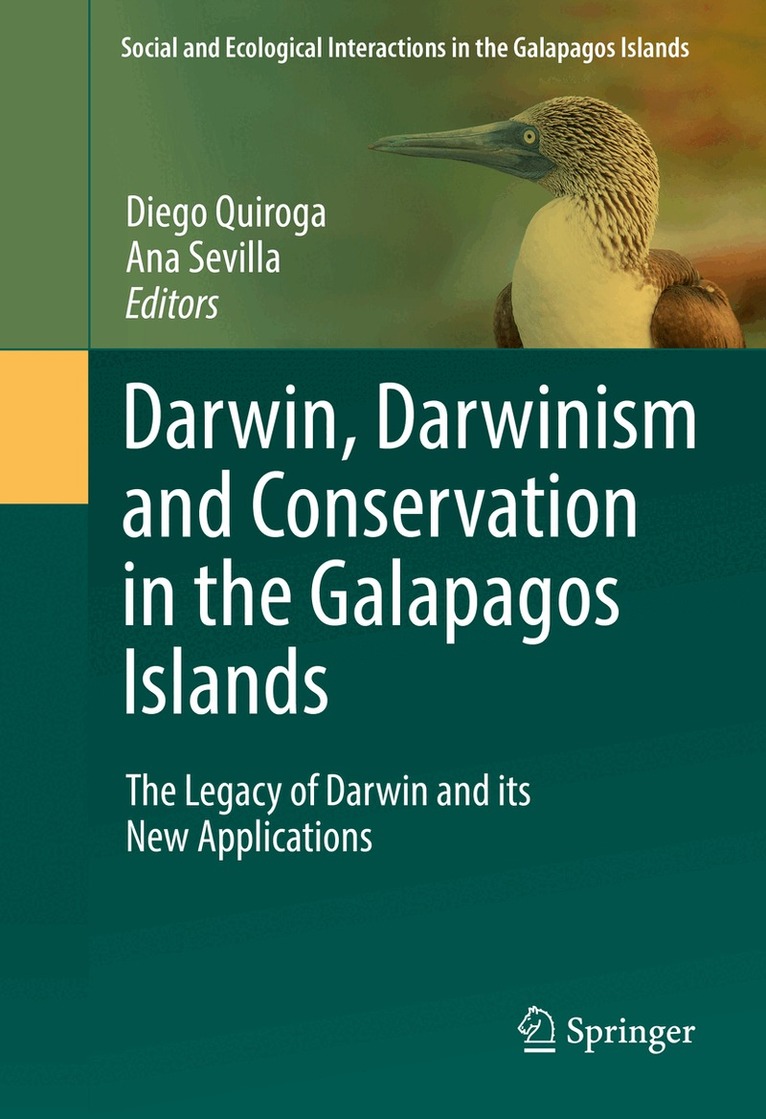
    Darwin, Darwinism and Conservation in the Galapagos Islands

    The Legacy of Darwin and its New Applications

    AvDiego Quiroga,Ana Sevilla

    Inbunden, Engelska, 2016

    Del i serien Social and Ecological Interactions in the Galapagos Islands

    1 302 kr

    Beställningsvara. Skickas inom 10-15 vardagar. Fri frakt över 249 kr.

    Beskrivning

    The book explores how Darwin´s legendary and mythologized visit to the Galapagos affected the socioecosystems of the Islands, as well as the cultural and intellectual traditions of Ecuador and Latin America. It highlights in what way the connection between Darwin and the Galapagos has had real, enduring and paradoxical effects in the Archipelago. This Twenty Century construct of the Galapagos as the cradle of Darwin’s theory and insights triggered not only the definition of the Galapagos as a living natural laboratory but also the production of a series of conservation practices and the reshaping of the Galapagos as a tourism destination with an increasingly important flow of tourists that potentially threaten its fragile ecosystems. The book argues that the idea of a Darwinian living laboratory has been limited by the success of the very same constructs that promote its conservation. It suggests critical interpretations of this paradox by questioning many of the dichotomies that havebeen created to understand nature and its conservation.  We also explore some possible ways in which Darwin's ideas can be used to better understand the social and natural threats facing the Islands and to develop sustainable and successful management practices.

    Produktinformation

    • Utgivningsdatum:2016-10-11
    • Mått:155 x 235 x 16 mm
    • Vikt:442 g
    • Format:Inbunden
    • Språk:Engelska
    • Serie:Social and Ecological Interactions in the Galapagos Islands
    • Antal sidor:164
    • Upplaga:16001
    • Förlag:Springer International Publishing AG
    • ISBN:9783319340500

    Utforska kategorier

    • Miljövetenskap och miljöpolitik inom Naturvetenskap och teknik
    • Biovetenskap inom Naturvetenskap och teknik

    Mer om författaren

    Diego Quiroga got his B.A. at the University of California Berkeley and his M.A. and Ph.D. at the University of Illinois, Urbana-Champaign in anthropology. He has done research on different areas of Ecuador and has written on diverse topics including medical anthropology, development, conservation and political ecology. Besides researching issues such as fisheries and tourism in the Galapagos, Diego is also studying the amazon forest and examining the changes and transformations that indigenous people in the area are experiencing and their response to these new challenges. He is the cofounder of GAIAS, the Galapagos Academic Institute for the Arts and the Sciences and the current director of the Center which is a branch of the Universidad San Francisco de Quito in San Cristobal, Galapagos.  Diego is also involved in the administration of the program and teaches classes for the local Galapagos students and in for different exchange programs in collaboration with many universities around the world.Ana Sevilla is a research associate at the Universidad San Francisco de Quito. She completed her Ph.D. at Facultad Latinoamericana de Ciencias Sociales and did her postdoctoral studies at Leiden University. Her research interests lie in the area of the history of science; she studies processes of knowledge production in non-European spaces of modernity. Ana has focused her explorations on the reception of Darwin´s ideas in Ecuador and Latin America. She is also involved in the Galapagos tourism industry. She has worked in one of the most important tourism operators of the Galapagos in the area of research and development of new products.

    Recensioner i media

    "This thought-provoking work will appeal to environmentalists, evolutionists, and historians of natural history. Summing Up: Recommended. Upper-division undergraduates and above; researchers and faculty." (J. S. Schwartz, Choice, Vol. 54 (9), May, 2017)

    Innehållsförteckning

    • Foreword.- 1.Darwin’s Galapagos Myth.- 2.On the Origin of Species and the Galapagos Islands.- 3.The Galapagos Islands and the Ecuadorean State: Early Encounters.- 4.Darwinians, Anti-Darwinians and the Galapagos (1835-1935).- 5.Mythologizing Darwin’s Islands.- 6.Mythologizing Darwin’s Islands.- 7.Darwinism in Latin America: Reception and Introduction.- 8.The Charles Darwin Foundation: some critical remarks about its history and trends.- 9.Darwin, Emergent Process and the Conservation of Galapagos Ecosystems.- 10.Darwinian Emergence, Conservation and Restoration: Novel Ecosystems and Hybrid Environments.