• Fri frakt över 249 kr
  • •
  • Snabba leveranser
  • •
  • Billiga böcker
Kundservice

Du är på sajten för privatpersoner.

Företag, bibliotek eller offentlig verksamhet?

Du handlar på classic.bokus.com, där alla dina funktioner finns intakta.
Till classic.bokus.com
Bokus logotyp. Gå till startsidan.
  • Erbjudanden
  • Nyheter
  • Student
  • Topplistor
  • Barn & ungdom
  • Bokus Play
  • E-böcker
  • Pocketböcker
  • Spel & pussel

10% rabatt på allt med kod NYSTART10 →

Sidfot

Mina sidor

    Hjälp

    • Kundservice
    • Vanliga frågor och svar
    • Frakt och leverans
    • Retur vid ångerrätt
    • Reklamera vara
    • Betalning
    • Köpvillkor
    • Allmänna villkor
    • Information om webbplatsens tillgänglighet

    Om Bokus

    • Om oss
    • Pressrum
    • För studenter
    • För företag
    • För bibliotek och offentlig verksamhet
    • För leverantörer
    • Hållbarhet

    Populärt

    • Aktuella erbjudanden
    • Presentkort
    • Studentlitteratur
    • Nya böcker
    • Topplistor
    • Signerade böcker
    • Engelska böcker

    Inspiration

    • Boktips
    • BookTok
    • Populära bokserier
    • Barnbokskaraktärer
    • Populära författare
    Logotyp för Bokus
    Följ oss på Facebook (extern länk)Följ oss på Instagram (extern länk)Följ oss på YouTube (extern länk)Följ oss på TikTok (extern länk)
    bokus @ CookiesAnpassa cookiesIntegritetspolicyKöpvillkor
    Till Citymail hemsida (extern länk)Till Budbee hemsida (extern länk)Till Postnord hemsida (extern länk)Till Schenker hemsida (extern länk)Till Early Bird hemsida (extern länk)Till Walleys hemsida (extern länk)
    1. Filosofi och religion
    2. Filosofi
    3. Filosofiska discipliner

    Structures of Practical Knowledge

    AvMatteo Valleriani

    Inbunden, Engelska, 2017

    2 165 kr

    Beställningsvara. Skickas inom 10-15 vardagar. Fri frakt över 249 kr.

    Beskrivning

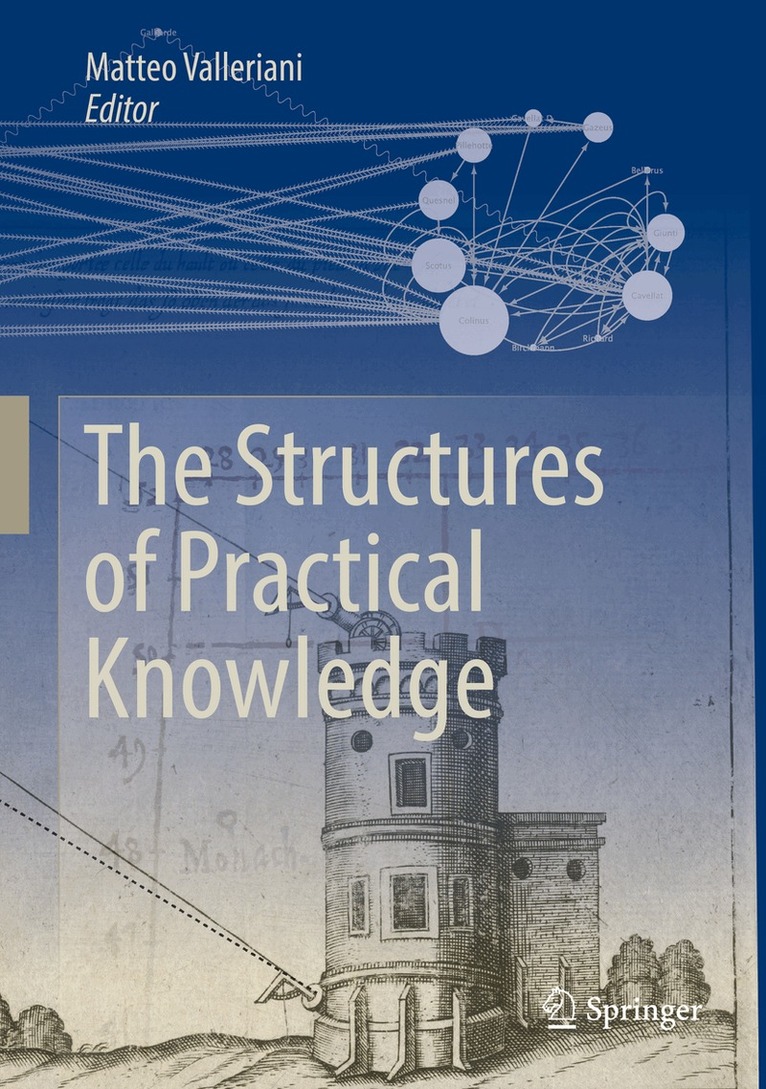
    The Structures of Practical Knowledge investigates the nature of practical knowledge – why, how, when and by whom it is codified, and once codified, how this knowledge is structured. The inquiry unfolds in a series of fifteen case studies, which range in focus from early modern Italy to eighteenth century China. At the heart of each study is a shared definition of practical knowledge, that is, knowledge needed to obtain a certain outcome, whether that be an artistic or mechanical artifact, a healing practice, or a mathematical result. While the content of practical knowledge is widely variable, this study shows that all practical knowledge is formally equivalent in following a defined workflow, as reflected in a construction procedure, a recipe, or an algorithm.As explored in the volume’s fifteen contributions, there are three levels at which structures of practical knowledge may be understood and examined. At the most immediate level, there are the individual workflows that encompasses practical knowledge itself. Probing further, it is possible to examine the structure of practical knowledge as it is externalized and codified in texts, drawings, and artifacts such as models. Finally, practical knowledge is also related to social structures, which fundamentally determine its dissemination and evolution into new knowledge structures. The social structures of professionals and institutions represent the critical means by which practical knowledge takes form. These actors are the agents of codification, and by means of selection, appropriation, investment, and knowledge development, they determine the formation of new structures of practical knowledge. On a more abstract level, the creation of new knowledge structures is understood as constituting the basis for the further development of scientific knowledge. Rich in subject matter and incisive in the theory it lays out, this volume represents an important contribution to the history of science and epistemology. Individually, the fifteen case studies – encompassing the history of architecture, mining, brewing, glass production, printing, ballistics, mechanics, cartography, cosmology and astronomy – are replete with original research, and offer new insights into the history of science. Taken together, the contributions remodel historical epistemology as a whole, elucidating the underlining knowledge structures that transcend disciplinary boundaries, and that unite practitioners across time and space.

    Produktinformation

    • Utgivningsdatum:2017-02-27
    • Mått:178 x 254 x 31 mm
    • Vikt:1 249 g
    • Format:Inbunden
    • Språk:Engelska
    • Antal sidor:491
    • Upplaga:17001
    • Förlag:Springer International Publishing AG
    • ISBN:9783319456706

    Utforska kategorier

    • Filosofiska discipliner inom Filosofi och religion
    • Naturvetenskapens filosofi inom Naturvetenskap och teknik
    • Naturvetenskapens historia inom Naturvetenskap och teknik

    Mer om författaren

    Matteo Valleriani's research focuses on the history of mechanics from classical antiquity to late Renaissance. In particular, his research intends to determine the role of the relations between practical knowledge and technology on the one side, and theoretical knowledge on the other side, within the framework of the processes of emergence of new theoretical knowledge. The research is structured on four different levels. The first level is the epistemological level that aims at formulating an epistemic theory of practical knowledge. The second level concerns mechanisms of diffusion of practical knowledge and the consequences this diffusion has in different cultures, as well as the transmission over epochs. The third level refers to the relationship between practical knowledge and natural philosophy. Finally, the fourth level analyzes the inherent points of contact between practical and theoretical knowledge and explores the mechanisms of the processes of emergence of newscientific knowledge.Matteo Valleriani's research moreover extends the implementation of the approach used to explore mechanisms of diffusion of knowledge also to studies dedicated to the role of Aristotelian knowledge in all cultures and epochs, in which this played a relevant role.

    Recensioner i media

    “The essays in the book cover a wonderfully diverse range of fields of knowledge, from theatre engineering, metalworking, woodblock printing, and astronomy to architecture, ballistics, artisanal knowledge, and brewing. … this volume contains some truly novel approaches to and insights into the structures of early modern practical knowledge.” (Marieke Hendriksen, Ambix, Vol. 66 (1), 2019)“This collection of dense articles by numerous authors … will appeal to a very select audience—historians of science and philosophers. The articles explore the relationship between practical and theoretical knowledge in different areas of science and technology. … Summing Up: Recommended. Researchers, faculty, and professionals.” (N. Sadanand, Choice, Vol. 55 (1), September, 2017)

    Innehållsförteckning

    • 1. The Epistemology of Practical Knowledge; Matteo Valleriani.-   2. Pocket-size architectural notebooks and the codification of practical knowledge; Elizabeth M. Merrill.-  3. Brewing Ale and Boiling Water in 1651; Elaine Leong.-  4. “Which Cannot Be Sufficiently Described by My Pen.” The Codification of Knowledge in Theater Engineering, 1480–1680; Viktoria Tkaczyk.-  5. Shooting with Ink; Jochen Büttner.-  6. Doing It Wrong: The Translation of Artisanal Knowledge and the Codification of Error; Sven Dupré.-  7. The Chiaroscuro Woodcut in the Early Modern Period; Eileen Reeves.-  8. Multi-tasking “pre-professional” architect/engineers and other bricolagic practitioners as key figures in the elision of boundaries between practice and learning in sixteenth-century Europe: Some Roman Examples; Pamela O. Long.-  9. Architectural Knowledge; Wolfgang Lefèvre.-  10. Knowledge by Design—Architecture and Jade Models During the Qianlong 乾隆 Reign (1735–1796); Dagmar Schäfer.-  11. Hybrid Experts; Ursula Klein.-  12. Utilitas astronomiae in the Renaissance: The Rhetoric and Epistemology of Astronomy; Pietro D. Omodeo.- 13. Incunable Almanacs and Practica as Practical Knowledge Produced in Trading Zones; Richard L. Kremer.- 14. The Codification of Vernacular Theories of Metallic Generation in sixteenth-century European Mining and Metalworking; Pamela H. Smith.- 15. Preserving the Cutting Edge: Traveling Woodblocks, Material Networks, and Visualizing Plants in Early Modern Europe; Bruce T. Moran.- 16. The Tracts on the Sphere: Knowledge Restructured over a Network; Matteo Valleriani.