• Fri frakt över 249 kr
  • •
  • Snabba leveranser
  • •
  • Billiga böcker
Kundservice

Du är på sajten för privatpersoner.

Företag, bibliotek eller offentlig verksamhet?

Du handlar på classic.bokus.com, där alla dina funktioner finns intakta.
Till classic.bokus.com
Bokus logotyp. Gå till startsidan.
  • Erbjudanden
  • Nyheter
  • Student
  • Topplistor
  • Barn & ungdom
  • Bokus Play
  • E-böcker
  • Pocketböcker
  • Spel & pussel

10% rabatt på allt med kod: NYSTART10 →

Sidfot

Mina sidor

    Hjälp

    • Kundservice
    • Vanliga frågor och svar
    • Frakt och leverans
    • Retur vid ångerrätt
    • Reklamera vara
    • Betalning
    • Köpvillkor
    • Allmänna villkor
    • Information om webbplatsens tillgänglighet

    Om Bokus

    • Om oss
    • Pressrum
    • För studenter
    • För företag
    • För bibliotek och offentlig verksamhet
    • För leverantörer
    • Hållbarhet

    Populärt

    • Aktuella erbjudanden
    • Presentkort
    • Studentlitteratur
    • Nya böcker
    • Topplistor
    • Signerade böcker
    • Engelska böcker

    Inspiration

    • Boktips
    • BookTok
    • Populära bokserier
    • Barnbokskaraktärer
    • Populära författare
    Logotyp för Bokus
    Följ oss på Facebook (extern länk)Följ oss på Instagram (extern länk)Följ oss på YouTube (extern länk)Följ oss på TikTok (extern länk)
    bokus @ CookiesAnpassa cookiesIntegritetspolicyKöpvillkor
    Till Citymail hemsida (extern länk)Till Budbee hemsida (extern länk)Till Postnord hemsida (extern länk)Till Schenker hemsida (extern länk)Till Early Bird hemsida (extern länk)Till Walleys hemsida (extern länk)
    1. Kultur
    2. Arkitektur

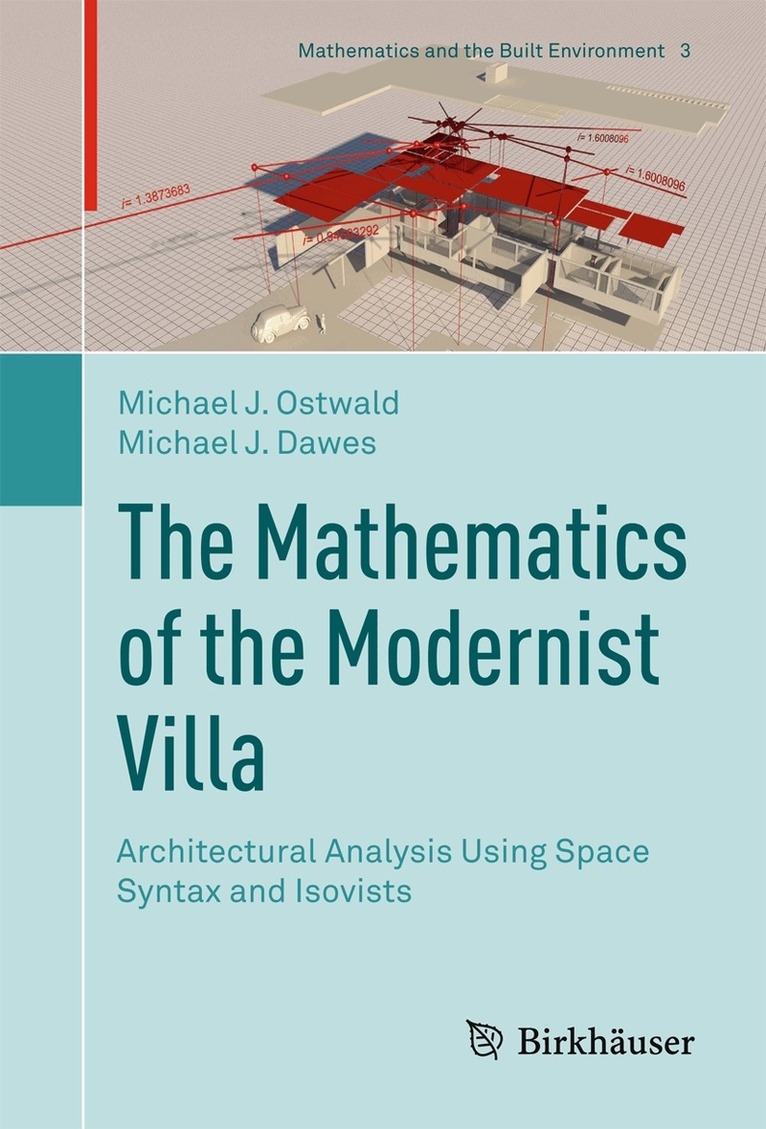
    Mathematics of the Modernist Villa

    Architectural Analysis Using Space Syntax and Isovists

    AvMichael J. Ostwald,Michael J. Dawes

    Inbunden, Engelska, 2018

    Del i serien Mathematics and the Built Environment

    1 341 kr

    Beställningsvara. Skickas inom 10-15 vardagar. Fri frakt över 249 kr.

    Fler format och utgåvor

    Häftad

    1 341 kr

    Beskrivning

    This book presents the first detailed mathematical analysis of the social, cognitive and experiential properties of Modernist domestic architecture.The Modern Movement in architecture, which came to prominence during the first half of the twentieth century, may have been famous for its functional forms and machine-made aesthetic, but it also sought to challenge the way people inhabit, understand and experience space. Ludwig Mies van der Rohe’s buildings were not only minimalist and transparent, they were designed to subvert traditional social hierarchies. Frank Lloyd Wright’s organic Modernism not only attempted to negotiate a more responsive relationship between nature and architecture, but also shape the way people experience space. Richard Neutra’s Californian Modernism is traditionally celebrated for its sleek, geometric forms, but his intention was to use design to support a heightened understanding of context. Glenn Murcutt’s pristine pavilions, seemingly the epitome ofregional Modernism, actually raise important questions about the socio-spatial structure of architecture. Rather than focussing on form or style in Modernism, this book examines the spatial, social and experiential properties of thirty-seven designs by Wright, Mies, Neutra and Murcutt. The computational and mathematical methods used for this purpose are drawn from space syntax, isovist geometry and graph theory. The specific issues that are examined include: the sensory and emotional appeal of space and form; shifting social and spatial structures in architectural planning; wayfinding and visual understanding; and the relationship between form and program.

    Produktinformation

    • Utgivningsdatum:2018-04-23
    • Mått:155 x 235 x 28 mm
    • Vikt:902 g
    • Format:Inbunden
    • Språk:Engelska
    • Serie:Mathematics and the Built Environment
    • Antal sidor:420
    • Förlag:Birkhauser Verlag AG
    • ISBN:9783319716459

    Utforska kategorier

    • Arkitektur inom Kultur
    • Arkitekturhistoria inom Kultur
    • Tillämpad matematik inom Naturvetenskap och teknik

    Mer om författaren

    Michael J. Ostwald is Professor and Dean of Architecture at the University of Newcastle (Australia). He has previously been a Professorial Research Fellow at Victoria University Wellington (New Zealand), a visiting Professor and Research Fellow at RMIT University, an Australian Research Council (ARC) Future Fellow at Newcastle and a visiting fellow at ANU, MIT, HKU and UCLA. Michael has a PhD in architectural history and theory and a DSc in design mathematics and computing. Under the auspices of the Byera Hadley international fellowship he completed postdoctoral research on geometry at the CCA (Montreal) and Harvard (Cambridge, USA). In 2016, the Australian Institute of Architects (AIA) awarded him the Neville Quarry Medal for Services to Architecture. Michael is Co-Editor-in-Chief of the Nexus Network Journal: Architecture and Mathematics (Springer) and on the editorial boards of ARQ (Cambridge) and Architectural Theory Review (Taylor and Francis). He is co-editor with Kim Williams of the two volume Architecture and Mathematics from Antiquity to the Future (Birkhäuser 2015) and co-author with Josephine Vaughan of The Fractal Dimension of Architecture (Birkhäuser 2016).Michael J. Dawes has Bachelor degrees in Science (Architecture) and Construction Management and a Masters degree in Architecture. He is currently completing a PhD investigating Christopher Alexander’s A Pattern Language. Since 2010 he has worked as a Research Associate and Academic at the University of Newcastle (Australia). His publications include refereed journal papers and chapters on graph theory, syntactical analysis and isovists. His research combines computational and mathematical analysis with architectural history and theory.

    Innehållsförteckning

    • Preface.-1. Introduction.- Part I Methods: 2. Space Syntax, Theory and Techniques.- 3.   Spaces, Lines and Intersections.- 4. Isovist Analysis, Theories and Methods.- Part II Mies, Neutra and Murcutt: 5. Mies van der Rohe: Characteristics of the Free Plan.- 6. Richard Neutra: Spatial Theory and Practice.- 7. Glenn Murcutt: Form and Social Function.- Part III Frank Lloyd Wright: 8. Wright and Spatial Preference Theory.- 9. Experiencing Wright’s Living Spaces.- 10.- Enticement In, and Through, Wright’s Architecture.- 11. Conclusion.- References.- Index.