• Fri frakt över 249 kr
  • •
  • Snabba leveranser
  • •
  • Billiga böcker
Kundservice

Du är på sajten för privatpersoner.

Företag, bibliotek eller offentlig verksamhet?

Du handlar på classic.bokus.com, där alla dina funktioner finns intakta.
Till classic.bokus.com
Bokus logotyp. Gå till startsidan.
  • Erbjudanden
  • Nyheter
  • Student
  • Topplistor
  • Barn & ungdom
  • Bokus Play
  • E-böcker
  • Pocketböcker
  • Spel & pussel

10% rabatt på allt med kod NYSTART10 →

Sidfot

Mina sidor

    Hjälp

    • Kundservice
    • Vanliga frågor och svar
    • Frakt och leverans
    • Retur vid ångerrätt
    • Reklamera vara
    • Betalning
    • Köpvillkor
    • Allmänna villkor
    • Information om webbplatsens tillgänglighet

    Om Bokus

    • Om oss
    • Pressrum
    • För studenter
    • För företag
    • För bibliotek och offentlig verksamhet
    • För leverantörer
    • Hållbarhet

    Populärt

    • Aktuella erbjudanden
    • Presentkort
    • Studentlitteratur
    • Nya böcker
    • Topplistor
    • Signerade böcker
    • Engelska böcker

    Inspiration

    • Boktips
    • BookTok
    • Populära bokserier
    • Barnbokskaraktärer
    • Populära författare
    Logotyp för Bokus
    Följ oss på Facebook (extern länk)Följ oss på Instagram (extern länk)Följ oss på YouTube (extern länk)Följ oss på TikTok (extern länk)
    bokus @ CookiesAnpassa cookiesIntegritetspolicyKöpvillkor
    Till Citymail hemsida (extern länk)Till Budbee hemsida (extern länk)Till Postnord hemsida (extern länk)Till Schenker hemsida (extern länk)Till Early Bird hemsida (extern länk)Till Walleys hemsida (extern länk)
    1. Juridik
    2. Rättsvetenskap
    3. Rättshistoria

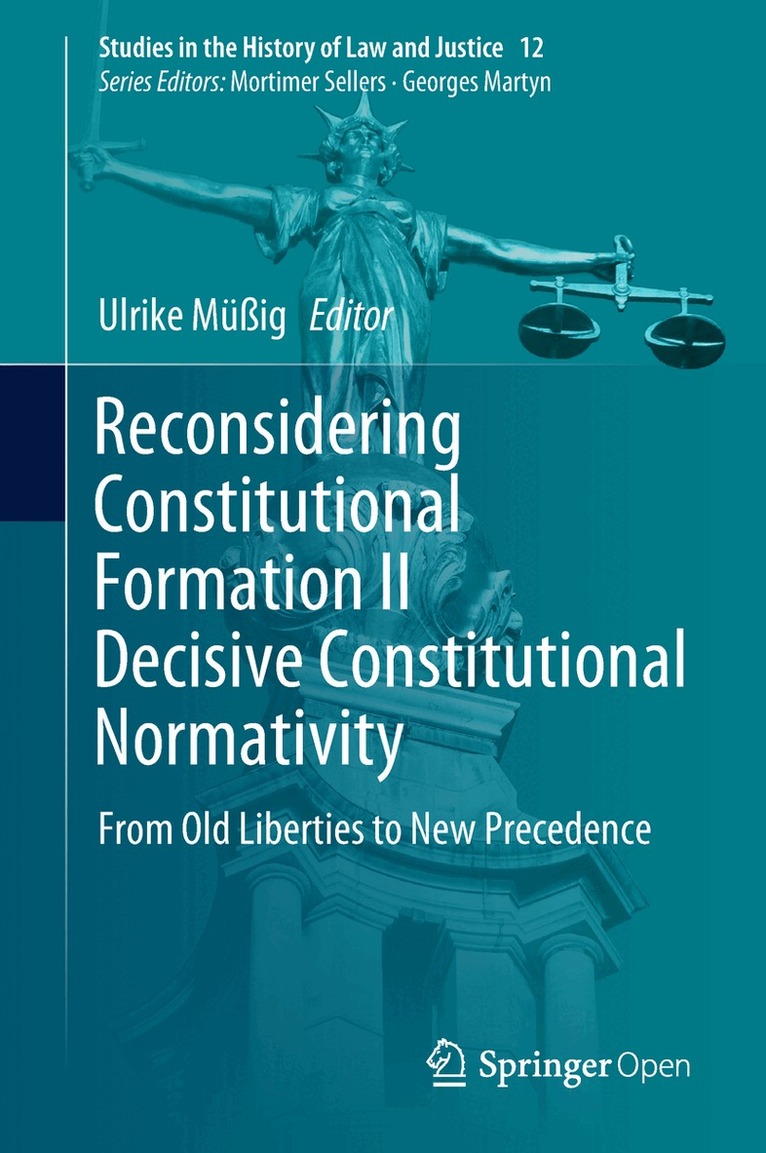
    Reconsidering Constitutional Formation II Decisive Constitutional Normativity

    From Old Liberties to New Precedence

    AvUlrike Müßig

    Inbunden, Engelska, 2018

    Del 12 i serien Studies in the History of Law and Justice

    503 kr

    Beställningsvara. Skickas inom 10-15 vardagar. Fri frakt över 249 kr.

    Beskrivning

    This second volume of ReConFort, published open access, addresses the decisive role of constitutional normativity, and focuses on discourses concerning the legal role of constitutional norms. Taken together with ReConFort I (National Sovereignty), it calls for an innovative reassessment of constitutional history drawing on key categories to convey the legal nature of the constitution itself (national sovereignty, precedence, justiciability of power, judiciary as constituted power).In the late 18th and early 19th centuries, constitutional normativity began to complete the legal fixation of the entire political order. This juridification in one constitutional text resulted in a conceptual differentiation from ordinary law, which extends to alterability and justiciability. The early expressions of this ‘new order of the ages’ suggest an unprecedented and irremediable break with European legal tradition, be it with British colonial governance or the French ancien régime. In fact, while the shift to constitutions as a hierarchically ‘higher’ form of positive law was a revolutionary change, it also drew upon old liberties. The American constitutional discourse, which was itself heavily influenced by British common law, in turn served as an inspiration for a variety of constitutional experiments – from the French Revolution to Napoleon’s downfall, in the halls of the Frankfurt Assembly, on the road to a unified Italy, and in the later theoretical discourse of twentieth-century Austria. If the constitution states the legal rules for the law-making process, then its Kelsian primacy is mandatory.Also included in this volume are the French originals and English translations of two vital documents. The first – Emmanuel Joseph Sieyès’ Du Jury Constitutionnaire (1795) – highlights an early attempt to reconcile the democratic values of the French Revolution with the pragmatic need to legally protect the Revolution. The second – the 1812 draft of the Constitution of the Kingdom of Poland – presents the ‘constitutional propaganda’ of the Russian Tsar Alexander I to bargain for the support of the Lithuanian and Polish nobility. These documents open new avenues of research into Europe’s constitutional history: one replete with diverse contexts and national experiences, but above all an overarching motif of constitutional decisiveness that served to complete the juridification of sovereignty. (www.reconfort.eu)

    Produktinformation

    • Utgivningsdatum:2018-06-06
    • Mått:155 x 235 x 29 mm
    • Vikt:811 g
    • Format:Inbunden
    • Språk:Engelska
    • Serie:Studies in the History of Law and Justice
    • Antal sidor:419
    • Förlag:Springer International Publishing AG
    • ISBN:9783319730363

    Utforska kategorier

    • Rättshistoria inom Juridik
    • Juridik: metod och teori inom Juridik
    • Författningsrätt och förvaltningsrätt inom Juridik

    Mer om författaren

    Ulrike Müßig, née Seif, is the Chair of the Department of Civil Law, German and European Legal History at the University of Passau. After studying law at the Universities of Würzburg and Cambridge, and as a visitor at the Université Paris II, Panthéon-Assas, she pursued her doctoral dissertation on comparative law, which was funded by the German National Academic Foundation. In 2000 she completed her postdoctoral qualification (habilitation) in European and German Legal History, Civil Law, Comparative Law and Private International Law at the University of Würzburg, which garnered her the Bayerischer  Habilitationsförderpreis (1996). Her postdoctoral thesis on comparative legal history won the DFG (German Research Foundation) Heisenberg Prize in 2000, was published as a monograph in 2003, in a second edition in 2009, and in a Spanish translation “El juez legal” (Dykinson) in 2014. In 2013 Ulrike Müßig won the ERC Advanced Grant ReConFort (Reconsidering Constitutional Formation) for her research project on communication dependency of constitutional formation in 18th and 19th century Europe. Since 2014 she has been a corresponding member of the National Academy al-Andalus in the historic–judicial class (Ilustre Sociedad Andaluza de Estudios Histórico-Jurídicos), and was elected into the historical–philosophical class of the Austrian Academy of Sciences in April 2015.

    Innehållsförteckning

    • Ulrike Müßig, A New Order of the Ages (Novus ordo seclorum) - Normativity and Precedence.- Gerald Stourzh, Development of Constitutional Precedence and the Constitutionalization of Individual Rights.- Anna Tarnowska, “To which Constitution the Further Law of the Present Sejm have to adhere to in all…” Constitutional Precedence of the 3 May System.- Marcin Byczyk, Constitutional Precedence and Substantial Criminal Law: The 1815 Constitution of the Kingdom of Poland in the Practical Test of the Codification of the Polish Substantial Criminal Law.- Brecht Deseure, Constitutional Precedence and the Genesis of the Belgian Constitution of 1831.- Frederik Dhondt, Inaugurating a Dutch Napoleon? Conservative Criticism of the 1815 Constitution of the United Kingdom of the Netherlands.- Eirik Holmøyvik, Constituent Power and Constitutionalism in 19th Century Norway.- Giuseppe Mecca, In Keeping with the Spirit of the Albertine Statute. Constitutionalisation of the National Unification.- Thomas Olechowski, Legal Hierarchies in the Works of Hans Kelsen and Adolf Julius Merkl.