• Fri frakt över 249 kr
  • •
  • Snabba leveranser
  • •
  • Billiga böcker
Kundservice

Du är på sajten för privatpersoner.

Företag, bibliotek eller offentlig verksamhet?

Du handlar på classic.bokus.com, där alla dina funktioner finns intakta.
Till classic.bokus.com
Bokus logotyp. Gå till startsidan.
  • Erbjudanden
  • Student
  • Topplistor
  • Barn & ungdom
  • Bokus Play
  • E-böcker
  • Ljudböcker
  • Pocketböcker
  • Spel & pussel

10% rabatt på allt med kod NYSTART10 →

Sidfot

Mina sidor

    Hjälp

    • Kundservice
    • Vanliga frågor och svar
    • Frakt och leverans
    • Retur vid ångerrätt
    • Reklamera vara
    • Betalning
    • Köpvillkor
    • Allmänna villkor
    • Information om webbplatsens tillgänglighet

    Om Bokus

    • Om oss
    • Pressrum
    • För studenter
    • För företag
    • För bibliotek och offentlig verksamhet
    • För leverantörer
    • Hållbarhet

    Populärt

    • Aktuella erbjudanden
    • Presentkort
    • Studentlitteratur
    • Nya böcker
    • Topplistor
    • Signerade böcker
    • Engelska böcker

    Inspiration

    • Boktips
    • BookTok
    • Populära bokserier
    • Barnbokskaraktärer
    • Populära författare
    Logotyp för Bokus
    Följ oss på Facebook (extern länk)Följ oss på Instagram (extern länk)Följ oss på YouTube (extern länk)Följ oss på TikTok (extern länk)
    bokus @ CookiesAnpassa cookiesIntegritetspolicyKöpvillkor
    Till Citymail hemsida (extern länk)Till Budbee hemsida (extern länk)Till Postnord hemsida (extern länk)Till Schenker hemsida (extern länk)Till Early Bird hemsida (extern länk)Till Walleys hemsida (extern länk)
    1. Ekonomi och Ledarskap
    2. Nationalekonomi
    3. Mikroekonomi

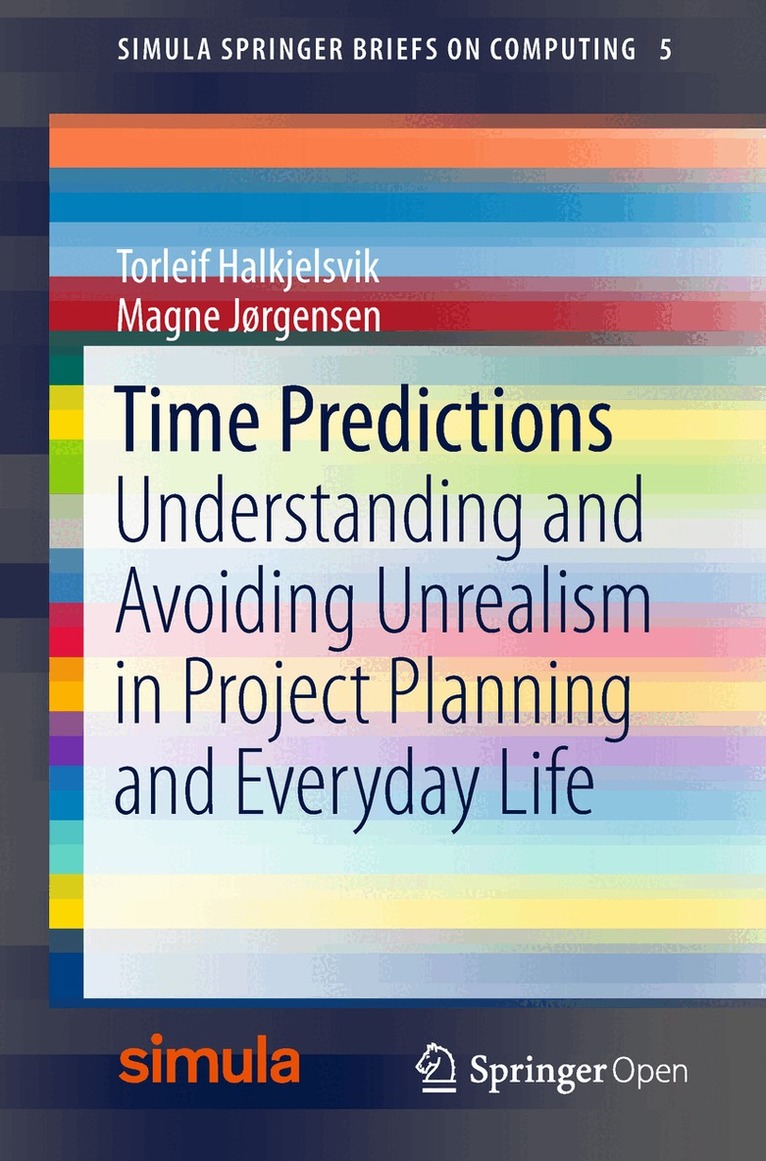
    Time Predictions

    Understanding and Avoiding Unrealism in Project Planning and Everyday Life

    AvTorleif Halkjelsvik,Magne Jørgensen

    Häftad, Engelska, 2018

    Del i serien Simula SpringerBriefs on Computing

    229 kr

    Beställningsvara. Skickas inom 10-15 vardagar. Fri frakt över 249 kr.

    Beskrivning

    This book is published open access under a CC BY 4.0 license.Predicting the time needed to complete a project, task or daily activity can be difficult and people frequently underestimate how long an activity will take. This book sheds light on why and when this happens, what we should do to avoid it and how to give more realistic time predictions. It describes methods for predicting time usage in situations with high uncertainty, explains why two plus two is usually more than four in time prediction contexts, reports on research on time prediction biases, and summarizes the evidence in support of different time prediction methods and principles. Based on a comprehensive review of the research, it is the first book summarizing what we know about judgment-based time predictions.Large parts of the book are directed toward people wishing to achieve better time predictions in their professional life, such as project managers, graphic designers, architects, engineers, film producers, consultants, software developers, or anyone else in need of realistic time usage predictions. It is also of benefit to those with a general interest in judgment and decision-making or those who want to improve their ability to predict and plan ahead in daily life.

    Produktinformation

    • Utgivningsdatum:2018-03-16
    • Mått:155 x 235 x 11 mm
    • Vikt:208 g
    • Format:Häftad
    • Språk:Engelska
    • Serie:Simula SpringerBriefs on Computing
    • Antal sidor:110
    • Förlag:Springer International Publishing AG
    • ISBN:9783319749525

    Utforska kategorier

    • Mikroekonomi inom Ekonomi och Ledarskap
    • Affärsförhandlingar inom Ekonomi och Ledarskap
    • Ledarskapsböcker inom Ekonomi och Ledarskap

    Mer om författaren

    Torleif Halkjelsvik: Torleif Halkjelsvik works as a research professor (seniorforsker) at the Norwegian Institute of Public Health in Oslo. His research is in the areas of judgment and decision-making, attitudes and attitude change, motivation and emotion, and addictions.Torleif Halkjelsvik has a background in social psychology and judgment and decision-making. He is interested in the determinants of people's behaviors and decisions in contexts ranging from project management to addictive behaviors.Magne Jørgensen: Magne Jørgensen is a chief research scientist at Simula Research Laboratory and a professor of informatics at University of Oslo. His areas of specialization are project management, time and cost predictions, and processes for judgment and decision-making under uncertainty. He received in 2014 the ACM Sigsoft award for most influential paper last ten years for the initial paper on evidence-based software engineering. Magne Jørgensen has worked with time predictions as a practitioner  (project manager and effort estimation support) in industrial software development projects, as a researcher over more than fifteen years and as an advisor for software companies.

    Innehållsförteckning

    • Preface.- 1. Introduction: 1.1 A prediction success.- 1.2 Prediction disasters.- 2. How we Predict Time Usage: 2.1 Mental time travel.- 2.2 How did you make that prediction?.- 2.3 Time predictions are everywhere.- 2.4 How good are we at predicting time?.- 3. Predictions and the Uncertainty of the Future: 3.1 Precisely wrong or roughly right?.- 3.2 Communication of time predictions.- 3.3 Probability-based time predictions.- 3.4 Right-skewed time distributions.- 3.5 Relearning to add: 2 + 2 is usually more than 4.- 3.6 How to predict the mean time usage.- 3.7 How time predictions affect performance.- 4. Overoptimistic Predictions: 4.1 Optimism, overoptimism, and overoptimistic predictions.- 4.2 The benefits of overoptimism.- 4.3 The desire to control time.- 4.4 Motivation to make accurate time usage predictions.- 4.5 Selection bias.- 4.6 Deception.- 4.7 Who makes the most realistic time predictions?.- 5. Time Prediction Biases: 5.1 The team scaling fallacy.- 5.2 Anchoring.- 5.3 Sequence effects.- 5.4 Format effects.- 5.5 The magnitude effect.- 5.6 Length of task description.- 5.7 The time unit effect.- 6. Uncertainty of Time Predictions: 6.1 Why are we overconfident?.- 6.2 What can we do to avoid overconfidence?.- 6.2.1 The use of alternative interval prediction formats.- 6.2.2 Learning from accuracy feedback.- 7. Time Prediction Methods and Principles: 7.1 Unpacking and decomposition.- 7.2 Analogies.- 7.3 Relative predictions.- 7.4 Time prediction models.- 7.5 Consider alternative futures.- 7.6 Combinations of time predictions.- 7.7 Let other people make the prediction?.- 7.8 Removing irrelevant and misleading information.- 7.9 From Fibonacci to t-shirt sizes: Time predictions using alternative scales.- 8. Time Predictions: Matching the Method to the Situation.- 9. How to Obtain Overoptimistic Time Predictions from Others.