• Fri frakt över 249 kr
  • •
  • Snabba leveranser
  • •
  • Billiga böcker
Kundservice

Du är på sajten för privatpersoner.

Företag, bibliotek eller offentlig verksamhet?

Du handlar på classic.bokus.com, där alla dina funktioner finns intakta.
Till classic.bokus.com
Bokus logotyp. Gå till startsidan.
  • Erbjudanden
  • Student
  • Topplistor
  • Barn & ungdom
  • Bokus Play
  • E-böcker
  • Ljudböcker
  • Pocketböcker
  • Spel och pussel

Pocketfynda! Hundratals böcker för 49 kr/st →

Sidfot

Mina sidor

    Hjälp

    • Kundservice
    • Vanliga frågor och svar
    • Frakt och leverans
    • Retur vid ångerrätt
    • Reklamera vara
    • Betalning
    • Köpvillkor
    • Allmänna villkor
    • Information om webbplatsens tillgänglighet

    Om Bokus

    • Om oss
    • Pressrum
    • För studenter
    • För företag
    • För bibliotek och offentlig verksamhet
    • För leverantörer
    • Hållbarhet

    Populärt

    • Aktuella erbjudanden
    • Presentkort
    • Studentlitteratur
    • Nya böcker
    • Topplistor
    • Signerade böcker
    • Engelska böcker

    Inspiration

    • Boktips
    • BookTok
    • Barnbokskaraktärer
    • Populära författare
    Logotyp för Bokus
    Följ oss på Facebook (extern länk)Följ oss på Instagram (extern länk)Följ oss på YouTube (extern länk)Följ oss på TikTok (extern länk)
    bokus @ CookiesAnpassa cookiesIntegritetspolicyKöpvillkor
    Till Citymail hemsida (extern länk)Till Budbee hemsida (extern länk)Till Postnord hemsida (extern länk)Till Schenker hemsida (extern länk)Till Early Bird hemsida (extern länk)Till Walleys hemsida (extern länk)
    1. Ekonomi och Ledarskap
    2. Företagsekonomi
    3. Affärsutveckling

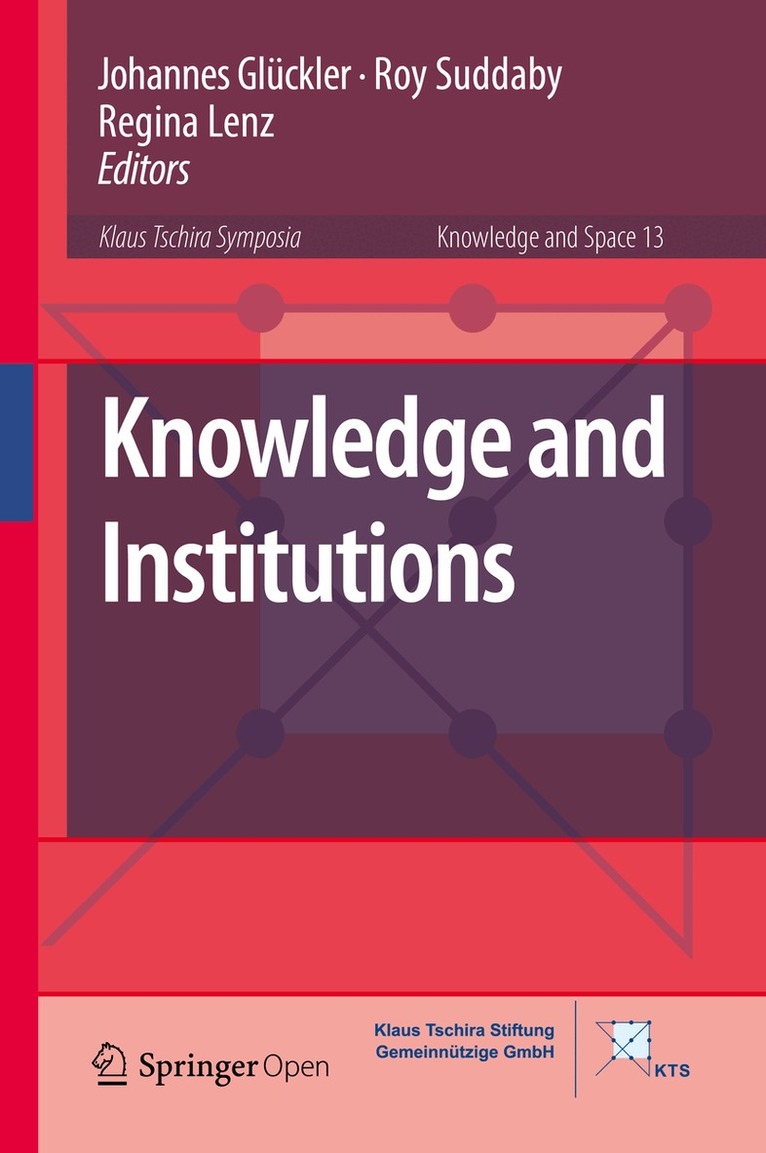
    Knowledge and Institutions

    AvJohannes Glückler,Roy Suddaby

    Inbunden, Engelska, 2018

    Del 13 i serien Knowledge and Space

    542 kr

    Beställningsvara. Skickas inom 10-15 vardagar. Fri frakt över 249 kr.

    Beskrivning

    This open access book bridges the disciplinary boundaries within the social sciences to explore the role of social institutions in shaping geographical contexts, and in creating new knowledge. It includes theorizations as well as original empirical case studies on the emergence, maintenance and change of institutions as well as on their constraining and enabling effects on innovation, entrepreneurship, art and cultural heritage, often at regional scales across Europe and North America. Rooted in the disciplines of management and organization studies, sociology, geography, political science, and economics the contributors all take comprehensive approaches to carve out the specific contextuality of institutions as well as their impact on societal outcomes. Not only does this book offer detailed insights into current debates in institutional theory, it also provides background for scholars, students, and professionals at the intersection between regional development, policy-making, and regulation.

    Produktinformation

    • Utgivningsdatum:2018-06-22
    • Mått:155 x 235 x 22 mm
    • Vikt:705 g
    • Format:Inbunden
    • Språk:Engelska
    • Serie:Knowledge and Space
    • Antal sidor:310
    • Förlag:Springer International Publishing AG
    • ISBN:9783319753270

    Utforska kategorier

    • Affärsutveckling inom Ekonomi och Ledarskap
    • Sociologi inom Samhälle och politik
    • Geografi inom Naturvetenskap och teknik

    Mer om författaren

    Johannes Glückler is Professor of Economic and Social Geography and Fellow of the Marsilius Center for Advanced Studies at Heidelberg University. His research follows a relational perspective and builds on theories of organization, networks and institutions in the analysis of knowledge and the space economy. He serves on several editorial boards of journals in the field of economic geography and as a partner of the Schader Foundation in the area of social network research. He is also co-founder of the M.Sc. Governance of Risks and Resources at the Heidelberg Center for Latin America in Santiago de Chile.Roy Suddaby is the Winspear Chair of Business at the Peter B. Gustavson School of Business, University of Victoria, Canada and Research Professor at the Newcastle University Business School, U.K. Professor Suddaby is an internationally regarded scholar of organizational theory and institutional change. His work has contributed to our understanding of the critical role of symbolic resources – legitimacy, authenticity, identity and history – in improving an organization’s competitive position. His current research examines the changing social and symbolic role of the modern corporation. Regina Lenz is a research associate at the Chair of Economic and Social Geography at Heidelberg University. She studied geography, history, English literature and philology, and economics at Heidelberg University and wrote her diploma thesis on the effectiveness of a development approach in Bangladesh’s leather sector. Furthermore, she has worked for a local business development agency and has done internships in development cooperation and international site selection. Her research focuses on the mechanisms of social institutions, as well as their effects on human interaction and public policy-making.

    Innehållsförteckning

    • Chapter 1. Knowledge, Geography and Institutions: An Introduction (Johannes Glückler, Roy Suddaby, Regina Lenz ).- Part I: Institutions, Knowledge and Innovation.- Chapter 2. Regional Innovation Transitions (Michael Storper).- chapter 3. Globalization and Institutional Change in Italian Industrial Districts (Harald Bathelt, Nicolas Conserva).- chapter 4. Innovation under a Protected Label of Origin: Institutional Change in Cognac (Jerker Moodysson, Lionel Sack).- Chapter 5. Conventions, Institutions and Knowledge - Perspectives on Institutions and Knowledge from the Standpoint of the “Economics of Convention” (Rainer Diaz-Bone).- Part II: Institutional Emergence, Change and Maintenance.- Chapter 6. Gastronomic Societies in the Basque Country (Andreas Hess).- Chapter 7. Continuity or Change? Drift and Morphosis in Shifting Institutional Contexts (Johannes Glückler, Regina Lenz).- Chapter 8. The Shared Challenges of Institutional Theories: Rational Choice, Historical Institutionalism andSociological Institutionalism (Henry Farrell).- Chapter 9. Organizational Fields as Mnemonic Communities (Diego Coraiola, Roy Suddaby, William M. Foster).- Part III: A Spatial Perspective on Institutions.- Chapter 10. Know Thy Place: Location and Imagined Communities in Institutional Field Dynamics (Tammar B. Zilber).- Chapter 11. The Art of Reconstructing a Shared Responsibility: Institutional Work of a Transnational Commons (Tiina Ritvala).- Chapter 12. Institutions and the Thirst for ‘Prestige’ Transport Infrastructure (Andrés Rodríguez-Pose, Riccardo Crescenzi, Mario Di Cataldo).- Chapter 13. Studying Entrepreneurship as an Institution (Pamela S. Tolbert, Ryan Coles).