• Fri frakt över 249 kr
  • •
  • Snabba leveranser
  • •
  • Billiga böcker
Kundservice

Du är på sajten för privatpersoner.

Företag, bibliotek eller offentlig verksamhet?

Du handlar på classic.bokus.com, där alla dina funktioner finns intakta.
Till classic.bokus.com
Bokus logotyp. Gå till startsidan.
  • Erbjudanden
  • Nyheter
  • Student
  • Topplistor
  • Barn & ungdom
  • Bokus Play
  • E-böcker
  • Pocketböcker
  • Spel & pussel

10% rabatt på allt med kod: NYSTART10 →

Sidfot

Mina sidor

    Hjälp

    • Kundservice
    • Vanliga frågor och svar
    • Frakt och leverans
    • Retur vid ångerrätt
    • Reklamera vara
    • Betalning
    • Köpvillkor
    • Allmänna villkor
    • Information om webbplatsens tillgänglighet

    Om Bokus

    • Om oss
    • Pressrum
    • För studenter
    • För företag
    • För bibliotek och offentlig verksamhet
    • För leverantörer
    • Hållbarhet

    Populärt

    • Aktuella erbjudanden
    • Presentkort
    • Studentlitteratur
    • Nya böcker
    • Topplistor
    • Signerade böcker
    • Engelska böcker

    Inspiration

    • Boktips
    • BookTok
    • Populära bokserier
    • Barnbokskaraktärer
    • Populära författare
    Logotyp för Bokus
    Följ oss på Facebook (extern länk)Följ oss på Instagram (extern länk)Följ oss på YouTube (extern länk)Följ oss på TikTok (extern länk)
    bokus @ CookiesAnpassa cookiesIntegritetspolicyKöpvillkor
    Till Citymail hemsida (extern länk)Till Budbee hemsida (extern länk)Till Postnord hemsida (extern länk)Till Schenker hemsida (extern länk)Till Early Bird hemsida (extern länk)Till Walleys hemsida (extern länk)
    1. Psykologi och pedagogik
    2. Pedagogik
    3. Material och digital teknik i undervisningen

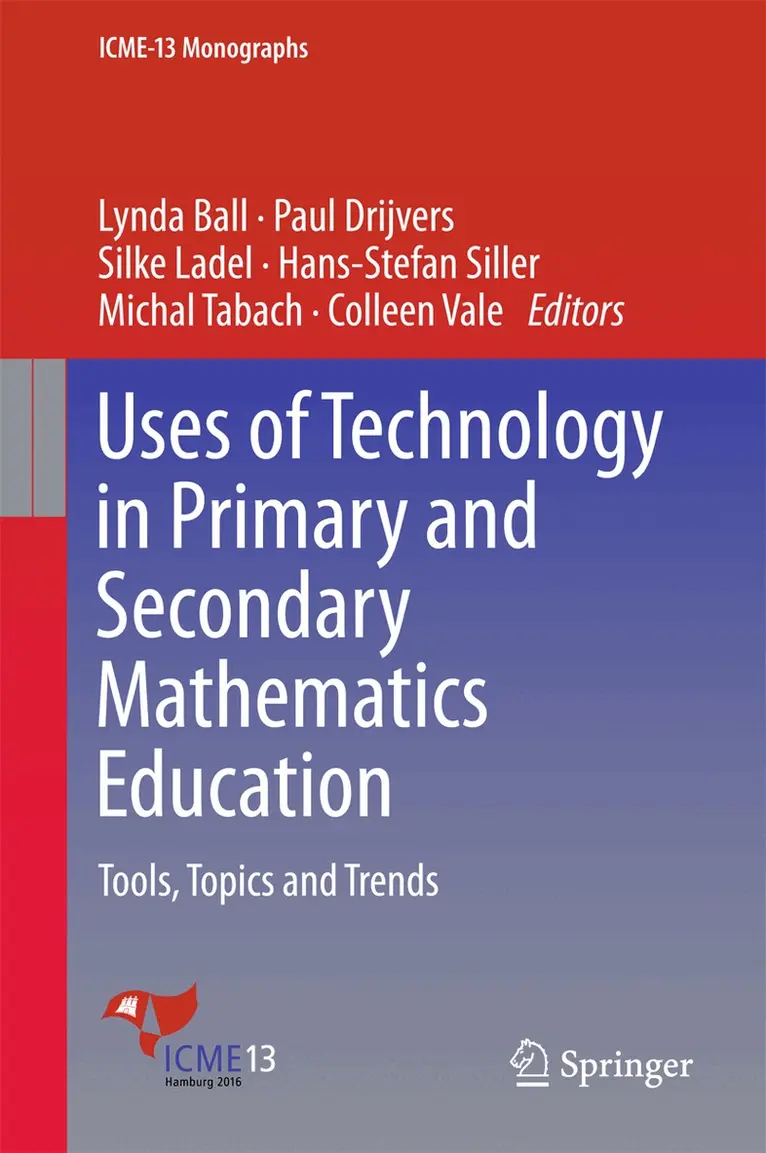
    Uses of Technology in Primary and Secondary Mathematics Education

    Tools, Topics and Trends

    AvLynda Ball,Paul Drijvers

    Inbunden, Engelska, 2018

    Del i serien ICME-13 Monographs

    1 475 kr

    Beställningsvara. Skickas inom 10-15 vardagar. Fri frakt över 249 kr.

    Beskrivning

    This book provides international perspectives on the use of digital technologies in primary, lower secondary and upper secondary school mathematics. It gathers contributions by the members of three topic study groups from the 13th International Congress on Mathematical Education and covers a range of themes that will appeal to researchers and practitioners alike. The chapters include studies on technologies such as virtual manipulatives, apps, custom-built assessment tools, dynamic geometry, computer algebra systems and communication tools. Chiefly focusing on teaching and learning mathematics, the book also includes two chapters that address the evidence for technologies’ effects on school mathematics. The diverse technologies considered provide a broad overview of the potential that digital solutions hold in connection with teaching and learning. The chapters provide both a snapshot of the status quo of technologies in school mathematics, and outline how they might impact school mathematics ten to twenty years from now.

    Produktinformation

    • Utgivningsdatum:2018-05-25
    • Mått:155 x 235 x 30 mm
    • Vikt:834 g
    • Format:Inbunden
    • Språk:Engelska
    • Serie:ICME-13 Monographs
    • Antal sidor:440
    • Upplaga:18001
    • Förlag:Springer International Publishing AG
    • ISBN:9783319765747

    Utforska kategorier

    • Material och digital teknik i undervisningen inom Psykologi och pedagogik
    • Läroplaner och kursplaner inom Psykologi och pedagogik
    • Undervisning i specifika ämnen inom Psykologi och pedagogik

    Innehållsförteckning

    • Introduction.- Using video analysis to explain how virtual manipulative app alignment affects children’s mathematics learning.- Applying the modification of attributes, affordances, abilities, and distance for learning framework to a child’s multi-touch interactions with an idealized number line.- Using one-to-one mobile technology to support student discourse.- Duo of digital and material artefacts dedicated to the learning of geometry at primary school.- Using cluster analysis to enhance student learning when using geometry mathematics apps.- How children using counting strategies represent quantities on the virtual and physical ‘twenty frame’.- Reshaping the learning experiences through apps: Affordances.- Empirical evidence for benefit? Reviewing quantitative research on the use of digital tools in mathematics education.- Digital tools in lower secondary school mathematics education. A review of qualitative research on mathematics learning of lower secondary school students.- Classical and digital technologies for the Pythagorean theorem.- Communication when learning and teaching mathematics with technology.- Online automated assessment and student learning: the Pépite project in elementary algebra.- Using dynamic CAS and geometry to enhance digital assessments.- Design of digital resources for promoting creative mathematical thinking.- Drawing in space: Doing mathematics with 3D pens.- Diagrams and tool use: Making a circle with Wiigraph.- A linguistic approach to written solutions in CAS-allowed exams.- Technological supports for mathematical thinking and learning:  Co-action and designing to democratize access to powerful ideas..- Recursive exploration space for concepts in linear algebra.- Geogebra as a tool in modelling processes.- Instrumental genesis and proof: Understanding the use of computer algebra systems in proofs in textbooks.- In search of standards: Teaching mathematics in a technological environment.- Using graphic calculators to graph quadratics.- Teacher beliefs and practice when teaching with technology a latent profile analysis.- Uses of technology in K-12 mathematics education: concluding remarks.