• Fri frakt över 249 kr
  • •
  • Snabba leveranser
  • •
  • Billiga böcker
Kundservice

Du är på sajten för privatpersoner.

Företag, bibliotek eller offentlig verksamhet?

Du handlar på classic.bokus.com, där alla dina funktioner finns intakta.
Till classic.bokus.com
Bokus logotyp. Gå till startsidan.
  • Erbjudanden
  • Nyheter
  • Student
  • Topplistor
  • Barn & ungdom
  • Bokus Play
  • E-böcker
  • Pocketböcker
  • Spel & pussel

10% rabatt på allt med kod: NYSTART10 →

Sidfot

Mina sidor

    Hjälp

    • Kundservice
    • Vanliga frågor och svar
    • Frakt och leverans
    • Retur vid ångerrätt
    • Reklamera vara
    • Betalning
    • Köpvillkor
    • Allmänna villkor
    • Information om webbplatsens tillgänglighet

    Om Bokus

    • Om oss
    • Pressrum
    • För studenter
    • För företag
    • För bibliotek och offentlig verksamhet
    • För leverantörer
    • Hållbarhet

    Populärt

    • Aktuella erbjudanden
    • Presentkort
    • Studentlitteratur
    • Nya böcker
    • Topplistor
    • Signerade böcker
    • Engelska böcker

    Inspiration

    • Boktips
    • BookTok
    • Populära bokserier
    • Barnbokskaraktärer
    • Populära författare
    Logotyp för Bokus
    Följ oss på Facebook (extern länk)Följ oss på Instagram (extern länk)Följ oss på YouTube (extern länk)Följ oss på TikTok (extern länk)
    bokus @ CookiesAnpassa cookiesIntegritetspolicyKöpvillkor
    Till Citymail hemsida (extern länk)Till Budbee hemsida (extern länk)Till Postnord hemsida (extern länk)Till Schenker hemsida (extern länk)Till Early Bird hemsida (extern länk)Till Walleys hemsida (extern länk)
    1. Medicin
    2. Medicin: allmänt

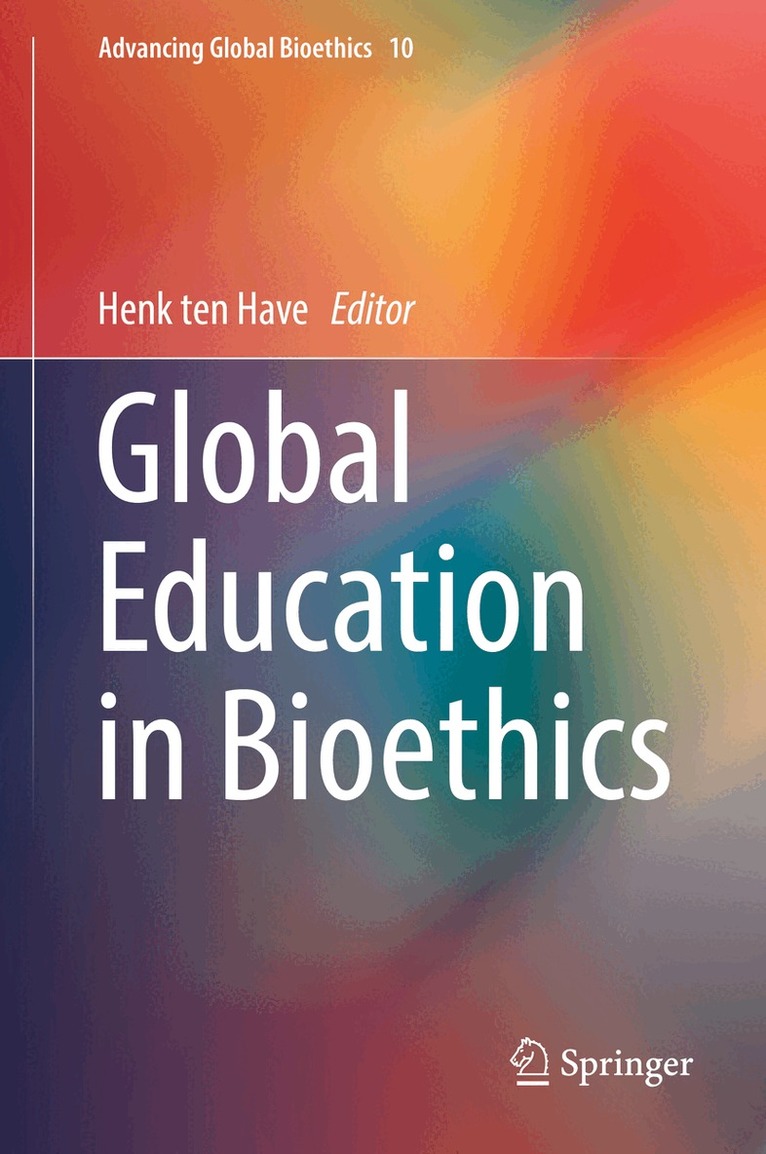
    Global Education in Bioethics

    AvHenk ten Have

    Inbunden, Engelska, 2018

    Del 10 i serien Advancing Global Bioethics

    1 562 kr

    Beställningsvara. Skickas inom 10-15 vardagar. Fri frakt över 249 kr.

    Beskrivning

    This book presents and elaborates on how the teaching of global ethics in healthcare contributes to furthering ideals of cosmopolitanism: solidarity, equality, respect for differences and concern with what human beings, and specifically patients have in common, regardless of where they live and who they are. Global problems such as pandemic diseases, disasters, lack of care and medication, homelessness and displacement call for global responses. The new area of global bioethics is providing answers by arguing that ethical discourse should first of all criticize the structures of violence and injustice that underlie many threats to global health. Education of health professionals should articulate that they are ‘citizens of the world’, like their patients. This book first demonstrates that a moral vision of global education is necessary to gain a global dimension. It is argued that a global framework of ethical principles is available; the challenge is to elaborate and specify that framework into specific educational approaches and models. The book subsequently analyzes goals and challenges of global education in biomedicine and healthcare. It is shown how such challenges (e.g. inequities and cultural differences) can be overcome. Finally, the book presents concrete examples (cases, methods, and practices) of global education in bioethics. The unique feature of the book is that it addresses global education challenges specifically in the area of healthcare, medicine, and medical science. It combines two areas of research and experience that are usually not connected: global bioethics and global education. This book is written for all those involved in global ethics teaching in medicine, nursing, ethics, philosophy, law, and theology courses.

    Produktinformation

    • Utgivningsdatum:2018-06-26
    • Mått:155 x 235 x 18 mm
    • Vikt:500 g
    • Format:Inbunden
    • Språk:Engelska
    • Serie:Advancing Global Bioethics
    • Antal sidor:198
    • Förlag:Springer International Publishing AG
    • ISBN:9783319789835

    Utforska kategorier

    • Medicin: allmänt inom Medicin
    • Skolväsen och utbildningssystem inom Psykologi och pedagogik
    • Biovetenskap inom Naturvetenskap och teknik

    Mer om författaren

    Henk ten Have studied medicine and philosophy at Leiden University, the Netherlands. He received his medical degree in 1976 from Leiden University and his philosophy degree in 1983. He worked as a researcher in the Pathology Laboratory, University of Leiden (1976-1977), as a practising physician in the Municipal Health Services, City of Rotterdam (1978-1979), and as a Professor of Philosophy in the Faculty of Medicine and Faculty of Health Sciences, University of Limburg, Maastricht (1982-1991). From 1991 he was a Professor of Medical Ethics and the Director of the Department of Ethics, Philosophy and History of Medicine in the University Medical Centre Nijmegen, the Netherlands. In September 2003 he joined UNESCO as Director of the Division of Ethics of Science and Technology, working at the Headquarters in Paris, France. Since July 2010 he is Director of the Center for Healthcare Ethics at Duquesne University in Pittsburgh, USA. In 2011 he was appointed as Adjunct Professor at King Saud bin Abdulaziz University for Health Sciences, Riyadh, Saudi Arabia.

    Recensioner i media

    “Global Education in Bioethics is recommended to experts in the area, to those who are well informed but also to beginners. … Thanks to diversity of presented methods it can be used by teachers in areas other than ethics if they want to promote global reflection on ethics and interdisciplinarity.” (Helena Štrucelj, JAHR - European Journal of Bioethics, Vol. 10 (20), 2019)

    Innehållsförteckning

    • Part I: Moral visions of global education.- Chapter 1. Cosmopolitanism and educating the citizen of the world (Henk ten Have).- Chapter 2. Global bioethics and global education (Solomon Benatar).- Part II: Goals and challenges of global ethics education.- Chapter 3. Goals of global ethics education (Volnei Garrafa and Thiago Rocha da Cunha).-  Chapter 4. Priorities in the teaching of ethics in a globalized world (Renzo Pegoraro).- Chapter 5. Can global ethics education solve inequities? (Leonardo de Castro).- Chaper 6. Interculturality and cultural competence (Ayesha Ahmad).- Chapter 7. Resources for global ethics education (Wanda Teays).- Part III: Practices of global ethics education.- Chapter 8. Permanent e-learning in the teaching of ethics (Susana Vidal).- Chapter 9. Arts and humanities as instruments for global ethics education (Jan Helge Solbakk).- Chapter 10. To see differently: incorporating the arts into the bioethics curriculum (Terry Maksymowych).- Chapter 11. The cinema as instrument for teaching and learning global ethics (Flavio Paranhos).- Chapter 12. The role of case studies in global ethics education  (Willem Hoffmann).