• Fri frakt över 249 kr
  • •
  • Snabba leveranser
  • •
  • Billiga böcker
Kundservice

Du är på sajten för privatpersoner.

Företag, bibliotek eller offentlig verksamhet?

Du handlar på classic.bokus.com, där alla dina funktioner finns intakta.
Till classic.bokus.com
Bokus logotyp. Gå till startsidan.
  • Erbjudanden
  • Nyheter
  • Student
  • Topplistor
  • Barn & ungdom
  • Bokus Play
  • E-böcker
  • Pocketböcker
  • Spel & pussel

10% rabatt på allt med kod: NYSTART10 →

Sidfot

Mina sidor

    Hjälp

    • Kundservice
    • Vanliga frågor och svar
    • Frakt och leverans
    • Retur vid ångerrätt
    • Reklamera vara
    • Betalning
    • Köpvillkor
    • Allmänna villkor
    • Information om webbplatsens tillgänglighet

    Om Bokus

    • Om oss
    • Pressrum
    • För studenter
    • För företag
    • För bibliotek och offentlig verksamhet
    • För leverantörer
    • Hållbarhet

    Populärt

    • Aktuella erbjudanden
    • Presentkort
    • Studentlitteratur
    • Nya böcker
    • Topplistor
    • Signerade böcker
    • Engelska böcker

    Inspiration

    • Boktips
    • BookTok
    • Populära bokserier
    • Barnbokskaraktärer
    • Populära författare
    Logotyp för Bokus
    Följ oss på Facebook (extern länk)Följ oss på Instagram (extern länk)Följ oss på YouTube (extern länk)Följ oss på TikTok (extern länk)
    bokus @ CookiesAnpassa cookiesIntegritetspolicyKöpvillkor
    Till Citymail hemsida (extern länk)Till Budbee hemsida (extern länk)Till Postnord hemsida (extern länk)Till Schenker hemsida (extern länk)Till Early Bird hemsida (extern länk)Till Walleys hemsida (extern länk)
    1. Samhälle och politik
    2. Sociologi och antropologi
    3. Sociologi

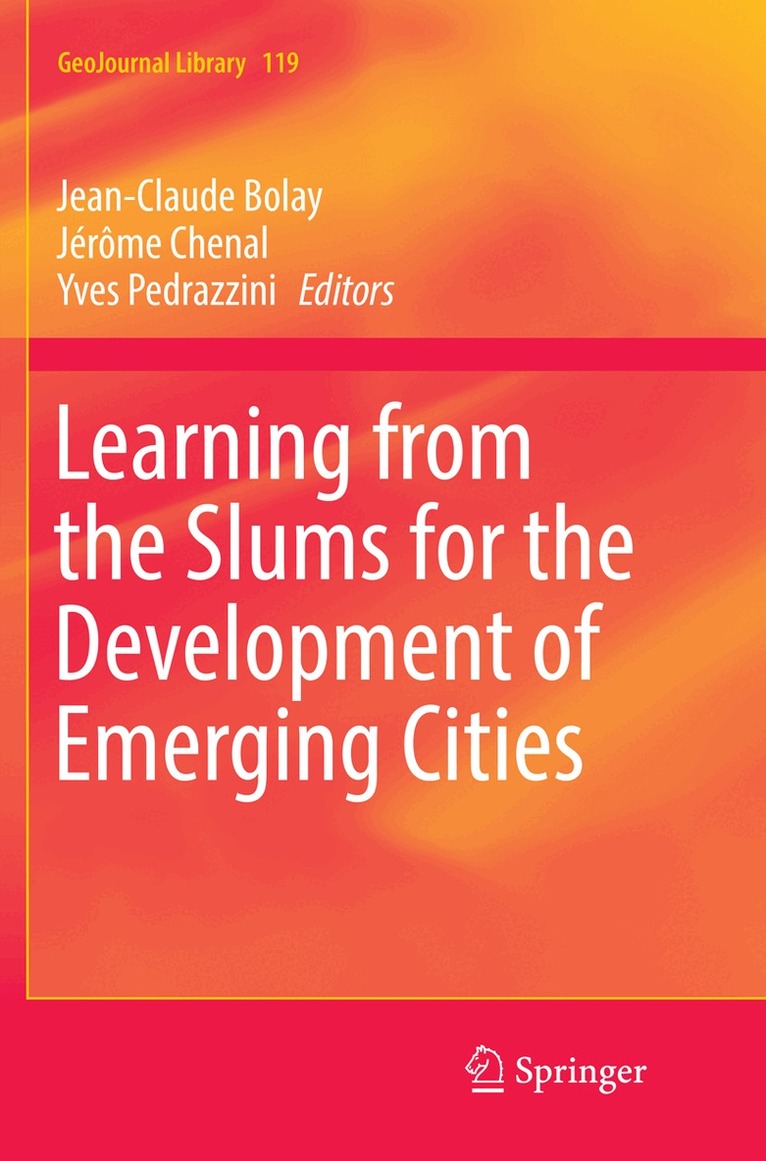
    Learning from the Slums for the Development of Emerging Cities

    AvJean-Claude Bolay,Jérôme Chenal

    Häftad, Engelska, 2018

    Del i serien GeoJournal Library

    546 kr

    Beställningsvara. Skickas inom 10-15 vardagar. Fri frakt över 249 kr.

    Beskrivning

    This book deals with slums as a specific question and a central focus in urban planning. It radically reverses the official version of the history of world cities as narrated during decades: slums are not at the margin of the contemporary process of urbanization; they are an integral part of it. Taking slums as its central focus and regarding them as symptomatic of the ongoing transformations of the city, the book moves to the very heart of the problem in urban planning. The book presents 16 case studies that form the basis for a theory of the slum and a concrete development manual for the slum. The interdisciplinary approach to analysing slums presented in this volume enables researchers to look at social and economic dimensions as well as at the constructive and spatial aspects of slums. Both at the scientific and the pedagogical level, it allows one to recognize the efforts of the slum’s residents, key players in the past, and present development of their neighborhoods, and to challenge public and private stakeholders on priorities decided in urban planning, and their mismatches when compared to the findings of experts and the demands of users. Whether one is a planner, an architect, a developer or simply an inhabitant of an emerging city, the presence of slums in one’s environment – at the same time central and nonetheless incongruous – makes a person ask questions. Today, it is out of the question to be satisfied with the assumption of the marginality of slums, or of the incongruous nature of their existence. Slums are now fully part of the urban landscape, contributing to the identity and the urbanism of cities and their stakeholders.

    Produktinformation

    • Utgivningsdatum:2018-06-07
    • Mått:155 x 235 x 14 mm
    • Vikt:440 g
    • Format:Häftad
    • Språk:Engelska
    • Serie:GeoJournal Library
    • Antal sidor:247
    • Förlag:Springer International Publishing AG
    • ISBN:9783319811208

    Utforska kategorier

    • Sociologi inom Samhälle och politik
    • Sociala grupper och identitet inom Samhälle och politik
    • Geografi inom Naturvetenskap och teknik

    Mer om författaren

    Jean-Claude Bolay was appointed Director of Cooperation at the Ecole Polytechnique Fédérale de Lausanne (EPFL) in 2001 and has headed what recently became the Cooperation & Development Center (CODEV) since 2005. A sociologist by training, he specialized in urban issues in Latin America, Asia and West Africa. He prepared his PhD in Political Sciences at El Colegio de Mexico, then at UC Berkeley, USA. Before joining EPFL in 1989, he worked for the Swiss Agency for Development and Cooperation (SDC) both in Switzerland and in Cameroon. He has carried out many international research projects in Vietnam and Latin American countries in particular, looking at social practices in urban societies, sustainable urban development and poverty reduction in developing countries. He was a scientific advisor and evaluator for the Swiss State Secretariat for Education and Research, the Belgian Universities’ Commission for Development and the French Ministry of Foreign Affairs, among other institutions. At EPFL, he has directed postgraduate courses on development in Africa and India. In parallel to his position as Director of CODEV, he was appointed Adjunct Professor in 2005 in the Laboratory of Urban Sociology of the Natural, Architectural and Built Environment School.Jérôme Chenal is a doctor of science (Ecole Polytechnique Fédérale de Lausanne - EPFL). After studying architecture at the EPFL, he worked as an urban planner for the Urbaplan agency, which specializes in urban development in Africa. He then joined the EPFL’s Laboratory of Urban Sociology (LaSUR), where he wrote his thesis. He was a visiting researcher at University College London’s (UCL) Development Planning Unit (DPU) for two years starting in 2010, before returning to the EPFL’s School of Architecture, Civil and Environmental Engineering (ENAC), where he currently works. His current researches concern the linkbetween spatial transformations and social mutations, at the crossroad of architecture and lifestyles, urban planning and street-level practices. His empirical investigations take place in metropolis of Africa and Asia, where he develops news methodological instruments for urban research using especially photography.Yves Pedrazzini is a leading authority on contemporary urban issues. He works as a senior scientist at the Laboratory of Urban Sociology (LASUR) and as a lecturer in the Section of Architecture at the Ecole Polytechnique Fédérale de Lausanne (EPFL), Switzerland. As a trained sociologist and anthropologist, Yves Pedrazzini leads research projects on urban violence, security and insecurity, gangs and bandits, public spaces and gated communities, urban culture, sports and art, in contexts as far afield as Colombia, Ethiopia, France, Portugal and Venezuela. His recent research focuses on the slum as a global icon, and on outsiders and urban outcasts as key figures of urbanity.

    Innehållsförteckning

    • Chapter 1: Introduction to the Slums; Jean-Claude Bolay.- Chapter 2: Chapter 2: The Slum, an Urban Theory; Yves Pedrazzini.- Chapter 3: Typology of the Slums; Jérôme Chenal.- Chapter 4: Financing Relocation of Households of Karyan Thomas and Douar Skouila within Essalam Operation in Casablanca; Olivier Toutain.- Chapter 5: Slums in Ouagadougou; Aude Nikiema.- Chapter 6: The Future of the Traditional Habitat in African Cities; Raphaël Chatelet.- Chapter 7: Case Study of Kibera/Nairobi, Kenya; Christoph Lüthi.- Chapter 8: Despised Territories of Ciudad Bolivar; Yafiza Zorro.- Chapter 9: Villa El Salvador: From Urban Self-management Projects to Territorial Marketing Strategies; Diana Burgos-Vigna.- Chapter 10: Rocinha, Favela beyond a Shelter Issue.- Fernanda Maria Lonardoni.- Chapter 11: Caught between Displacement and Permanence: Social Housing Project in Nova Luz; Simone Gatti.- Chapter 12: (Re)Urbanization of Villa 31 Carlos Mugica; Javier Fernández Castro.- Chapter 13: Detroit: Depopulation, Disinvestment and Blight Induce a Volatile Environment for Housing in a Former Metropolis; Margaret Dewar.- Chapter 14: Environmental Circumstances of Informal Settlements in Port-au-Prince after January 12, 2010: Cité de l’Eternel Case Study; Anie Bras, Abigail Kern, Georges Eddy Lucien and Evens Emmanuel.- Chapter 15: Dharavi: Where the Urban Design Episteme is Falling Apart; Camillo Boano.- Chapter 16: Cambodian Informal Settlements - A Cradle of Competitions for Land, Forced Evictions and Resistance: Boenk Kak Case Study; Valérie Clerc.- Chapter 17: Slums in Shanghai; Anouk Matthey Dandrieu.- Chapter 18: “PLAN CAÑADA”, a Participative Urban Planning Project for a Slum Area in Madrid, Spain; Todo por la Praxis.- Chapter 18: Informal Settlements in Southeast Europe during the Post-Socialist Period; Alexander D. Slaev and Sonia A. Hirt.- Chapter 19: From Theory to the Field; Jérôme Chenal.- Chapter 6: Conclusion; Jean-Claude Bolay, Jérôme Chenal and Yves Pedrazzini.