• Fri frakt över 249 kr
  • •
  • Snabba leveranser
  • •
  • Billiga böcker
Kundservice

Du är på sajten för privatpersoner.

Företag, bibliotek eller offentlig verksamhet?

Du handlar på classic.bokus.com, där alla dina funktioner finns intakta.
Till classic.bokus.com
Bokus logotyp. Gå till startsidan.
  • Erbjudanden
  • Nyheter
  • Student
  • Topplistor
  • Barn & ungdom
  • Bokus Play
  • E-böcker
  • Pocketböcker
  • Spel & pussel

10% rabatt på allt med kod NYSTART10 →

Sidfot

Mina sidor

    Hjälp

    • Kundservice
    • Vanliga frågor och svar
    • Frakt och leverans
    • Retur vid ångerrätt
    • Reklamera vara
    • Betalning
    • Köpvillkor
    • Allmänna villkor
    • Information om webbplatsens tillgänglighet

    Om Bokus

    • Om oss
    • Pressrum
    • För studenter
    • För företag
    • För bibliotek och offentlig verksamhet
    • För leverantörer
    • Hållbarhet

    Populärt

    • Aktuella erbjudanden
    • Presentkort
    • Studentlitteratur
    • Nya böcker
    • Topplistor
    • Signerade böcker
    • Engelska böcker

    Inspiration

    • Boktips
    • BookTok
    • Populära bokserier
    • Barnbokskaraktärer
    • Populära författare
    Logotyp för Bokus
    Följ oss på Facebook (extern länk)Följ oss på Instagram (extern länk)Följ oss på YouTube (extern länk)Följ oss på TikTok (extern länk)
    bokus @ CookiesAnpassa cookiesIntegritetspolicyKöpvillkor
    Till Citymail hemsida (extern länk)Till Budbee hemsida (extern länk)Till Postnord hemsida (extern länk)Till Schenker hemsida (extern länk)Till Early Bird hemsida (extern länk)Till Walleys hemsida (extern länk)
    1. Naturvetenskap och teknik
    2. Teknik och industri
    3. Elektronik och kommunikationer

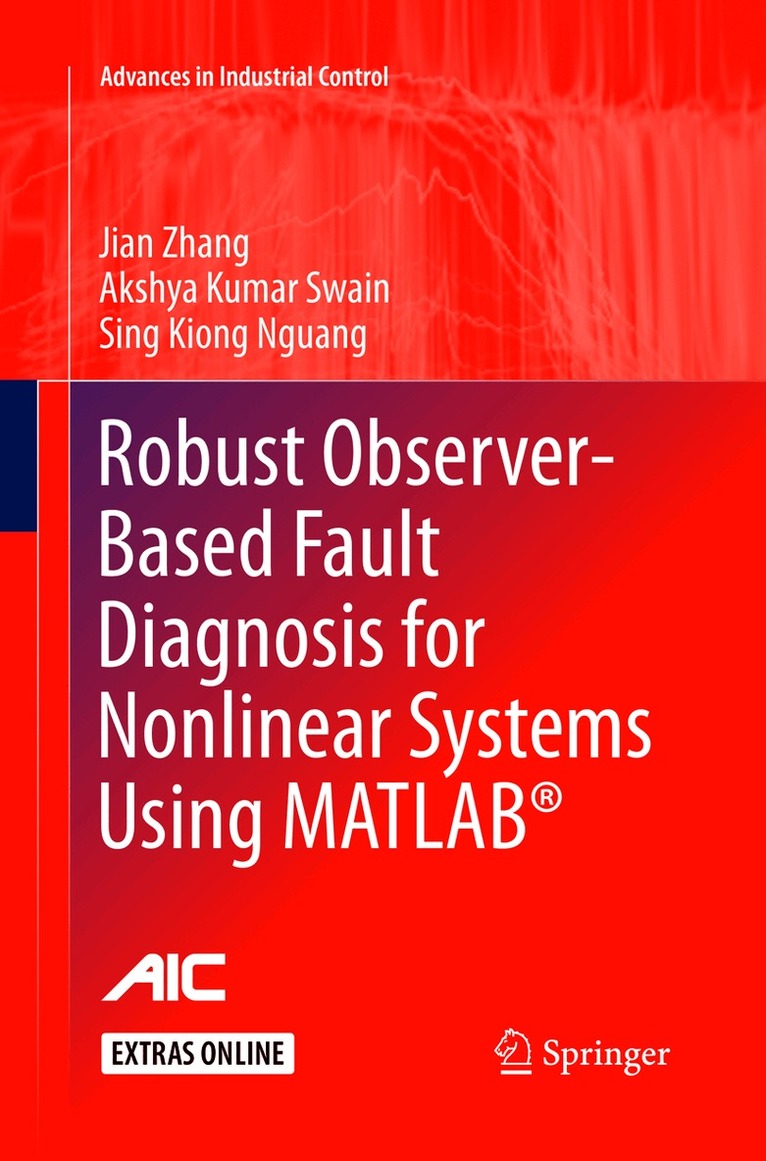
    Robust Observer-Based Fault Diagnosis for Nonlinear Systems Using MATLAB®

    AvJian Zhang,Akshya Kumar Swain

    Häftad, Engelska, 2018

    Del i serien Advances in Industrial Control

    1 085 kr

    Beställningsvara. Skickas inom 10-15 vardagar. Fri frakt över 249 kr.

    Fler format och utgåvor

    Inbunden

    1 085 kr

    Beskrivning

    This book introduces several observer-based methods, including:•the sliding-mode observer•the adaptive observer• the unknown-input observer and• the descriptor observer methodfor the problem of fault detection, isolation and estimation, allowing readers to compare and contrast the different approaches. The authors present basic material on Lyapunov stability theory, H¥ control theory, sliding-mode control theory and linear matrix inequality problems in a self-contained and step-by-step manner. Detailed and rigorous mathematical proofs are provided for all the results developed in the text so that readers can quickly gain a good understanding of the material. MATLAB® and Simulink® codes for all the examples, which can be downloaded from http://extras.springer.com, enable students to follow the methods and illustrative examples easily. The systems used in the examples make the book highly relevant to real-world problems in industrial control engineering and include a seventh-order aircraft model, a single-link flexible joint robot arm and a satellite controller. To help readers quickly find the information they need and to improve readability, the individual chapters are written so as to be semi-independent of each other.Robust Oberserver-Based Fault Diagnosis for Nonlinear Systems Using MATLAB® is of interest to process, aerospace, robotics and control engineers, engineering students and researchers with a control engineering background.

    Produktinformation

    • Utgivningsdatum:2018-05-30
    • Mått:155 x 235 x 14 mm
    • Vikt:371 g
    • Format:Häftad
    • Språk:Engelska
    • Serie:Advances in Industrial Control
    • Antal sidor:224
    • Förlag:Springer International Publishing AG
    • ISBN:9783319812564

    Utforska kategorier

    • Elektronik och kommunikationer inom Naturvetenskap och teknik
    • Flyg- och rymdteknik inom Naturvetenskap och teknik
    • Rymdforskning inom Naturvetenskap och teknik

    Mer om författaren

    Jian Zhang received his PhD degree from the University of Auckland, New Zealand, in 2013. His main research interests include robust nonlinear control and fault diagnosis. He has published 14 refereed journal and conference papers on fault diagnosis, nonlinear filters and nonlinear system identification.Akshya Swain received his PhD degree from the Department of Automatic Control and Systems Engineering of The University of Sheffield, United Kingdom in 1997. He has published over 140 referred journal and conference papers on nonlinear system identification, nonlinear control, control of wireless power transfer systems, wireless sensor networks and biomedical signal processing. He is currently on the editorial board of two international journals.Sing Kiong Nguang received the PhD degree from the Department of Electrical and Computer Engineering of the University of Newcastle, Callaghan, Australia, in 1992 and 1995, respectively. Currently, he is a Chair Professor atthe Department of Electrical and Computer Engineering, University of Auckland, New Zealand. He has published over 300 refereed journal and conference papers on nonlinear control design, nonlinear control systems, nonlinear time-delay systems, nonlinear sampled-data systems, biomedical systems modeling, fuzzy modeling and control, biological systems modeling and control, and food and bioproduct processing. He has served on the editorial board of a number of international journals, and is the Editor-in-Chief of the International Journal of Sensors, Wireless Communications and Control.

    Innehållsförteckning

    • Introduction.- Detection and Isolation of Actuator Faults.- Detection and Isolation of Sensor Faults.- Robust Estimation of Actuator Faults.- Robust Estimation of Sensor Faults.- Simultaneous Estimation of Actuator and Sensor Faults Using SMO and AO.- Simultaneous Estimation of Actuator and Sensor Faults Using SMO and UIO.- Simultaneous Estimation of Actuator and Sensor Faults for Descriptor Systems.- Conclusions and Future Work.- Appendices: Solving Linear Matrix Inequality (LMI) Problems; Proof of Lemma 3.1.