• Fri frakt över 249 kr
  • •
  • Snabba leveranser
  • •
  • Billiga böcker
Kundservice

Du är på sajten för privatpersoner.

Företag, bibliotek eller offentlig verksamhet?

Du handlar på classic.bokus.com, där alla dina funktioner finns intakta.
Till classic.bokus.com
Bokus logotyp. Gå till startsidan.
  • Erbjudanden
  • Nyheter
  • Student
  • Topplistor
  • Barn & ungdom
  • Bokus Play
  • E-böcker
  • Pocketböcker
  • Spel & pussel

10% rabatt på allt med kod: NYSTART10 →

Sidfot

Mina sidor

    Hjälp

    • Kundservice
    • Vanliga frågor och svar
    • Frakt och leverans
    • Retur vid ångerrätt
    • Reklamera vara
    • Betalning
    • Köpvillkor
    • Allmänna villkor
    • Information om webbplatsens tillgänglighet

    Om Bokus

    • Om oss
    • Pressrum
    • För studenter
    • För företag
    • För bibliotek och offentlig verksamhet
    • För leverantörer
    • Hållbarhet

    Populärt

    • Aktuella erbjudanden
    • Presentkort
    • Studentlitteratur
    • Nya böcker
    • Topplistor
    • Signerade böcker
    • Engelska böcker

    Inspiration

    • Boktips
    • BookTok
    • Populära bokserier
    • Barnbokskaraktärer
    • Populära författare
    Logotyp för Bokus
    Följ oss på Facebook (extern länk)Följ oss på Instagram (extern länk)Följ oss på YouTube (extern länk)Följ oss på TikTok (extern länk)
    bokus @ CookiesAnpassa cookiesIntegritetspolicyKöpvillkor
    Till Citymail hemsida (extern länk)Till Budbee hemsida (extern länk)Till Postnord hemsida (extern länk)Till Schenker hemsida (extern länk)Till Early Bird hemsida (extern länk)Till Walleys hemsida (extern länk)
    1. Psykologi och pedagogik
    2. Pedagogik
    3. Pedagogisk psykologi

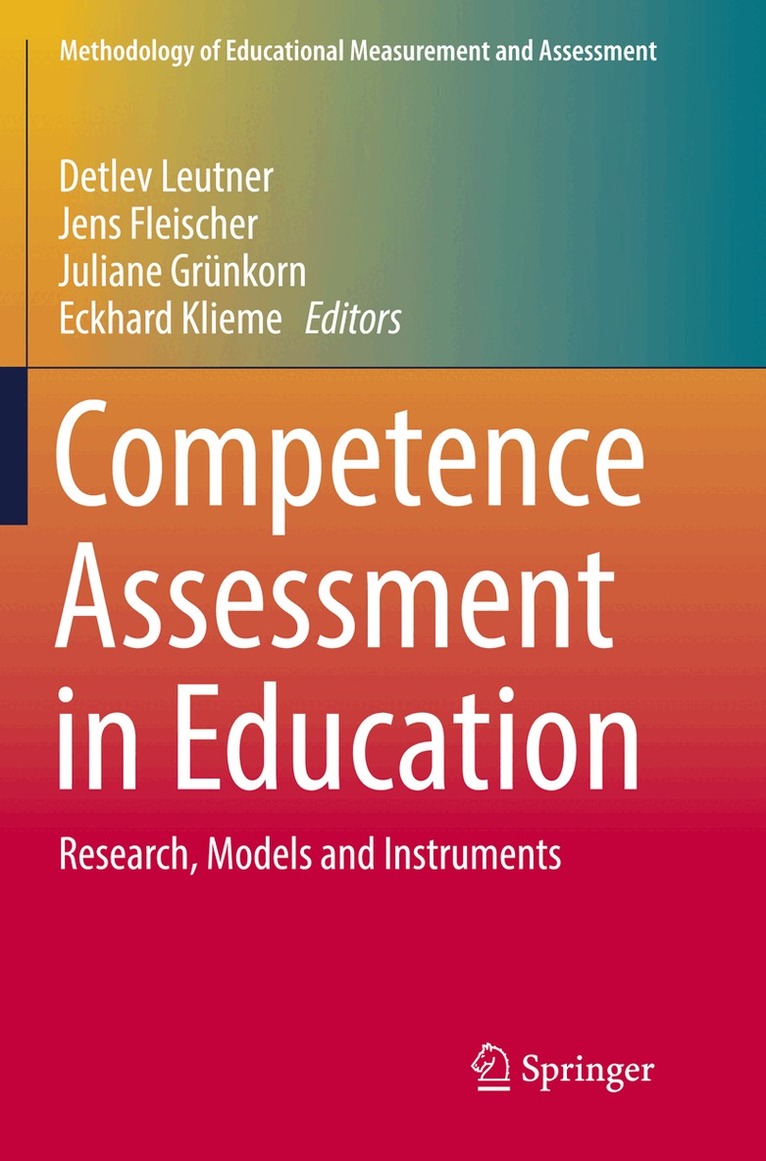
    Competence Assessment in Education

    Research, Models and Instruments

    AvDetlev Leutner,Jens Fleischer

    Häftad, Engelska, 2018

    Del i serien Methodology of Educational Measurement and Assessment

    1 265 kr

    Beställningsvara. Skickas inom 10-15 vardagar. Fri frakt över 249 kr.

    Beskrivning

    This book addresses challenges in the theoretically and empirically adequate assessment of competencies in educational settings. It presents the scientific projects of the priority program “Competence Models for Assessing Individual Learning Outcomes and Evaluating Educational Processes,” which focused on competence assessment across disciplines in Germany.The six-year program coordinated 30 research projects involving experts from the fields of psychology, educational science, and subject-specific didactics. The main reference point for all projects is the concept of “competencies,” which are defined as “context-specific cognitive dispositions that are acquired and needed to successfully cope with certain situations or tasks in specific domains” (Koeppen et al., 2008, p. 62). The projects investigate different aspects of competence assessment: The primary focus lies on the development of cognitive models of competencies, complemented by the construction of psychometric models based on these theoretical models. In turn, the psychometric models constitute the basis for the construction of instruments for effectively measuring competencies.The assessment of competencies plays a key role in optimizing educational processes and improving the effectiveness of educational systems. This book contributes to this challenging endeavor by meeting the need for more integrative, interdisciplinary research on the structure, levels, and development of competencies.

    Produktinformation

    • Utgivningsdatum:2018-06-21
    • Mått:155 x 235 x 28 mm
    • Vikt:768 g
    • Format:Häftad
    • Språk:Engelska
    • Serie:Methodology of Educational Measurement and Assessment
    • Antal sidor:503
    • Förlag:Springer International Publishing AG
    • ISBN:9783319843018

    Utforska kategorier

    • Pedagogisk psykologi inom Psykologi och pedagogik
    • Examination och betygsättning inom Psykologi och pedagogik
    • Psykologisk metod inom Psykologi och pedagogik

    Innehållsförteckning

    • 1. Competence assessment in education: An introduction.- PART 1: Modeling and assessing student competencies.- 2. Science-P I: Modeling conceptual understanding in primary school.- 3. Science-P II: Modeling scientific reasoning in primary school.- 4. The Heidelberg inventory of geographic system competency model.- 5. An extended model of literary literacy.- 6. Self-regulated learning with expository texts as a competence: Competence structure and competence training.- 7. Investigating pre-service teachers’ professional vision within university-based teacher education.- 8. Teacher knowledge experiment: Conditions for the development of pedagogical content knowledge.- 9. Teachers’ school tracking decisions.- 10. Modeling, measuring, and training teachers´ counseling and diagnostic competences.- 11. Development and evaluation of a competency model for teaching integrative processing of texts and pictures (BiTe).- PART 3: Modeling and assessing vocational competencies and adult learning.- 12. Multidimensional competency assessments and structures in VET.- 13. Professional competencies of building trade apprentices after their first year of training.- 14. Assessing tomorrow’s potential: A competence measuring approach in vocational education and training.- PART 6: Competency development: Modeling of change and training of competencies.- 15. The development of students’ physics competence in middle school.- 16. Modelling and fostering decision-making competence regarding challenging issues of sustainable development.- 17. Metacognitive knowledge in secondary school students: Assessment, structure, and developmental change.- 18. Development of dynamic usage of strategies for integrating text and picture information in secondary schools.- 19. 20. An intensive longitudinal study on the development of student achievement over two years (LUISE).- PART 5: Innovations in psychometric models and computer-based assessment.- 21. Multidimensional structures of competencies: Focusing on text comprehension in English as a foreign language.- 22. Multidimensional adaptive measurement of competences.- 23. Development, validation and application of a competence model for mathematical problem solving by using and translating representations of functions.- 24. Relating product data to process data from computer-based competence assessment.- 25. Dynamic problem solving: Multiple-item testing based on minimal complex systems.- PART 6: Feedback from competency assessment: Concepts, conditions and consequences.- 26. Formative assessment in mathematics instruction: Theoretical considerations and empirical results of the Co2CA project.- 27. Arguing validity in educational assessment.- 28. Evaluating prerequisites for the development of a dynamic test of reading competence: Feedback effects on reading comprehension in children.