• Fri frakt över 249 kr
  • •
  • Snabba leveranser
  • •
  • Billiga böcker
Kundservice

Du är på sajten för privatpersoner.

Företag, bibliotek eller offentlig verksamhet?

Du handlar på classic.bokus.com, där alla dina funktioner finns intakta.
Till classic.bokus.com
Bokus logotyp. Gå till startsidan.
  • Erbjudanden
  • Nyheter
  • Student
  • Topplistor
  • Barn & ungdom
  • Bokus Play
  • E-böcker
  • Pocketböcker
  • Spel & pussel

10% rabatt på allt med kod NYSTART10 →

Sidfot

Mina sidor

    Hjälp

    • Kundservice
    • Vanliga frågor och svar
    • Frakt och leverans
    • Retur vid ångerrätt
    • Reklamera vara
    • Betalning
    • Köpvillkor
    • Allmänna villkor
    • Information om webbplatsens tillgänglighet

    Om Bokus

    • Om oss
    • Pressrum
    • För studenter
    • För företag
    • För bibliotek och offentlig verksamhet
    • För leverantörer
    • Hållbarhet

    Populärt

    • Aktuella erbjudanden
    • Presentkort
    • Studentlitteratur
    • Nya böcker
    • Topplistor
    • Signerade böcker
    • Engelska böcker

    Inspiration

    • Boktips
    • BookTok
    • Populära bokserier
    • Barnbokskaraktärer
    • Populära författare
    Logotyp för Bokus
    Följ oss på Facebook (extern länk)Följ oss på Instagram (extern länk)Följ oss på YouTube (extern länk)Följ oss på TikTok (extern länk)
    bokus @ CookiesAnpassa cookiesIntegritetspolicyKöpvillkor
    Till Citymail hemsida (extern länk)Till Budbee hemsida (extern länk)Till Postnord hemsida (extern länk)Till Schenker hemsida (extern länk)Till Early Bird hemsida (extern länk)Till Walleys hemsida (extern länk)
    1. Samhälle och politik
    2. Samhälle och kultur
    3. Kultur och medier
    4. Referensverk och tvärvetenskap

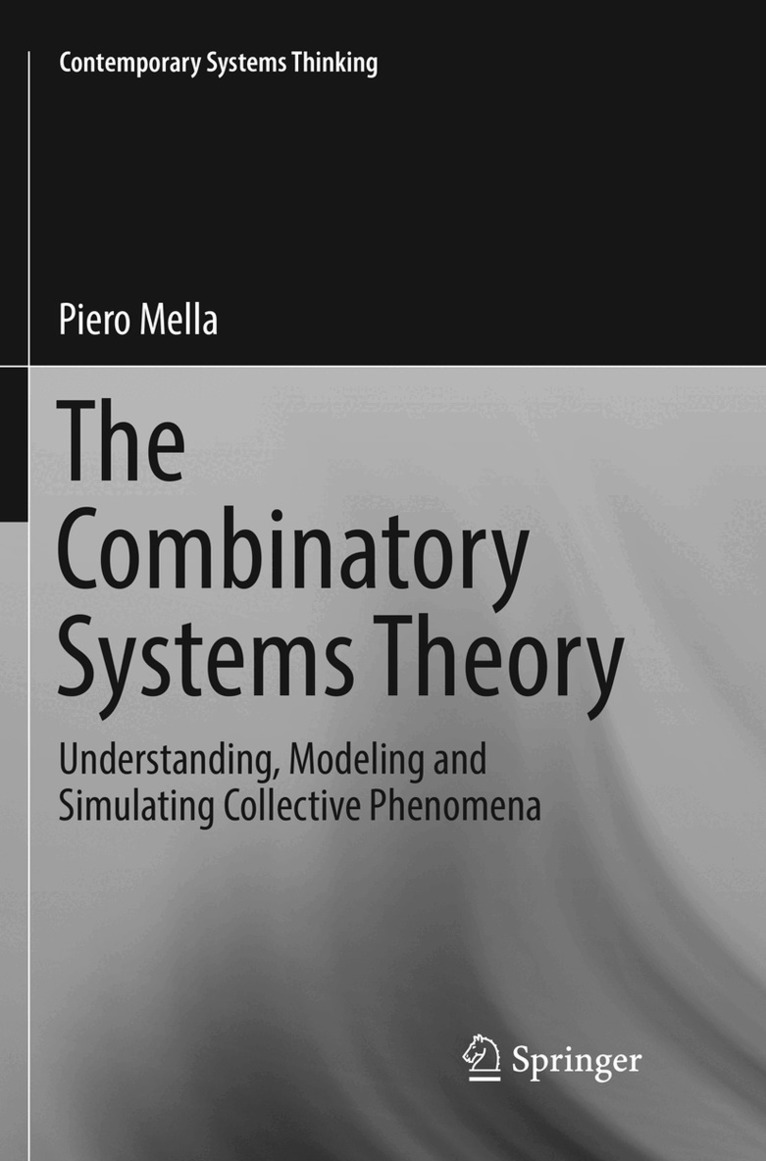
    Combinatory Systems Theory

    Understanding, Modeling and Simulating Collective Phenomena

    AvPiero Mella

    Häftad, Engelska, 2018

    Del i serien Contemporary Systems Thinking

    1 435 kr

    Beställningsvara. Skickas inom 5-8 vardagar. Fri frakt över 249 kr.

    Fler format och utgåvor

    Inbunden

    1 733 kr

    E-bok

    2 201 kr

    Häftad

    1 733 kr

    E-bok

    1 413 kr

    Beskrivning

    This study adopts the logic of Systems Thinking and Control Systems, presenting a simple but complete theory called the Theory of Combinatory Systems. This new theory is able to describe, interpret, explain, simulate and control collective phenomena and their observable effects. Despite specific differences among these phenomena – many of which are “one way", non-repeatable or reproducible – they can all be described or explained, and thus understood, using the model, as simple as it is general, of combinatory systems; that is, systems formed by collectivities, or populations of non-connected and unorganized individuals of some species, which appear to be directed by an invisible hand that guides the analogous actions of similar individuals in order to produce an emerging collective phenomenon. Combinatory Systems function due to the presence of micro control systems which, operating at the individual level, lead to uniform micro behavior by individuals in order to eliminate the (gap)with respect to the objective that is represented – or revealed – by the global information (macro behavior or effect). The book also examines Combinatory Automata, which represent a powerful tool for simulating the most relevant combinatory systems. In stochastic combinatory automata, when both probabilities and periods of transition of state are agent/time/state sensitive, the probabilistic micro behaviors are conditioned by the macro behavior of the entire system, which makes the micro-macro feedback more evident.The Combinatory Systems Theory: Understanding, Modeling and Simulating Collective Phenomena is composed of four main chapters. Chapter 1 presents the basic ideas behind the theory, which are analysed in some detail. Chapter 2 describes the heuristic models of several relevant combinatory systems observable in different environments. Chapter 3, while not making particular use of sophisticated mathematical and statistical tools, presents the Theory of Combinatory Automata and builds models for simulating the operative logic of combinatory systems. Chapter 4 tries to answer three questions: are combinatory systems “systems” in the true sense of the term? Why is this theory able to explain so many and so varied a number of phenomena, even though it is based on a very simple modus operandi? Are combinatory systems different than complex systems? The book has been written with no prerequisite required to read and understand it, in particular math, statistics and computer knowledge.

    Produktinformation

    • Utgivningsdatum:2018-08-08
    • Mått:155 x 235 x undefined mm
    • Vikt:464 g
    • Format:Häftad
    • Språk:Engelska
    • Serie:Contemporary Systems Thinking
    • Antal sidor:287
    • Förlag:Springer International Publishing AG
    • ISBN:9783319854878

    Utforska kategorier

    • Referensverk och tvärvetenskap inom Samhälle och politik
    • Ledarskap och motivation inom Ekonomi och Ledarskap
    • Tillämpad datateknik inom Data och IT

    Mer om författaren

    Piero Mella is Full Professor of Business Economics and Control Theory at the Faculty of Economics, University of Pavia. In the past he has been the Dean of the Faculty as well as the Director of its Department of Business Research. He has authored dozens of publications (among which a treatise entitled Amministrazione d’Impresa [Management of the Firm], UTET Press), and for years he has researched systems theory from multiple perspectives. His recent essays about Systems theory include: Guida al Systems Thinking [A Guide to Systems Thinking] (Il Sole24Ore, Milano, 2007) and Sistemi di controllo [Control Systems] (Franco Angeli, Milano, 2008), and Systems Thinking: Intelligence in Action (2012). He has developed the Theory of Combinatory Systems; he is editor of the journal "Economia Aziendale on-line".

    Innehållsförteckning

    • 1  The Theory of Combinatory Systems.- 2   The Observable Variety. Heuristic Models of Combinatory Systems.- 3   Simulation Models. The Combinatory Automaton.- 4  The Heuristic Value of  Combinatory Systems Theory .-