• Fri frakt över 249 kr
  • •
  • Snabba leveranser
  • •
  • Billiga böcker
Kundservice

Du är på sajten för privatpersoner.

Företag, bibliotek eller offentlig verksamhet?

Du handlar på classic.bokus.com, där alla dina funktioner finns intakta.
Till classic.bokus.com
Bokus logotyp. Gå till startsidan.
  • Erbjudanden
  • Nyheter
  • Student
  • Topplistor
  • Barn & ungdom
  • Bokus Play
  • E-böcker
  • Pocketböcker
  • Spel & pussel

10% rabatt på allt med kod: NYSTART10 →

Sidfot

Mina sidor

    Hjälp

    • Kundservice
    • Vanliga frågor och svar
    • Frakt och leverans
    • Retur vid ångerrätt
    • Reklamera vara
    • Betalning
    • Köpvillkor
    • Allmänna villkor
    • Information om webbplatsens tillgänglighet

    Om Bokus

    • Om oss
    • Pressrum
    • För studenter
    • För företag
    • För bibliotek och offentlig verksamhet
    • För leverantörer
    • Hållbarhet

    Populärt

    • Aktuella erbjudanden
    • Presentkort
    • Studentlitteratur
    • Nya böcker
    • Topplistor
    • Signerade böcker
    • Engelska böcker

    Inspiration

    • Boktips
    • BookTok
    • Populära bokserier
    • Barnbokskaraktärer
    • Populära författare
    Logotyp för Bokus
    Följ oss på Facebook (extern länk)Följ oss på Instagram (extern länk)Följ oss på YouTube (extern länk)Följ oss på TikTok (extern länk)
    bokus @ CookiesAnpassa cookiesIntegritetspolicyKöpvillkor
    Till Citymail hemsida (extern länk)Till Budbee hemsida (extern länk)Till Postnord hemsida (extern länk)Till Schenker hemsida (extern länk)Till Early Bird hemsida (extern länk)Till Walleys hemsida (extern länk)
    1. Ekonomi och Ledarskap
    2. Nationalekonomi

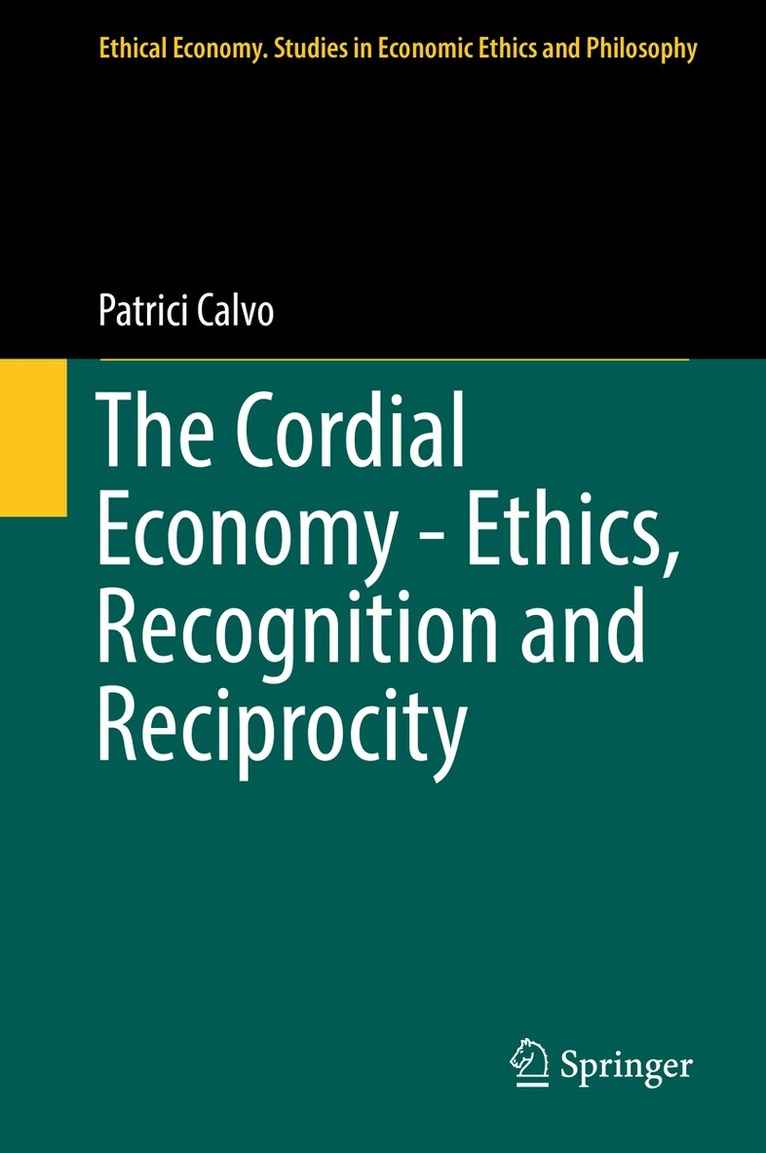
    Cordial Economy - Ethics, Recognition and Reciprocity

    AvPatrici Calvo

    Inbunden, Engelska, 2018

    Del 55 i serien Ethical Economy

    924 kr

    Beställningsvara. Skickas inom 10-15 vardagar. Fri frakt över 249 kr.

    Fler format och utgåvor

    Häftad

    924 kr

    E-bok

    1 176 kr

    Beskrivning

    This book proposes, from a civil perspective —such as that developed by Stefano Zamagni— and a cordial perspective —such as that developed by Adela Cortina—, orientations to design an economy in tune with what the historical moment demands. Among other things, this comes from encouraging institutions, organisations and companies to include in their designs aspects as important for carrying out their activities as cordial reciprocity, mutual recognition of the communicative and affective capacities of the linked or linkable parties, public commitment and the active participation of civil society.The book first shows the conceptualisation of the process of self-interest as operating for one’s own benefit and its inclusion in the orthodox economic model. In Chapter 2 it then displays some of the logical/formal and experimental limits of the axiomatic economics model to discover the possibility of building bridges between theoretical modelling and factual validation.  Chapter 3demonstrates the fragility of a rationality model based on the paradigmatic figure of homo oeconomicus.  Chapter 4 reflects on the critical process that has identified reciprocity as a determining factor for human cooperation, turning this behaviour into a paradox in which the lack of a reasonable explanation from the selfish perspective becomes inconsistent in the predominant economic theory. Chapter 5 is from a moral point of view it describes and criticises the different approaches to reciprocity observed by sociologists, biologists, psychologists and economists. Chapter 6 analyses three mutual recognition proposals as possible foundations for human cooperation, highlighting one of them –cordial recognition, developed by Cortina– because it is more closely related to studies of reciprocity, particularly the most recent contributions from the neurosciences. Chapter 7 proposes cordial reciprocity as a horizon of meaning for the various approaches to reciprocity observed.Chapter 8 explores the possible emergence and development of cordial goods, a type of relational and communicative good that enables joint actions to take place in different contexts of human activity. Chapter 9 analyses the application and implementation of cordial reciprocity at the macro, meso and micro levels of the economy. And finally, it proposes guidelines for designing a monitoring and compliance system which, based on the communication, storage and processing of big data and the committed participation of stakeholders, offers businesses the possibility of inspecting their underlying dimensions of morality, emotions and responsibility.

    Produktinformation

    • Utgivningsdatum:2018-05-28
    • Mått:155 x 235 x 17 mm
    • Vikt:477 g
    • Format:Inbunden
    • Språk:Engelska
    • Serie:Ethical Economy
    • Antal sidor:187
    • Förlag:Springer International Publishing AG
    • ISBN:9783319907833

    Utforska kategorier

    • Nationalekonomi inom Ekonomi och Ledarskap
    • Ekonomisk politik inom Ekonomi och Ledarskap
    • Filosofiska discipliner inom Filosofi och religion

    Mer om författaren

    ​Patrici Calvo holds a Humanities degree from the Universidad Jaume I (Extraordinary End of Degree Award), Master’s in Corporate Social Responsibility from the Universidad Politécnica de Valencia, Master’s in New Trends and Innovation Processes in Communication from the Universidad Jaume I, Master’s in Training Trainers in Corporate Social Responsibility from the Universidad de Buenos Aires and Doctor in Philosophy from the Universitat Jaume I with the international doctoral thesis entitled Economic rationality: ethical aspects of reciprocity (with honors and In recent years he has combined his work as a Ministry of Science and Innovation pre-doctoral researcher  (2008-2012) and Valencian Regional Government Department for Education, Training and Employment post- doctoral researcher (2013-2015) with national (10 months) and international (24 months) research fellowships in the Uehiro Centre for Practical Ethics at the University of Oxford (UK), the Dipartimento di Sociologia Achille Ardigò and the Dipartimento di Sociologia e Diritto dell ́Economia at the Università di Bologna (Italy) and the Fundación ETNOR [Foundation for Ethics in Business and Organizations] (Spain). Over the past years he has participated in a range of scientific and technological development research projects: Politics, business and education from the applied neuroethics perspective [FI2013-47136-C2-2-P/FISO] (2014-2015) and The contribution of neuroeconomics to the ethical dimension of institutional design [FFI2010-21639-C02-02/FISO] (2010-2103), both led by Dr. Domingo García-Marzá and funded by the Spanish Ministries of Economy and Competitiveness, and Science and Innovation, respectively; and Ethics of democracy: political crisis and new forms of civil society participation [P1·1B2013-24] (2014-2015), led by Dr. Domingo García-Marzá and funded by the  Jaume I University. He has also been involved in various technological support and knowledge transfer projects (7)with firms and organizations, such as Institutional design for management of ethics and fulfillment in UBE Europe and Latin America [13I239.01/1] in 2013. He has also made notable contributions at national and international conferences (30), and in books and indexed and scientific journals such as New Insight into Relational Goods [monographic book edited together with Pierpaolo Donati of the Università di Bologna]; “Whistleblowing ante la miseria moral de instituciones y organizaciones” [in Empresas, Derechos Humanos y RSC: una mirada holística desde las Ciencias Sociales y Jurídicas, published by Editorial Aranzadi]; “Ética empresarial, responsabilidad social y bienes comunicativos” [in Tópicos. Revista de Filosofía]; “Neuroeconomía, ¿un saber práctico?” (in Ética y neurociencias: la aportación a la política, la economía y la educación, published by Universitat Jaume I); “Neuro-racionalidad: heterogeneidad motivacional y compromiso moral” [in Daimon. Revista Internacional de Filosofía]; “Civil society participation in the management of the common good: a case of ethics in biological resource centres” [in Recerca. Revista de Pensament i Anàlisi]; “Economía civil desde una ética de la razón cordial” [in CIRIEC. Revista de Economía Pública, Social y Cooperativa]; and CSR in the internal management of organisations” [in Journal of Applied Ethics]. He is currently Assistant Professor of ethics in the Department of Philosophy and Sociology at Jaume I University. He teaches on the following undergraduate and official master’s courses: Ethics, Bioethics, Ethics of organizations, Business ethics, Ethics and legislation, Ethics and professional deontology, Theory of Democracy, Philosophy of Science, Theory of argumentation and discourse.

    Innehållsförteckning

    • Acknowledgements.- Prologue: Ethics & economic rationality: the cordiality horizon; Elsa González-Esteban.- Introduction: Towards a cordial economy.- Chapter 1. Economic selfishness. The architecture of homo oeconomicus.- Chapter 2. Economic theory. The axiomisation of homo oeconomicus.- Chapter 3. Economic racionality. The reciprocity paradox.- Chapter 4. Reciprocity approaches. The possibility of human cooperation.- Chapter 5. Cordial recognition. The communicative and affective link in human.- Chapter 6. Cordial reciprocity. The ethical foundation of human cooperation.- Chapter 7. Cordial rationality. The language of human cooperation.- Chapter 8. Cordial goods. The role of intangibles in the economy.- Chapter 9. Cordial economics. The participation of civil society in the economy.- Chapter 10. Cordial Big Data. Managing the cordial dimension of the business.- Index.